
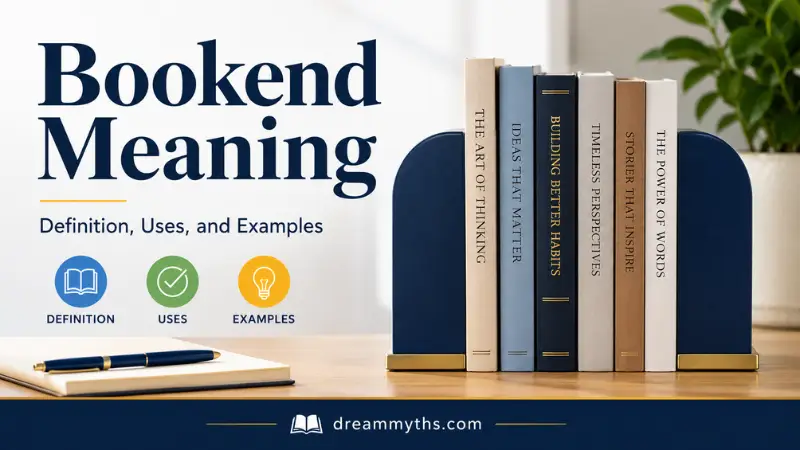
The bookend meaning is easy to understand when you picture a row of books standing neatly on a shelf. A bookend is a support placed at the end of books to keep them upright. From that simple physical purpose, the word has developed a useful figurative meaning in English.
In everyday and professional writing, people also use “bookend” to describe two things that frame a larger event, period, story, or idea. An opening and closing ceremony, for example, can bookend a conference.
Because the word works as both a noun and a verb, understanding the bookend meaning helps readers recognize it in conversations, articles, business writing, journalism, and discussions about stories or events.
What Is the Bookend Meaning?
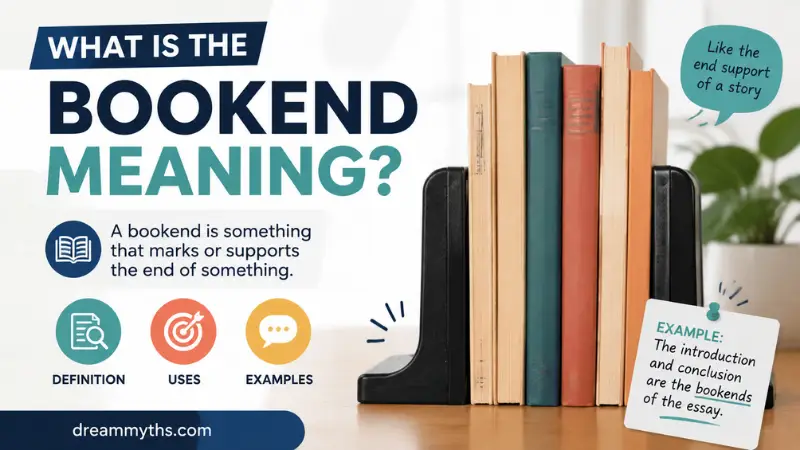
The bookend meaning refers to an object that supports books at the end of a row and keeps them standing upright. The word can also describe something that frames or marks the beginning and ending of a larger subject.
In its literal sense, a bookend is a physical object. It may sit beside books on a shelf and prevent them from leaning or falling over.
For example:
The heavy wooden bookend kept the novels upright.
Here, “bookend” refers to a physical support.
The figurative sense is different. When two events or elements “bookend” something, they appear at opposite ends and create a frame around what comes between them.
For example:
The opening and closing ceremonies bookended the tournament.
The ceremonies mark the beginning and end of the tournament rather than supporting physical books.
What Is the Figurative Bookend Meaning?
The figurative bookend meaning is to frame, surround, or mark something at its beginning and end. The comparison comes from the way physical bookends hold a row of books between two outer supports.
This figurative use can describe:
- events
- stories
- movies
- time periods
- presentations
- articles
- essays
- projects
- speeches
- major milestones
For example:
Two major discoveries bookended the scientist’s career.
The discoveries occurred near opposite ends of the career and help define its overall span.
Another example is:
The introduction and conclusion bookend the report.
The introduction starts the report, while the conclusion finishes it. The main discussion sits between them.
This figurative use is an important part of the bookend meaning because it explains why the word appears in contexts that have nothing to do with bookshelves.
How Does the Bookend Meaning Work as a Verb?
The bookend meaning as a verb is to frame something with elements positioned at its beginning and end. The verb “bookend” can be used for events, scenes, sections, ideas, or other parts of a larger structure.
For example:
Two concerts bookended the festival.
The first concert occurred near the beginning and the second near the end.
The verb can also describe writing:
The author bookends the chapter with a childhood memory.
The memory appears at the beginning and returns at the end, creating a structural frame.
Common forms include:
- bookend
- bookends
- bookended
- bookending
For example:
The two speeches bookended the conference.
The word “bookended” is the past-tense form of the verb.
What Is the Literal Bookend Meaning?
The literal bookend meaning is a physical support used to keep books upright and organized. Bookends are especially useful when a shelf has empty space around a group of books.
Imagine several books standing together on a shelf. Without support, the books may lean toward one side. A bookend provides a firm surface that helps hold the row in position.
Bookends can be made from materials such as wood, metal, stone, glass, ceramic, or plastic. Some are simple and practical, while others are designed as decorative pieces.
For example:
She placed a pair of brass bookends beside her favorite novels.
Here, “bookends” clearly refers to physical objects.
The surrounding context usually makes the literal sense obvious because words such as “shelf,” “books,” “library,” or “furniture” often appear nearby.
What Is the Bookend Meaning in Writing?
The bookend meaning in writing involves framing a piece of content with related material at the beginning and end. Writers can use this technique to create a stronger sense of structure and connection.
For example:
The essay is bookended by two stories from the writer’s childhood.
The stories appear at opposite ends of the essay and help frame the central discussion.
A similar structure can appear in articles:
The writer bookends the article with the same question.
The question appears near the beginning and returns near the end.
The technique can also involve repeated images, themes, phrases, or ideas. The two appearances do not always need to be identical. What matters is their position and their role in framing the material between them.
What Are the Common Bookend Meaning Uses?
The bookend meaning appears in several common situations. Although the contexts differ, each use keeps the central idea of support, framing, or marking an outer boundary.
1. Supporting Books
The literal use describes an object that holds books upright.
The marble bookends matched the new bookshelf.
2. Framing a Time Period
Events can mark the approximate beginning and end of a period.
Two major storms bookended the winter season.
3. Framing a Story
Opening and closing scenes can surround the central narrative.
The first and final scenes bookend the movie.
4. Framing a Presentation
A story, quotation, or idea can appear at the beginning and end of a presentation.
A personal story bookended her presentation.
5. Framing an Essay
An essay may begin and end with related material.
The writer bookended the essay with the same image.
6. Marking an Event
Activities can establish the outer points of a conference or celebration.
A welcome dinner and farewell reception bookended the conference.
7. Framing an Idea
Examples can appear at opposite ends of a discussion.
The two examples bookend the author’s main argument.
These uses show the flexibility of the word without changing its basic concept.
How Do You Use the Bookend Meaning in a Sentence?
The easiest way to use the bookend meaning correctly is to first decide whether you are describing a physical object or a figurative framing relationship.
Literal examples include:
The wooden bookend kept the textbooks from falling.
She bought decorative bookends for the living room shelf.
These bookends are strong enough for large reference books.
Figurative examples include:
The opening and closing ceremonies bookended the event.
Two important victories bookended the team’s season.
The final scene bookends the story’s opening.
The conference was bookended by two keynote speeches.
These examples demonstrate the difference between the physical and figurative senses.
What Does the Bookend Meaning “Bookended By” Mean?
The bookend meaning in the phrase “bookended by” is that something is framed or surrounded by two elements positioned at its beginning and end.
For example:
The year was bookended by two major announcements.
One announcement happened near the beginning of the year, while another happened near the end.
Another example:
The conference was bookended by two keynote speeches.
One keynote opened the conference, and another closed it.
The phrase is particularly useful when the relationship between the two outer elements matters more than their exact dates or positions.
Is the Bookend Meaning Formal or Informal?
The bookend meaning belongs to standard English and can be used in both everyday and professional communication. “Bookend” is not slang.
The literal noun is natural in casual conversation:
I need a bookend for this shelf.
The figurative verb also works in polished writing:
Two important events bookended the company’s first year.
You may encounter the word in journalism, business writing, education, literary criticism, and general conversation.
Its tone depends on the sentence rather than the word itself.
What Is the Bookend Meaning in Business Writing?
The bookend meaning can be useful in business writing when two meetings, milestones, events, or stages frame a project or period.
For example:
The planning session and final review bookended the project.
Another example:
The first and final meetings bookended the six-month initiative.
The word can make a sentence concise because it communicates a beginning-and-ending relationship in a single verb.
However, “bookend” should not be used simply because two events happened at different times. The framing relationship should be meaningful.
What Is the Bookend Meaning in Stories and Movies?
The bookend meaning is especially useful when discussing narrative structure. An opening and closing scene, chapter, image, or idea can frame the central story.
For example:
The opening and closing scenes bookend the character’s journey.
The two scenes do not necessarily have to be identical. Their important feature is that they occupy the beginning and end of the narrative.
Another example:
The novel is bookended by two letters from the main character.
This means the letters appear at the beginning and end of the novel.
In film and literary discussion, “bookend” can therefore describe structure rather than simply saying that something happens twice.
Can the Bookend Meaning Describe a Period of Time?
Yes, the bookend meaning can describe two events, developments, or milestones that mark the beginning and end of a period.
For example:
The product launch and final update bookended the company’s first year.
The launch occurred near the beginning, while the final update occurred near the end.
Another example:
Two major victories bookended the team’s season.
The victories establish important points near opposite ends of the season.
This use is common because a period can be imagined as something placed between two supporting points.
Can the Bookend Meaning Describe an Article or Essay?
Yes, the bookend meaning can describe an article, essay, report, or speech that uses related material at the beginning and end.
For example:
The report is bookended by a short introduction and a final summary.
The introduction and summary create the outer structure of the report.
Another example:
Two personal memories bookend the essay.
The memories appear near the beginning and end, framing the central material.
The emphasis is on structure. The word suggests that the outer elements help define or surround what lies between them.
Is the Bookend Meaning Always About Two Things?
Usually, the figurative bookend meaning suggests two framing elements because the image comes from bookends placed at opposite ends of a row. However, the exact sentence can determine how the word is used.
For example:
The opening and closing scenes bookend the film.
This is the clearest type of figurative construction because both framing elements are explicitly named.
A single element can also be described as part of a bookending structure when the other side is understood from context. Still, when clarity matters, identifying both elements is usually the stronger choice.
What Is the Difference Between Bookend Meaning and Bookmark?
The bookend meaning is different from the meaning of “bookmark.” A bookend supports books, while a bookmark marks a reader’s place inside a book.
Compare:
I used a bookmark to save my place.
with:
I used a bookend to keep the books upright.
A bookmark goes inside a book or marks a specific location for later reading. A bookend sits beside a group of books and provides physical support.
The similar appearance of the two words can cause confusion, but their functions are completely different.
What Is the Difference Between Bookend Meaning and Bracket?
The bookend meaning and the word “bracket” can overlap in some figurative situations, but they are not exact synonyms.
“Bookend” strongly suggests elements at the beginning and end of a sequence. “Bracket” has several meanings and can refer to enclosing something, punctuation, or placing something within a range.
For example:
Two major events bookended the decade.
This emphasizes the events at opposite ends.
By contrast:
Put the extra information in brackets.
Here, “brackets” refers to punctuation.
The best choice depends on the relationship being described.
Is the Bookend Meaning Positive or Negative?
The bookend meaning itself is neutral. It does not automatically express a positive or negative opinion.
For example:
Two joyful celebrations bookended the year.
The sentence has a positive tone because of “joyful celebrations.”
But:
Two difficult crises bookended the year.
The negative tone comes from “difficult crises,” not from the word “bookended.”
The term simply describes position, structure, or support.
What Are Common Mistakes With the Bookend Meaning?
Understanding the bookend meaning helps avoid several common mistakes.
Mistake 1: Assuming Bookend Only Refers to Books
The word has a well-established figurative use.
Better understanding:
Two major events bookended the year.
The sentence describes events rather than physical book supports.
Mistake 2: Using Bookend for Any Two Events
Two events happening at different times do not automatically create a meaningful bookending relationship.
Less effective:
Two routine appointments bookended my week.
Clearer:
I had appointments on Monday and Friday.
“Bookend” works best when the two events meaningfully frame the period between them.
Mistake 3: Confusing Bookend With Bookmark
A bookend supports books on a shelf. A bookmark marks a reading position inside a book.
Mistake 4: Treating Bookend as Slang
Bookend is standard English. Its figurative use may sound polished, but it is not slang.
What Is the Bookend Meaning in Modern English?
The bookend meaning remains useful in both literal and figurative English. The physical noun appears in conversations about shelves, books, furniture, and decoration, while the figurative verb is useful for describing structure.
A journalist might write:
Two major events bookended the year.
A teacher might say:
The introduction and conclusion bookend the essay.
A homeowner might say:
These bookends look great on the shelf.
The context determines which sense the reader understands.
When Should You Use the Bookend Meaning?
Use the bookend meaning when you want to emphasize that something sits at or defines the two ends of a larger structure.
The word works particularly well when:
- two events frame a period
- opening and closing scenes frame a story
- two sections surround a central discussion
- milestones define a project
- physical supports hold books upright
- a repeated idea appears at the beginning and end
The word is effective because it creates a clear mental image while keeping the sentence concise.
When Should You Avoid the Bookend Meaning?
Avoid the bookend meaning when a simpler expression is clearer or when there is no meaningful framing relationship.
For example, if you only mean that one event happened early and another happened later, “bookend” may sound unnecessarily figurative.
Instead of:
Two routine appointments bookended my week.
You could write:
I had appointments on Monday and Friday.
The figurative expression is strongest when the beginning and ending elements actually help define the central period or content.
What Are the Best Synonyms for the Bookend Meaning?
The best alternative depends on which sense you mean.
For the physical noun, possible alternatives include:
- book support
- book holder
- support
For the figurative sense, useful alternatives can include:
- frame
- surround
- bracket
- enclose
- mark the beginning and end
These words are not always interchangeable.
“Frame” is often useful for stories, arguments, and discussions, while “bookend” emphasizes the presence of elements at opposite ends.
What Is the Origin of the Bookend Meaning?
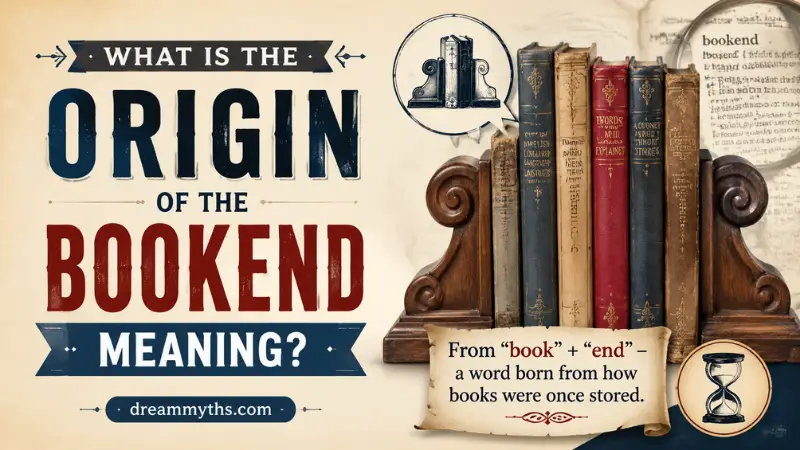
The bookend meaning is closely connected to the word’s transparent construction: “book” plus “end.” The literal object is placed at the end of a row of books to provide support.
The figurative sense follows naturally from that physical image. When two things occur at the beginning and end of a sequence, they can be described as bookends because they function like supports around the material in the middle.
A precise first-use date for every figurative application is not necessary for understanding current English, so unsupported historical dates should not be attached to the word.
Frequently Asked Questions
Is the bookend meaning formal or informal?
The bookend meaning is standard English and works in casual, professional, and educational contexts. The word is not slang.
Is bookend a noun or a verb?
Bookend can be both a noun and a verb. As a noun, it can refer to a physical support for books; as a verb, it can mean to frame something by placing elements at its beginning and end.
What does bookend mean in writing?
In writing, the bookend meaning usually refers to framing content with related material at the beginning and end. For example, an opening image and a closing image can bookend an essay.
What is the simple bookend meaning?
The simple bookend meaning is an object that supports books and keeps them upright. Figuratively, “bookend” can describe something that frames or marks the beginning and end of a period, story, event, or piece of writing.
What does “bookended by” mean?
“Bookended by” means framed or surrounded by elements at the beginning and end. For example, a conference can be bookended by an opening keynote and a closing keynote.
Is bookend the same as bookmark?
No. A bookend keeps books upright on a shelf, while a bookmark marks a reader’s place inside a book.
Is bookend a slang word?
No. Bookend is a standard English word. Its figurative use is common in professional and general writing and does not make the word slang.
Conclusion
The bookend meaning begins with a simple physical object that keeps books standing upright. From that familiar image, English developed a useful figurative sense for things that frame a period, story, event, project, or piece of writing.
Bookend can function as both a noun and a verb. The literal sense belongs to bookshelves, while the figurative sense is valuable when two elements mark opposite ends of something larger.
When the relationship is genuinely about framing or defining a beginning and ending, “bookend” is a clear, natural, and powerful choice in modern American English.


