

Your heart is still going and the room doesn’t feel right yet. So here’s the short version before anything else: dream meaning kidnapped points to lost control, not looming danger. Somewhere in your waking life, a choice that should be yours isn’t.
Waking up terrified from a dream where you were kidnapped is more common than you imagine. The racing heart and lingering dread point to something deeper: feelings of being trapped, controlled, or stripped of choice in real life.
Before we go further, I want to say the thing I wish someone had said to me at 3 a.m. after my own version of this dream: a kidnapping dream is not a premonition. In all the years I’ve been reading dream letters, I have never once seen one function as a warning of a literal abduction. It works as something far more useful — a remarkably precise instrument. It measures the gap between the life you’re living and the amount of say you actually have in it. When that gap widens, the dream shows up. When the gap closes, it goes quiet, often within weeks.
This guide reveals the being kidnapped meaning in dreams through psychology, symbolism, and global cultural views, plus positive spins, negative warnings, and twenty relatable scenarios. It also spends as much time on what to do on Monday morning as it does on symbolism, because in my experience nobody’s dreams ever stopped because they finally decoded them. Decode the message and reclaim your power today.
What is the meaning of a kidnapping dream?
Dream meaning kidnapped comes down to lost control, not real danger. The dream flags where you feel cornered or stripped of choice — usually at work, inside a relationship, or during change you didn’t choose. The kidnapper is the pressure. Escaping means you’re already fighting back. Recurring versions mean the constraint hasn’t moved yet.
Why Do We Dream About Being Kidnapped?
Kidnapping dream, defined: a dream in which you are seized, restrained or transported against your will. In dream analysis it belongs to the loss-of-agency family — the same group as being chased, being buried alive, or being unable to move or speak. The defining feature isn’t the villain. It’s the removal of choice.
Dreams about being kidnapped tap into universal fears. They rarely predict real danger. Instead, they mirror inner conflicts.
Psychologists link these dreams to anxiety and stress. Your subconscious uses kidnapping as a metaphor for situations where you feel stripped of choice.
Common triggers include:
- Overwhelming responsibilities at work or home.
- Toxic relationships that limit freedom.
- Major life changes that feel forced upon you.
Understanding this helps turn fear into insight.
There’s a fourth trigger that list misses, and in my inbox it’s the most common of all: anticipatory powerlessness. Nothing bad has happened yet. You’re waiting on a diagnosis, a visa decision, a redundancy announcement, an exam result. Your life is being decided somewhere you aren’t allowed to be. The dreaming brain has no clean image for waiting on someone else’s verdict, so it reaches for the nearest available metaphor — someone has taken you somewhere and you cannot leave.
The worst run of these dreams I’ve ever had came during a six-week stretch waiting on a mortgage decision. Not one thing in my waking life was actually dangerous. But every meaningful decision about where I would live was being made by strangers in a building I had never set foot in. Three dreams in four nights, all variations on a locked back seat. The morning the approval came through, they stopped. I hadn’t gained safety that morning — I’d gained control, and that turned out to be the variable my sleeping mind had been tracking the whole time.
This is also why these dreams tend to repeat rather than resolve. The trigger is a waiting period, and waiting periods don’t end on your schedule. The mechanics are the same as why recurring dreams happen in general: an unresolved situation keeps the file open, and the mind keeps reopening it.
The Sleep Science Behind Kidnapping Dreams
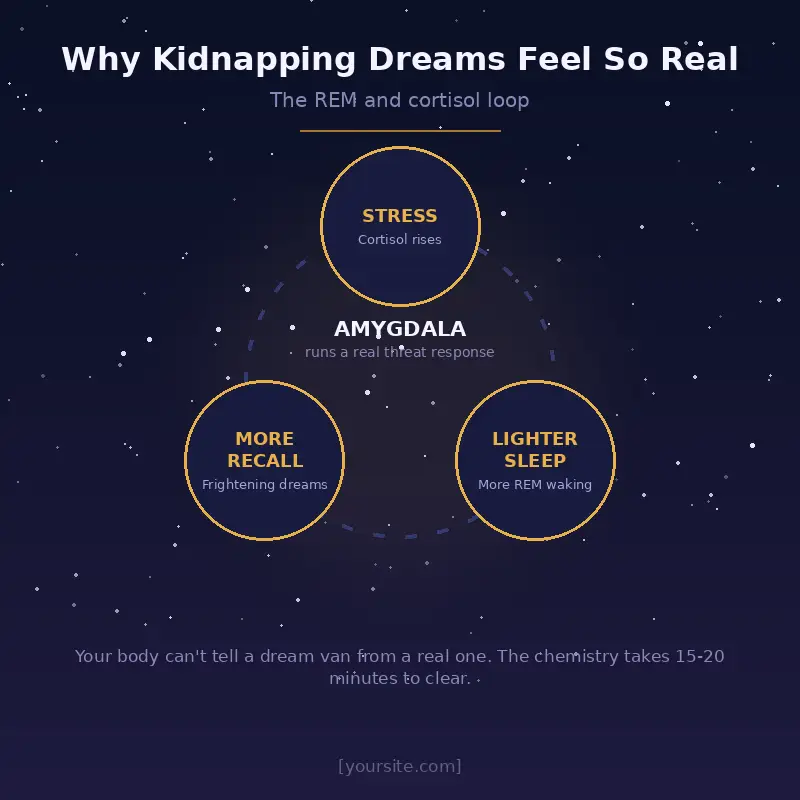
Most kidnapping dreams occur during REM sleep, the stage where the brain’s emotional centres run hot while the regions handling logic and impulse control run cool. That imbalance is exactly why the dream feels overwhelming and makes no narrative sense at the same time.
Two mechanisms matter here. The first is threat simulation theory, proposed by cognitive neuroscientist Antti Revonsuo, which argues that dreaming evolved as a rehearsal space — the brain runs threat scenarios in a consequence-free environment to keep escape responses sharp. Under that model, a kidnapping dream isn’t a malfunction. It’s a drill.
The second is the cortisol and hypervigilance loop. Elevated stress hormones push you toward lighter, more fragmented sleep, which means more REM awakenings, which means you remember more dreams — and the ones you remember skew frightening, because you woke up inside them. This is why stressful periods feel like they generate more nightmares. Partly they do. Partly you’re just catching more of them.
It also explains the physical aftermath: the pounding heart, the dry mouth, the dread that outlives the memory. Your amygdala ran a genuine threat response. Your body doesn’t distinguish between a dream van and a real one, and the chemistry takes fifteen to twenty minutes to clear after you open your eyes.
Years ago I stopped trying to interpret these dreams at 4 a.m., and it’s the best decision I’ve made in this work. The physiology is still running at that hour, and everything you conclude in that state comes out catastrophic. Now I write down four things in the dark — who took me, where, could I speak, did I get out — and go back to sleep. The interpreting happens over coffee, when the amygdala isn’t holding the pen.
Psychological Meanings of Dreams
How Psychologists Read the Dream Meaning of Being Kidnapped
From a psychological view, being kidnapped in a dream often represents loss of control.
Experts say it points to feeling “held hostage” by emotions, people, or circumstances.
- Feeling trapped: You may feel stuck in a job, relationship, or habit.
- Manipulation: Someone (or something) exerts undue influence over your decisions.
- Repressed aspects: Parts of your personality feel suppressed or “abducted” from expression.
In Jungian terms, the kidnapper symbolizes shadow elements—unacknowledged fears or traits forcing change.
Positive side: Escaping in the dream shows growing resilience. It signals you’re ready to break free.
Negative side: Repeated dreams highlight ongoing powerlessness. They urge addressing the root cause to prevent burnout.
Beyond Jung, three frameworks give this dream real explanatory power, and it’s worth knowing which one fits your situation.
- Freud’s wish-fulfilment and repression model reads the kidnapper as a disguised desire — something you want but can’t admit wanting, so the dream lets it take you rather than letting you choose it. This one fits dreamers who feel guilty about wanting out of something.
- Calvin Hall’s cognitive theory treats dreams as straightforward statements about how you see yourself and others. Under Hall, a kidnapping dream isn’t coded at all. It’s a plain sentence: I am not in charge here.
- The continuity hypothesis holds that dreams continue waking concerns rather than compensating for them. It predicts, correctly in my experience, that kidnapping dreams cluster in the weeks when your calendar is controlled by other people.
Two concepts are worth naming, because readers recognise themselves in both instantly. Locus of control is Julian Rotter’s term for whether you believe outcomes come from your own actions or from outside forces. Learned helplessness is Martin Seligman’s finding that repeated uncontrollable stress teaches people to stop trying, even after escape becomes possible. A recurring kidnapping dream is very often a locus-of-control problem announcing itself in pictures.
I found this out about myself by accident. I went back through four years of my own journal and tagged every dream by theme, expecting kidnapping dreams to track my busiest months. They didn’t — some of my most exhausting periods produced none at all. What they tracked was reporting lines. Every single cluster fell inside a stretch where I was working under someone who reviewed my decisions before I was allowed to act on them. The variable wasn’t workload. It was permission.
Symbolic Interpretations of Kidnapping Dreams
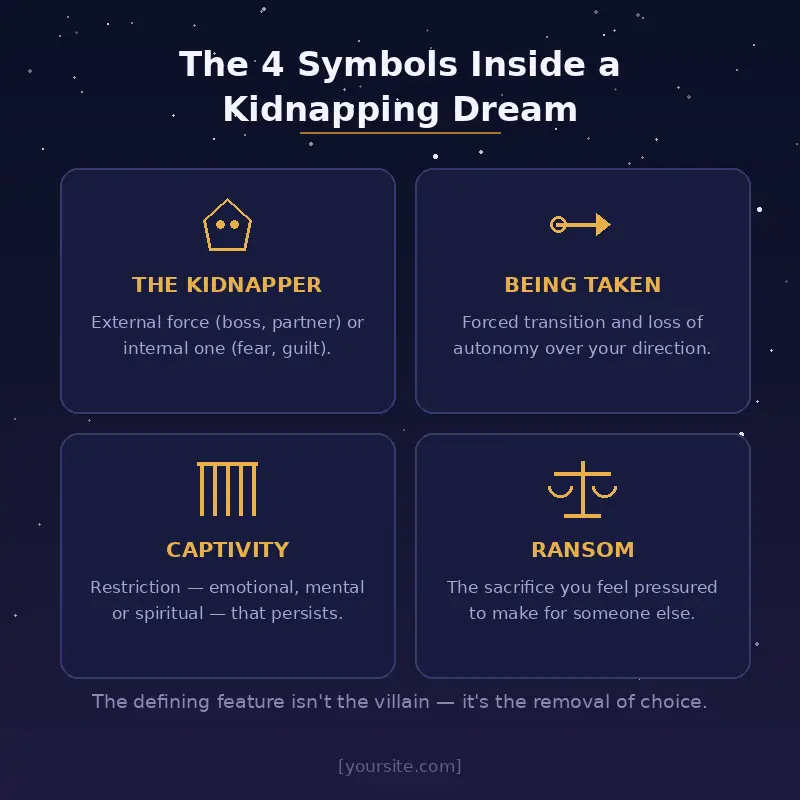
Symbolically, kidnapping breaks down into key elements.
- The kidnapper: Represents external forces (boss, partner) or internal ones (fear, guilt).
- Being taken: Suggests forced transition or loss of autonomy.
- Captivity: Reflects restriction, emotional, mental, or spiritual.
- Ransom or demands: Points to sacrifices you feel pressured to make.
Positive interpretations include transformation. Like myths where abduction leads to growth (e.g., Persephone’s story symbolizing seasonal change).
Negative interpretations warn of violation, boundaries crossed or identity threatened.
Step-by-step symbolism:
- Sudden abduction = unexpected life shift.
- Struggle/resistance = fight for independence.
- Confinement = prolonged stress.
- Rescue/escape = empowerment and resolution.
Four more elements come up constantly in reader submissions, and almost no guide covers them.
- The vehicle. Cars, vans and boats appear in a large share of these dreams, and the seat matters. Being in the back with no access to the wheel is the most literal image the dreaming mind produces for my direction is being chosen for me.
- The place you’re taken to. A basement reads as suppression. An unfamiliar house reads as an identity you didn’t choose. Somewhere from your past reads as regression under pressure.
- Your own voice. Dreamers who can’t scream are usually experiencing REM muscle atonia bleeding into the dream — and if you’ve also woken unable to move while fully aware of the room, sleep paralysis explained covers why that happens. Symbolically, though, it maps hard onto real situations where speaking up carries a cost.
- The kidnapper’s face. Faceless or hooded points to a diffuse, systemic pressure — bureaucracy, debt, an illness. A known face points to a specific relationship, and it’s worth being honest with yourself about which one.
A letter I received a few years ago reframed all of this for me. A woman described a dream in which her kidnapper kept politely apologising to her while driving her away. She was baffled by it — where was the fear supposed to be? We worked backwards through the elements together. She was three months into caring for a parent who thanked her constantly for a level of sacrifice she had never actually agreed to give. Her dream had isolated the one detail that carried the entire situation: taken with an apology is still taken. The ransom in her dream wasn’t money. It was her twenties.
Cultural and Religious Perspectives on Being Kidnapped in Dreams

Cultures interpret kidnapped dreams through spiritual lenses.
Christianity: Often seen as spiritual captivity or attack. It may symbolize bondage to sin, fear, or the “enemy” trying to steal destiny. Biblical themes of deliverance (e.g., Israelites from Egypt) suggest prayer for freedom. Positive: Divine rescue or call to faith.
Islam: Can indicate captivity by desires, attachments, or negative patterns blocking spiritual growth. It urges self-reflection and seeking Allah’s protection. Negative: Warning against heedlessness; positive: Prompt for liberation through faith.
Hinduism: Aligns with karma or maya (illusion) trapping the soul. Abduction represents forces pulling one from dharma (right path). Positive: Opportunity for moksha (liberation) through awareness.
Ancient Egyptian: Linked to underworld journeys or gods like Set abducting Osiris—symbolizing chaos, death, and rebirth. Dreams signal transition or soul’s trial.
Mayan: Viewed abduction as shamanic initiation or spirit world contact. It may mean forced entry into deeper knowledge. Positive: Growth through ordeal; negative: Warning of imbalance.
Across traditions, these dreams call for reclaiming power.
Two additions are worth making here, because readers search for them by name. Ibn Sirin’s classical framework underpins most Islamic dream interpretation you’ll find online, and in that tradition captivity dreams are read against the dreamer’s own state — the same image can indicate entanglement in something harmful for one person and a coming release from difficulty for another. Our fuller Islamic dream interpretation guide covers how the dreamer’s character changes the reading, which is a far more sophisticated position than the flat symbol-dictionaries dominating search results.
A Jewish reading deserves a place alongside the others too. The Talmudic principle that a dream left uninterpreted is like a letter left unread frames the whole exercise as a duty to engage rather than to fear — and the Exodus narrative gives captivity-and-deliverance the same central position it holds in the Christian reading above.
| Tradition | Reads the kidnapper as | Prescribed response |
|---|---|---|
| Christianity | Spiritual bondage, an enemy targeting destiny | Prayer, deliverance, renewed faith |
| Islam | Captivity by desire or heedlessness | Self-reflection, seeking protection |
| Hinduism | Maya and karma pulling you from dharma | Awareness as the route to moksha |
| Judaism | A message requiring interpretation | Engage with it; don’t leave it unread |
| Ancient Egyptian | Chaos (Set) preceding rebirth (Osiris) | Accept the trial as transition |
| Mayan | Shamanic initiation, spirit contact | Growth through ordeal |
| Secular psychology | Externalised loss of agency | Identify and change the real constraint |
I don’t referee between these traditions, and after years of correspondence with readers from most of them, I’d distrust anyone who does. What strikes me instead is the convergence. Six frameworks, developed on four continents across roughly three thousand years, all arrive at more or less the same instruction — this dream is asking you to look at where your freedom went. When traditions that agree on almost nothing else agree that precisely, the agreement itself is the finding.
20 Common Scenarios and Their Meanings
Here are detailed examples to make interpretations relatable.
- Stranger kidnaps you suddenly — Fear of unknown changes or external threats.
- Kidnapped by an ex-partner — Lingering control or unresolved feelings in that relationship.
- Child or family member kidnapped — Anxiety about protecting loved ones or losing innocence.
- You escape the kidnapper — Inner strength; you’re breaking free from restrictions.
- Held hostage with no escape — Deep feeling of being trapped in life (job, marriage).
- Kidnapped and tortured — Overwhelming stress or self-punishment.
- Kidnapped in your own home — Violation of personal space or safety.
- Friends help rescue you — Support network aiding your independence.
- You kidnap someone else — You exert control (perhaps guilt over influencing others).
- Recurring kidnappings — Unresolved anxiety needing attention.
- Kidnapped during travel — Fear of losing direction in life path.
- Blindfolded and taken — Uncertainty about future or hidden truths.
- Ransom demanded from family — Feeling your worth tied to others’ expectations.
- Kidnapped by an authority figure (boss/police) — Power dynamics at work or in society.
- You fight back and win — Empowerment; reclaiming agency.
- Kidnapped in childhood home — Past traumas resurfacing.
- Group kidnapping — Shared societal pressures or collective fears.
- Rescued by a stranger — Unexpected help or new opportunities.
- Kidnapped and brainwashed — Fear of losing identity to influences.
- Peaceful captivity — Acceptance of change; rare positive surrender to growth.
These scenarios show how personal details shape meaning.
Here are the same twenty in the format readers actually use them — matched to the waking-life situation that most often produces them, and the first thing I’d suggest doing about it.
| # | Scenario | Core emotion | Usual real-life trigger | First move |
|---|---|---|---|---|
| 1 | Stranger takes you suddenly | Shock | Change you didn’t see coming | Name the change out loud |
| 2 | Kidnapped by an ex-partner | Residual pull | Unclosed relationship loop | Audit remaining contact |
| 3 | Child or family member taken | Protective dread | Caregiving overload | Share the load with one person |
| 4 | You escape | Relief, pride | Boundary recently set | Notice what worked; repeat it |
| 5 | Held hostage, no escape | Resignation | Long-term stuck situation | Find one reversible decision |
| 6 | Taken and hurt | Self-blame | Punishing internal standards | Interrupt the self-talk |
| 7 | Taken from your own home | Violation | Privacy or space intruded on | Reclaim one physical boundary |
| 8 | Friends rescue you | Trust | Support you haven’t accepted yet | Actually ask someone |
| 9 | You are the kidnapper | Guilt | Influence you’ve used over someone | Offer them the choice back |
| 10 | Recurring kidnappings | Fatigue | Unaddressed chronic stressor | Journal for 14 nights |
| 11 | Taken while travelling | Disorientation | Life-direction uncertainty | Write the next 3 months down |
| 12 | Blindfolded | Uncertainty | Information withheld from you | Ask the question you’re avoiding |
| 13 | Ransom demanded from family | Conditional worth | Performing for approval | Test one expectation |
| 14 | Taken by a boss or police | Powerlessness | Hierarchy pressing on you | Document; find your leverage |
| 15 | You fight back and win | Agency | Confidence returning | Bank the evidence |
| 16 | Taken in your childhood home | Regression | Old material resurfacing | Consider professional support |
| 17 | Group kidnapping | Collective dread | Societal or workplace pressure | Reduce news or group input |
| 18 | A stranger rescues you | Surprise hope | Unexpected help arriving | Say yes to it |
| 19 | Kidnapped and brainwashed | Identity fear | Losing yourself in a role | Reconnect with one old interest |
| 20 | Peaceful captivity | Acceptance | Change you’ve stopped resisting | Ask if it’s peace or surrender |
If I had to name the one that arrives in my inbox most often, it’s number five by a wide margin. Held somewhere, no door, no plot, no rescue — just the flat fact of not being able to leave. It comes almost exclusively from people in year three or four of something: a job, a marriage, a city. Long enough that leaving would cost something real. That dream isn’t asking you to blow your life up. In my experience it’s asking a much smaller question — when did you last make a decision that was genuinely yours? — and it usually quiets down once you can point to one.
What to Do After a Kidnapping Dream: A 5-Step Reset
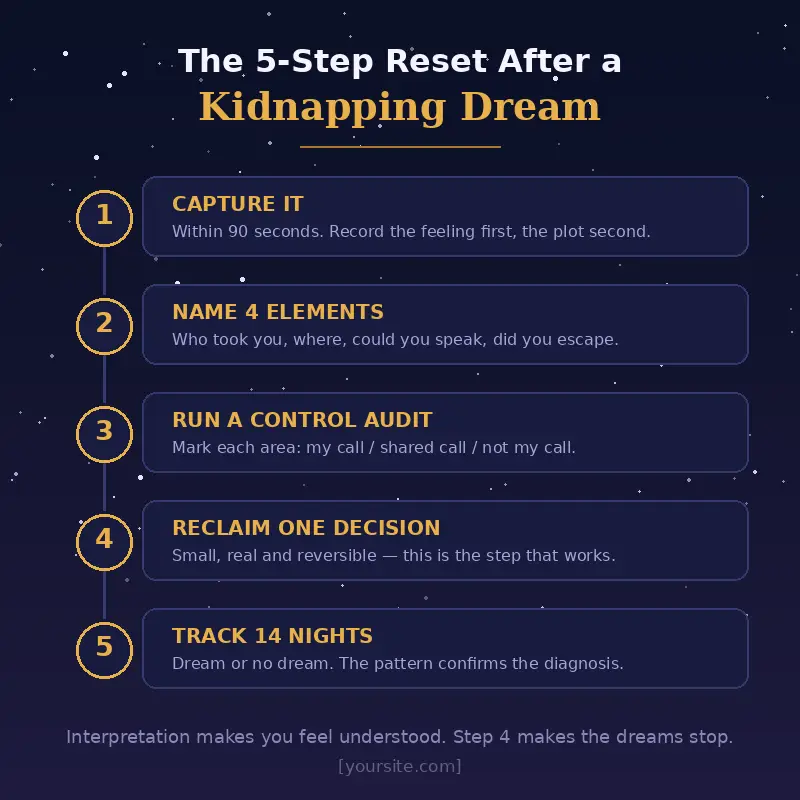
- Capture it within 90 seconds. Dream recall decays fast. Phone notes are fine. Record the feeling first and the plot second — the feeling is the data. If you’ve never kept one, how to start a dream journal walks through the format I use. It takes under two minutes a night and it’s the highest-return habit in this entire guide.
- Name the four elements. Who took you, where you were taken, whether you could speak, whether you escaped. Those four carry most of the meaning.
- Run the control audit. List every area of your life on one page and mark each: my call, shared call, not my call. Nearly every reader I’ve done this with finds the dream’s answer sitting in that third column.
- Reclaim one decision this week. Not the big one. One small, real, reversible choice that’s genuinely yours. This is the step that actually changes the dreams.
- Track for 14 nights. Mark each night dream / no dream. If the pattern breaks after you act on step four, you’ve confirmed the diagnosis. If it doesn’t, read the next section.
There’s an optional sixth step worth trying. Some readers find that rewriting the dream’s ending while awake — you turn, you speak, you open the door and walk out — changes what happens the next time it runs. This is the everyday version of imagery rehearsal therapy, and people who practise lucid dreaming for beginners often report they can steer it in the moment. It doesn’t work for everyone and it isn’t necessary. But it costs nothing, and it puts you in the active role, which is the whole point.
I’ll be honest about which of these matters most, because I’ve tested both approaches on readers for years. I’ve sent people elaborate interpretation exercises, and I’ve sent people the single instruction in step four. The follow-up emails are lopsided and not remotely close. Interpretation makes people feel understood. Step four makes the dreams stop.
Kidnapping Dreams vs Other Loss-of-Control Dreams
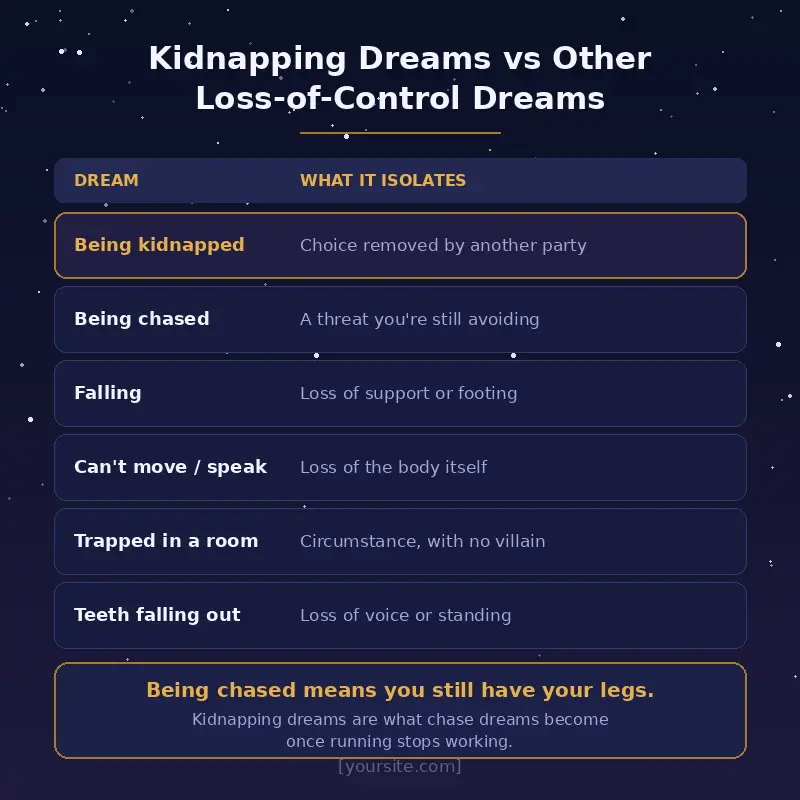
Kidnapping dreams sit inside a family, and knowing the neighbours sharpens the reading.
| Dream | What it isolates | Key difference |
|---|---|---|
| Being kidnapped | Choice removed by another party | Someone is doing it to you |
| Being chased | Threat you’re avoiding | You still have movement |
| Falling | Loss of support or footing | No antagonist at all |
| Paralysis / can’t move | Loss of the body itself | Often overlaps sleep paralysis |
| Trapped in a room | Circumstance, not a person | No villain to name |
| Teeth falling out | Loss of power to speak or be seen | Self-image, not captivity |
The distinction that matters most: being chased means you still have your legs. Kidnapping dreams are what chase dreams become once you stop believing that running will work.
If your dreams cycle between these rather than settling on one, pay attention to that. Readers who write to me about kidnapping dreams very often mention dreams about being chased in the same message, and a smaller group report dreams about falling in the same week. The family shares a root — each one is your mind reporting on stability from a slightly different angle. Teeth falling out dream meaning belongs to the same cluster whenever the loss you’re feeling is about voice or standing rather than freedom.
The shift I watch for is chronological. When someone tells me their dreams used to be chase dreams and have quietly become kidnapping dreams over the past year, that transition is the message, and it usually means they’ve stopped believing effort will change their situation. It’s the single most useful pattern I’ve learned to listen for.
When a Kidnapping Dream Is Worth Taking to a Professional
Almost all of these dreams are ordinary stress doing ordinary things, and they resolve on their own. A few warrant more than a blog post, and I’d rather say so plainly than leave you guessing.
Consider speaking to a doctor or therapist if:
- The dreams are frequent enough that you’ve become afraid of going to sleep, or you’re losing significant sleep to them.
- They replay a real event you lived through. Post-traumatic nightmares respond well to specific treatment and aren’t something to wait out alone.
- Daytime anxiety, hypervigilance or low mood is building alongside them.
- They’ve persisted for months with no identifiable stressor behind them.
- You’ve worked through the reset above and nothing has shifted.
Good options exist. Imagery rehearsal therapy (IRT) — rewriting the dream’s ending while awake and mentally rehearsing the new version — has a strong track record for chronic nightmares, and CBT-based approaches help where anxiety is driving the pattern. Nightmare disorder is a recognised diagnosis, which means it is a recognised thing to get help with. Needing that help is not an overreaction, and it isn’t a failure of self-interpretation.
I include this section because of one letter I still think about. A reader had been faithfully journaling and interpreting for eight months, treating every recurrence as a puzzle she hadn’t solved cleverly enough. The dreams were replaying something real that had happened to her. What she needed wasn’t a better symbol dictionary — it was a trauma-informed therapist, which she found, and which worked. I’d rather send ten people to a professional they didn’t strictly need than leave one person interpreting alone when they deserve actual support.
If any of this is landing close to home, please speak to your doctor or a qualified mental health professional. This article is dream analysis and general information. It isn’t clinical advice, and it isn’t a substitute for someone who can see your actual situation.
FAQs About Being Kidnapped Meaning in Dreams
What does it mean to dream of being kidnapped and escaping?
It often signals resilience. You’re recognizing control issues and taking steps to regain freedom.
Is dreaming of being kidnapped a bad omen?
Not usually. It’s a warning from your subconscious, not a prediction. It highlights areas needing change.
Why do I keep having dreams about being kidnapped?
Recurring dreams point to persistent stress or unresolved feelings of powerlessness. Journaling or therapy can help.
Does being kidnapped in a dream mean someone wants to harm me in real life?
Rarely literal. Focus on symbolic loss of control rather than physical danger.
What does it mean when you dream about being kidnapped by someone you know?
A familiar kidnapper points to a specific relationship where you feel your choices are being overridden. The dreaming mind rarely picks faces at random. Ask what that person currently decides on your behalf — even with the best of intentions. Care and control look identical from inside a dream.
What is the biblical meaning of being kidnapped in a dream?
In Christian interpretation it commonly reads as spiritual captivity — bondage to fear, sin, or an influence working against your purpose — with deliverance as the answering theme, echoed in the Exodus narrative. Many believers treat it as a prompt toward prayer and renewed faith rather than a warning of physical danger.
Why do I dream about being kidnapped every night?
Nightly recurrence usually means a chronic, unresolved stressor rather than an escalating threat. The dream repeats because the underlying constraint hasn’t changed. If it persists beyond a few weeks, costs you sleep, or arrives alongside daytime anxiety, raise it with a doctor or therapist — recurring nightmares respond well to treatment.
What does it mean to dream of a loved one being kidnapped?
This is typically about your protective capacity, not their safety. It surfaces most often in caregivers, new parents, and anyone responsible for someone vulnerable. The fear isn’t that they’ll be taken — it’s that you can’t guarantee you’d be able to stop it. That’s an honest fear, and the dream is naming it.
Are kidnapping dreams a sign of past trauma?
They can be, particularly if the dream replays real events, features a childhood setting, or arrives with strong bodily symptoms on waking. But most are ordinary stress dreams with no trauma behind them. If yours feel like memory rather than metaphor, please speak with a mental health professional — trauma-related nightmares have specific, effective treatments.
How do I stop having kidnapping dreams?
Address the control problem, not the dream. Identify where you currently have the least say in your own life, then reclaim one real decision this week. Improve the sleep basics: consistent schedule, less late screen time, lower evening caffeine. For persistent nightmares, imagery rehearsal therapy has strong evidence and is worth asking a clinician about.
Conclusion: Reclaim Your Power from Kidnapping Dreams
Key takeaways
- Kidnapping dreams signal lost control, not literal danger.
- The kidnapper represents the pressure — external (a person, a system) or internal (fear, guilt).
- Escaping in the dream is a good sign: your mind is rehearsing resistance.
- Recurring versions point to a chronic, unaddressed constraint, not a curse or an omen.
- Six religious and cultural traditions converge on the same instruction: look at where your freedom went.
- The reliable fix isn’t interpretation. It’s reclaiming one real decision in waking life.
Being kidnapped, meaning in dreams, boils down to loss of control—but also potential for growth. Whether psychological trap, cultural warning, or symbolic shift, these dreams urge awareness.
Reflect on your life. Where do you feel restricted? Take small steps toward freedom. Your subconscious speaks loudly, listen, and transform fear into empowerment. Sweet dreams await those who heed the message.
One last thing, and it’s the reason I keep writing about this dream instead of moving on to prettier symbols. Of the readers who write back to me months later, the ones who report the dreams stopping almost never say they finally worked out what the dream meant. They say they changed something. They had the conversation. They handed in the notice. They set the boundary. They asked the question they’d been swallowing for a year.
The interpretation isn’t the cure. It’s the diagnosis. The cure is one decision that’s genuinely yours, made this week rather than someday — and it’s allowed to be small. Your sleeping mind is not subtle, but it is fair. Give it evidence that you still get a say, and it will usually stop staging the argument at 3 a.m.
If a kidnapping dream brought you here, do one thing before you close this tab: write down the single situation in your life where you currently have the least say. That sentence is what your dream has been trying to hand you all along.