

You wake up at 3 a.m. Your heart is beating fast. The dream felt real. Was that a message from God, or just a busy mind?
That question is old. It is also fair. Dreams sit in a strange place between sleep and spiritual truth. A Christian approach treats them with care, not fear. Interpretation belongs to God, and God’s wisdom is a gift from God, not a trick we master. This guide follows Christian tradition, holds to Scripture, and leaves room for honest spiritual discernment.
You will not find magic here. You will not find formulas. You will find a calm way to pray, weigh, and grow.
Modern interpretation often turns dreams into a code to crack. The biblical perspective is different. It asks what God is already saying through His Word, and whether a dream lines up with that truth. Divine communication has always run through Scripture first. Dreams, when God uses them, point back to it — the way they did for Daniel and Joseph. Biblical dream interpretation, done well, leads to peace, prayer, and spiritual growth rather than confusion about dream meaning.
Quick answer:
A dream interpretation biblical approach tests every dream by Scripture, prayer, and wise counsel instead of by a formula. The Bible shows God speaking through dreams to Jacob, Joseph, Daniel, and Peter. Today a dream may carry spiritual truth or simple mental activity, so Christians weigh the source, the fruit, and the meaning with humility.
What Is Dream Interpretation?
Dream interpretation is the practice of looking at your dreams and asking what they mean. It studies the images, the story, and the feelings you had while you slept.
Dreams are mental activity that happens during sleep. Your brain sorts thoughts, memories, desires, hopes, and fears. Recent experiences show up in odd shapes. A hard week at work becomes a flood. A worry about a friend becomes a locked door.
A Christian reading adds two more layers on top of that psychological reflection:
- Personal meaning. What do these emotions and experiences say about your inner life right now?
- Supernatural significance. Could God be using this dream to raise spiritual questions you have been dodging?
Christian discernment holds both layers together. It does not treat every dream as a divine telegram, and it does not treat every dream as noise. A biblical framework keeps Scripture as the final spiritual authority. The dream is evidence to weigh. The Bible is the standard that weighs it.
Why Christians Search for the Meaning of Their Dreams
Most people search for dream meaning after a night that shook them. Vivid dreams, unusual dreams, memorable dreams, emotional dreams — these send people looking for answers by morning.
Common reasons Christians search:
- Disturbing dreams that leave fear behind. The images fade, but the fear stays for hours.
- Stress and pressure. Deadlines, money, and health worries press into sleep.
- Unprocessed emotions. Grief, regrets, longings, and relational tension surface at night because daytime is too full.
- A sense of spiritual meaning. Some dreams feel weightier than others, and that feeling raises real questions.
Many people start with a dream dictionary. A dream dictionary gives one fixed answer for every symbol — water means this, falling means that. Christian dream interpretation works differently. It asks about your life, your week, and your walk with God. The same image can carry two very different meanings for two different people. A biblical meaning grows out of context, not out of a lookup table. That is the heart of a biblical perspective on dreams.
What the Bible Says About Dream Interpretation
The Bible does not treat dreams as strange. Scripture records divine dreams and visions across both testaments, from Genesis to Revelation.
Here is the pattern in short:
- Genesis. God spoke to Jacob in a dream at Bethel. God gave Joseph dreams about his future, then used him to interpret dreams for Pharaoh.
- 1 Kings. God appeared to Solomon in a dream and Solomon asked for wisdom.
- Daniel. God gave Nebuchadnezzar troubling dreams. Daniel received the meaning through prayer, not through cleverness.
- Matthew. An angel guided Joseph, the husband of Mary, through a series of dreams that protected Jesus.
- Acts. Ananias received a vision about Saul. Peter received a vision on a rooftop. Paul received a night vision that redirected his mission.
- Revelation. John recorded visions that carry warning, encouragement, and hope.
Notice what these dreams did. They brought guidance, warning, preparation, conviction, and encouragement. They led to obedience. Not one of them handed the dreamer a shortcut around God. Every time, revelation came with humility and prayer attached. That is the shape of divine communication in Scripture, and it is the shape biblical dream interpretation should keep today.
How God Guided Jacob Through a Dream (Genesis 28)
Jacob was running. He had cheated his brother and left home with almost nothing. He slept in the open with a stone under his head.
In that moment of vulnerability, God gave him a dream. Jacob saw a ladder set on the earth with its top reaching heaven, and angels moving up and down it. God stood above it and spoke a promise: I am with you, and I will keep you wherever you go.
Jacob’s ladder is one of the clearest biblical dream pictures of divine presence. The spiritual meaning is not hidden in the rungs. It sits in the promise. God gave a covenant, protection, and purpose to a man who deserved none of it. Genesis 28 shows guidance arriving as reassurance, not as a puzzle.
Joseph’s Dreams and God’s Direction (Genesis 37–50)
Joseph’s story runs from Genesis 37 to Genesis 50, and dreams frame the whole thing.
As a young man, Joseph had prophetic dreams about his family bowing to him. Telling his brothers cost him dearly. Years later, in prison, he interpreted dreams for Pharaoh’s cupbearer and baker in Genesis 40. Then in Genesis 41 he interpreted Pharaoh’s dream of seven cows and seven ears of grain: seven years of abundance, then seven years of famine.
Joseph’s line matters more than his accuracy. He told Pharaoh that interpretation belongs to God. That is humility in one sentence. Joseph read the biblical interpretation correctly because he pointed away from himself. The dreams carried divine direction, and they slowly revealed his calling — to preserve life during famine.
Daniel’s Wisdom in Interpreting Dreams (Book of Daniel)
The Book of Daniel raises the stakes. In Daniel 2, Nebuchadnezzar demanded that his advisors tell him both his dream and its meaning. No one could. Daniel and his friends prayed. God revealed the dream and its symbols, and Daniel praised the One who reveals mysteries.
Daniel 4 records another dream about a great tree, and Daniel delivered a hard word to a proud king.
Two things stand out in Daniel’s method. First, prayer came before interpretation. Second, Daniel refused credit. He said plainly that divine knowledge came from God, not from his own wisdom. The visions dealt with kingdoms and empires, but the personal lesson is smaller and closer: humility opens the door to biblical truth.
God’s Guidance to Joseph in the New Testament (Matthew 1–2)
Matthew 1–2 shows a quieter kind of biblical dream. Joseph, the carpenter engaged to Mary, received four dreams in a row.
An angel told him to take Mary as his wife. A divine warning sent him to Egypt because Herod meant danger for Jesus. Another dream told him to return home. A final dream steered the family to Nazareth.
Each dream produced immediate obedience. Joseph did not analyze the symbols. There were none. The New Testament pattern here is clear guidance followed by clear action, with protection as the result. Divine direction in Matthew looks like a father getting up in the dark and moving his family to safety.
How God Used Peter’s Vision to Guide the Early Church (Acts 10)
Acts 10 records a symbolic vision, not a dream, and the difference is worth keeping. Peter was praying on a rooftop when he saw a sheet lowered from heaven filled with animals he had been taught to avoid. A voice told him to eat. Peter refused three times.
Peter did not understand right away. He sat with it in reflection. Then messengers arrived from Cornelius, and the meaning landed: God was opening the door to the Gentiles.
This is one of the best models of discernment in the Bible. Dreams and visions in Acts came with time, community, and the Holy Spirit’s confirmation. Peter’s obedience changed the Early Church. Divine communication was confirmed by events, not by feelings alone.
Does God Still Use Dreams Today?
Direct answer: God can still use dreams today to awaken, guide, convict, or encourage us. Scripture never says divine communication through dreams has stopped. It does say that all guidance must be tested by God’s Word, weighed in prayer, and confirmed through discernment.
Modern dreams do not carry the authority of Scripture. Nothing does. But God is free to work in a Christian life through a dream that raises spiritual awareness, brings healthy conviction, or offers encouragement at a low moment.
Four things a dream may honestly do today:
- Awaken. It wakes you to something you have been sleeping through spiritually.
- Guide. It nudges you toward a conversation, a decision, or a step of repair.
- Convict. It exposes a habit or attitude you have excused.
- Encourage. It reminds you that you are not alone.
Each of these should send you back to prayer and to Scripture — never past them.
Why Biblical Dream Interpretation Is Not Magic or a Formula
New section. Scripture draws a hard line between seeking God and seeking power over the future. Divination, spell-work, and fortune-telling are condemned throughout the Bible. So a Christian approach to dreams has to stay on the right side of that line.
Three warning signs that a method has drifted into magic or formulas:
- Fixed codes. Every snake means one thing, every color means another, for every person, always.
- Control. The goal shifts from knowing God to controlling outcomes.
- Secret knowledge. The interpreter claims spiritual authority that Scripture never gives them.
Joseph and Daniel both refused this. Both said interpretation belongs to God. That single confession keeps dream interpretation humble, and it keeps the spotlight where it belongs.
Biblical Principles for Evaluating Dreams: 6 Discernment Questions
Before you decide what a dream means, decide how you will evaluate it. Dream evaluation needs a method you can repeat.
Four biblical principles come first:
- Check the Word. Scripture is the standard. Any message that contradicts the Bible is not from God, no matter how vivid the dream.
- Look for the source. Ordinary mental processing, external influences, and divine communication all produce dreams. Naming the likely dream source calms a lot of fear.
- Examine the fruit. God’s character produces clarity, truth, and peace. Chaos, malice, and crushing fear are not His fruit. Healthy conviction draws you toward God. Shame drives you away.
- Seek godly wisdom. Mature believers and wise counsel see what you cannot see alone.
Then work through six questions. This is the practical core of discerning whether a dream has biblical or spiritual meaning.
1. Does it align with Scripture?
Alignment is the first test and the strongest one. A spiritual message that matches biblical truth, sound doctrine, and God’s character deserves reflection. A dream that pushes you against Christian teaching does not, however vivid it felt.
Consistency with the Bible is not a small detail. It is the whole floor you stand on when you weigh dream meaning.
2. Does it reveal emotional truth?
Many dreams are honest before we are. A dream about a missed exam can reveal fear of failure. A dream about an old house can carry grief you filed away.
Look for unresolved issues, inner conflict, longing, regret, stress, and buried desire. This is mental processing, and it is valuable. Emotional truth builds self-awareness, and self-awareness is where real reflection starts. Feelings in a dream are data, not verdicts.
3. Does it lead toward spiritual fruit?
Trace where the dream leads you over the next few days. Spiritual fruit looks like love, growth, clarity, obedience, wisdom, and steadier Christian character.
Healthy conviction moves you to repair something. Spiritual insight makes you gentler, not harsher. If a dream produces only dread and self-attack, discernment says set it down. Truth from God arrives with peace attached, even when it stings.
4. Is the dream recurring or unusually vivid?
Repetition is a signal worth respecting. A recurring dream, or one with unusual vividness and high emotional intensity, often marks a pattern your mind refuses to drop.
Track recurring themes in a dream journal for a few weeks. Significance may be spiritual. It may be plain mental processing. Either way, a memorable dream that keeps returning deserves spiritual discernment rather than a shrug.
5. Does the dream invite prayer, reflection, or wise counsel?
Bring the dream into conversation. Talk with mature believers, a trusted pastor, or a spiritual director who knows Scripture and knows you.
Evaluation inside Christian community protects you from two errors: reading too much into a dream, and reading nothing at all. Wisdom grows in dialogue. Prayer keeps the whole process pointed at God rather than at dream meaning for its own sake.
6. Does the dream address something you’ve been avoiding?
This question is uncomfortable, so people skip it. Don’t.
Avoidance shows up in dreams as chase scenes, hidden rooms, and doors that will not close. Ask honestly: is there an unresolved issue, an emotional conflict, a personal issue, or a hard conversation I keep postponing? Honest self-examination turns fear and buried emotions into awareness, and awareness into spiritual growth. Conviction that leads to change is a gift.
Understanding the Emotional Meaning of Dreams
Emotions are the most reliable clue a dream gives you. The images shift. The feeling stays.
A few common patterns and their usual emotional meaning:
- Running or being chased — pressure or conflict you are avoiding.
- Being lost — a personal situation without a clear next step.
- Searching for something — loss, grief, or a need that has not been met.
- Falling — a fear of losing control or support.
None of these are fixed rules. Context decides. The same dream symbols mean one thing during a stressful month and something else during a calm one.
Most of this is psychological significance rather than spiritual significance, and that is not a downgrade. Mental processing is how God made the sleeping brain work. Naming unresolved feelings builds self-awareness. Self-awareness makes you easier to lead.
Dreams, Visions, and Prophecy: What Is the Difference?
New section. These three words get mixed together, and mixing them causes confusion.
- A dream happens during sleep. Jacob’s ladder is a dream.
- A vision happens while awake. Peter’s rooftop experience in Acts 10 is a vision.
- Prophecy is a message from God delivered to others, and Scripture holds it to a strict standard of accuracy and alignment with God’s Word.
Most nighttime experiences are dreams, and most dreams are ordinary. Calling a personal dream “prophecy” places a weight on it that Scripture never intended. Keeping the words straight keeps expectations sane.
The T-TAQ Method for Interpreting Dreams
T-TAQ is a simple four-step tool for dream interpretation. It slows you down and keeps reflection organized. Use it in a notebook, in under ten minutes, the morning after a dream.

Title
Give the dream a short title, like a headline. Five words or fewer. “The Locked Blue Door.” “Late for the Wedding.”
Naming the dream narrative forces you to choose a main idea. The title you pick reveals what your memory holds as the central meaning. Write it before you write anything else, because summary sharpens interpretation.
Theme
Now name the theme. The theme is the central storyline underneath the pictures: loss, waiting, rescue, exposure, reunion.
Symbolism serves the theme, not the other way around. If a recurring theme appears across several dreams, note the pattern. A repeated main subject usually points to a live issue in your context, and that pattern often carries more meaning than any single image.
Affect
Affect means the emotions you felt inside the dream and right after waking.
Name the feelings plainly: fear, grief, joy, relief, shame, anger, stress, peace. Your emotional response is often more accurate than the plot. A cheerful dream experience with a heavy mood matters more than the cheerful part. Record the mood before it fades.
Question
End with one question the dream seems to ask you.
It might be an emotional question — What am I still grieving? It might be a spiritual question — Where am I refusing to trust God? Turning a dream into a question protects you from forcing an answer. It names the tension, the personal concern, or the unresolved issue, and it hands the rest to prayer and discernment. That single question is usually the most useful part of the whole interpretation.
Divine Dreams vs. Ordinary Dreams: A Side-by-Side Comparison
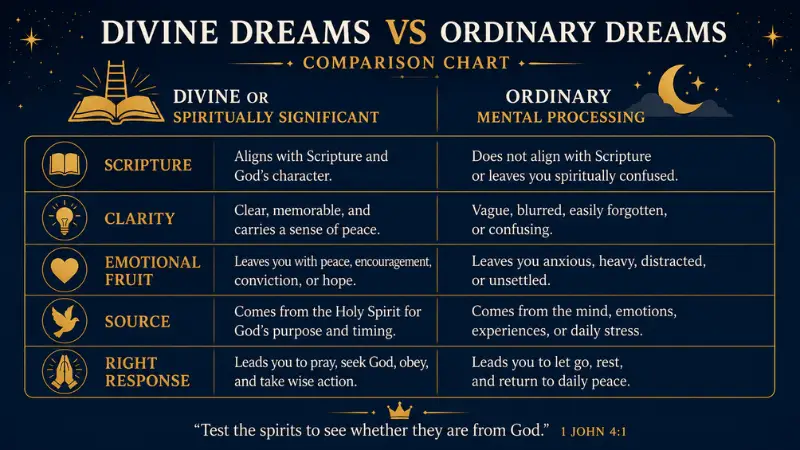
New section. This table compares the two categories most Christians are trying to tell apart. Treat it as a guide for reflection, not a scoring system.
| Feature | Divine or spiritually significant dream | Ordinary mental-processing dream |
|---|---|---|
| Alignment with Scripture | Fully consistent with the Bible and God’s character | Neutral; may mix truth with random images |
| Clarity | Simple and direct, like Joseph’s dreams in Matthew | Scattered, shifting, hard to summarize |
| Emotional aftereffect | Peace, healthy conviction, or steady resolve | Relief, confusion, or leftover stress |
| Fruit over time | Obedience, love, humility, spiritual growth | Mostly emotional release |
| Confirmation | Confirmed by Scripture, wise counsel, or events (Acts 10) | No outside confirmation needed |
| Source | Divine communication | Recent experiences, stress, memories, external influences |
| Right response | Prayer, reflection, obedience | Reflection, self-awareness, rest |
Most dreams sit in the right column. That is normal, and it is fine.
Common Symbolic Themes in Scripture
Biblical symbols carry weight because of biblical context, not because of a dictionary. Scripture usually explains its own dream imagery — as with Pharaoh’s dream, where the meaning was stated outright.
| Symbol | Common biblical use |
|---|---|
| Water | Life, cleansing, and sometimes chaos or judgment |
| Grain and harvest | Provision, work, and the results of a season |
| Harvested grain | Abundance stored up, as in Pharaoh’s dream |
| Trees | Life, growth, and kingdoms that rise or fall |
| Animals and beasts | Nations, empires, and spiritual powers in prophetic passages |
| Numbers | Symbolic weight, such as seven for completion |
| Weather and nature | Judgment, blessing, or the presence of God |
| Fire, wind, oil | Often linked to the work of the Holy Spirit |
Two cautions keep this honest. First, symbolic themes in Scripture are not automatic keys to your dreams. Pharaoh’s seven cows pointed to specific years because God said so, not because seven always means years. Second, spiritual attitudes matter more than symbol charts. Read the symbolism inside its own passage first.
How to Pray About Your Dreams
Prayer is where dream interpretation belongs. Christian prayer over a dream is short, humble, and honest.
A simple pattern:
- Thank God for rest and for His care during the night.
- Describe the dream to God in plain words, including the feelings.
- Ask for wisdom and understanding. Ask for spiritual insight, and ask for truth even if the truth is uncomfortable.
- Ask for discernment about the source and the dream meaning.
- Open the Scripture and let God’s Word shape your reflection.
- Ask for peace and leave the dream with Him.
Humility is the tone throughout. You are not demanding an answer. You are asking for guidance and staying open to receiving none. Dreams that come from God will survive being prayed over. Dreams that came from a late dinner will quietly lose their grip.
What to Do After a Significant Dream
Five practical steps, in order. This is also the answer to a question many Christians ask: what to do when you have a vivid or recurring dream? Write it down, notice the emotions, pray, talk to someone wise, and watch for patterns.
1. Write it down right away.
Immediate recall fades within minutes. Keep a dream journal by the bed and record the dream details before your feet hit the floor.
Write the people, the place, the events, the actions, the dialogue, the colors, the numbers, and the symbols. Do not edit. Do not interpret yet. Memory is the raw material, and it disappears fast.
2. Notice the emotions.
Go back through your record and mark the feelings. Fear, grief, joy, peace, anger, confusion — name each one.
Note the emotional intensity too. A mild dream with sharp affect points somewhere. Stress in a dream often mirrors stress in waking life, and naming it is the first step in self-awareness. Emotions usually reveal dream meaning faster than symbols do.
3. Bring it to Jesus in prayer.
Take the dream to Jesus directly. Ask for wisdom, ask for discernment, and ask for peace.
Prayer keeps a Christian faith response at the center. Read Scripture alongside your reflection. Spiritual reflection done with humility protects you from two mistakes: chasing meaning and ignoring God’s guidance altogether.
4. Process it with a safe, wise friend or spiritual director.
Say it out loud to someone safe. A mature believer, a wise friend, or a spiritual director offers reflection you cannot generate alone.
Safe counsel does not hand you a verdict. It asks better questions. Conversation inside Christian community gives you accountability and wisdom, and it keeps discernment about dream meaning from turning into a private echo chamber.
5. Look for themes that repeat over time.
One dream is a data point. Ten dreams are a pattern.
Review your dream journal every month or two. Circle recurring themes, repeated symbols, and emotions that keep showing up in the same situations. Long-term reflection turns scattered nights into personal meaning, and it often surfaces spiritual themes that a single dream would never reveal. Repetition is the clearest signal you have.
FAQ: Common Questions Christians Ask About Dreams
Short answers to the questions Christians ask most about dreams, spiritual meaning, and discernment. Each one holds Scripture as the standard.
Does God speak through dreams?
Yes. The Bible records God using dreams and visions to give guidance, warning, revelation, and encouragement — to Jacob, Joseph, Daniel, and Peter among others. Christian belief holds that God can still do this today. Modern dreams carry no authority of Scripture, so every dream still requires discernment against God’s Word.
How do I interpret my dreams as a Christian?
Start with prayer, then write the dream in a dream journal. Note the emotions, the symbols, and the context of your life this week. Test any spiritual message against Scripture and look for biblical parallels. Hold multiple interpretations loosely, seek wise counsel, and judge by spiritual fruit. Christian guidance beats a quick answer.
How do I know if a dream is from God or just my mind?
Weigh four things: Scripture, source, fruit, and context. A dream from God aligns with the Bible, brings clarity and peace rather than dread, and produces healthy conviction. Ordinary dreams usually trace back to stress, emotions, and psychological processing. Bring it to prayer, and let discernment work slowly. Most dreams are mental processing, and that is normal.
Are dreams messages from God?
Sometimes, but not usually. Biblical dreams did carry a divine message — guidance, warning, or revelation. Most dreams have a psychological origin: mental activity sorting the day. A Christian perspective keeps both possibilities open and tests each dream against Scripture rather than assuming every dream is a message from God.
Are recurring dreams important?
Often, yes. Repetition and unusual vividness point to something unfinished. Recurring dreams frequently track stress, fear, or unresolved issues, and sometimes carry emotional themes or spiritual themes worth attention. Log the patterns in a dream journal and look for personal meaning across several dreams. Importance shows up in the pattern, not in one night.
Should Christians ignore disturbing dreams?
No, but do not take them literally either. Disturbing dreams usually reflect fear, anxiety, stress, or unresolved issues rather than prediction. The healthiest Christian response is emotional processing plus spiritual reflection: write it down, pray, read Scripture, and share it with wise counsel. Ignoring a disturbing dream leaves the fear in place. Obsessing over it feeds the fear.
Want to Go Deeper? Take the Next Step in Understanding Your Dreams
Deeper understanding of your dreams comes from steady habits, not from one breakthrough night.
Your next step is simple. Start a dream journal this week. Use the T-TAQ method on the next dream you remember. Bring what you find into prayer and into Scripture. Ask one trusted person for wise counsel and Christian guidance.
That rhythm — reflection, prayer, discernment, emotional processing — builds spiritual discernment over months. It also builds spiritual growth that outlasts any single dream interpretation.
Further Reading
Keep going with resources that respect both Scripture and honest research. Solid Christian books on dream interpretation, biblical dreams, and spiritual discernment give you more room to study than any single article can. Choose ones that stay anchored to the Bible when they discuss dream meaning.
“Do Not Be Anxious” — What It Really Means
Anxiety and dreams travel together. Scripture’s call to “do not be anxious” is not a command to feel nothing. Its biblical meaning is an invitation to bring fear to God in prayer and to trust Him with what you cannot control. Christian teaching here supports emotional health rather than replacing it, and it points toward peace.
Spiritual Direction or Coaching? Choosing What’s Best For You
Both offer support, but they aim at different things. Coaching focuses on goals and personal development. Spiritual direction focuses on reflection, discernment, and your life with God. If your main need is spiritual growth and wise counsel, direction usually fits better. If your main need is a decision or a plan, coaching may serve you well. Christian guidance is available in both.
What Is Spiritual Direction?
Spiritual direction is an old Christian practice. You meet regularly with a spiritual director who listens, asks questions, and helps you notice where God is at work in your life. It is not therapy and not advice-giving. The focus is prayer, reflection, discernment, and Christian formation — slow spiritual growth in the company of someone trained to pay attention.
Related Products
Browse related products chosen to support this work: dream journals for nightly recording, dream interpretation books grounded in Scripture, and study guides for small groups. These Christian resources and biblical resources pair well with the practices above, and Christian books on discernment make a natural next purchase.


