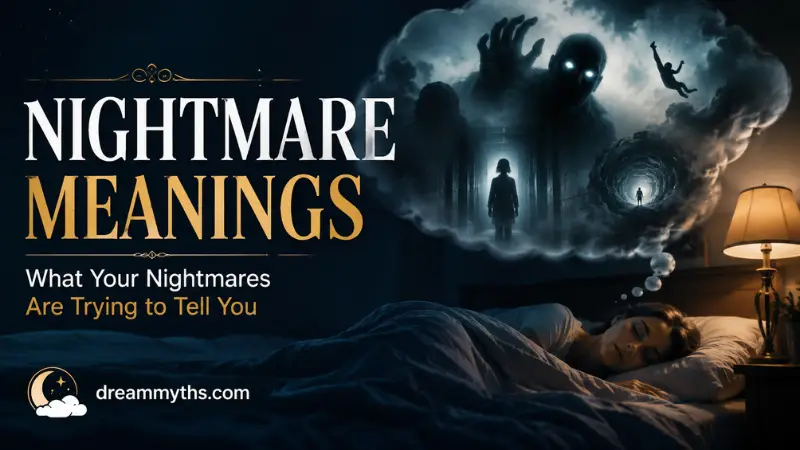
Nightmare meanings usually point to unprocessed emotion, not prophecy. A nightmare is a frightening dream in later REM sleep that wakes the sleeper. Common themes — being chased, falling, teeth falling out — map to stress, loss of control, and fear of loss. Most adults have them occasionally. A small minority have them chronically.
Key Takeaways
- Nightmare meanings are personal. The same falling dream can mean two different things to two people.
- Most adults get them. Commonly cited estimates say 50–85% of adults report at least occasional bad dreams; roughly 2–8% deal with chronic nightmares.
- Timing matters. Nightmares cluster in later REM cycles, which is why a 3 a.m. wake-up leaves you anxious, disoriented, and drained.
- Triggers are often physical. Stress, past trauma, medications, alcohol, fever, and sleep apnea all raise nightmare frequency.
- They respond to treatment. Image Rehearsal Therapy, breathing work, and basic sleep hygiene reduce both frequency and severity.
What Are Nightmares?
A nightmare is a vivid, frightening dream that wakes the sleeper, usually during REM sleep later in the night. Nightmares carry strong fear, anxiety, sadness, or sorrow, and the dreamer usually remembers them clearly. The word also has an obsolete sense: an evil spirit believed to oppress sleepers.
The word “nightmare” carries three senses in modern dictionaries.
- The medical definition — a distressing dream that awakens the sleeper, marked by terror and clear recall.
- The obsolete sense — an evil spirit thought to sit on and oppress sleepers at night.
- The figurative sense — any distressing situation or frightening experience in waking life, as in “the paperwork was a nightmare.”
A bad dream and a nightmare are not quite the same thing. The difference sits in one detail: a nightmare wakes you. Bad dreams are unsettling but you sleep through them. Nightmares are realistic enough and intense enough that you get rattled awake, often mid-scene, heart pounding.
Recurring themes show up again and again across sleepers: falling, tooth loss, being chased, exam unpreparedness. Occasional bad dreams are normal. Being chronically affected is not — roughly 2–8% of adults live with frequent nightmares, and that group is the one most likely to lose restorative sleep.
Why Do Nightmares Happen? Causes and Triggers
Nightmares happen when the sleeping brain processes stress, fear, or physical disruption during REM sleep. Common triggers include daily anxiety, past trauma, certain medications, alcohol, fever, bereavement, and sleep apnea. Brain activity and neurotransmitters shift during REM, which makes emotional material vivid. Both mind and body feed the same dream.
Emotional and psychological triggers
- Stress — deadlines, money, conflict at home. Daily anxiety carries straight into the dream.
- Past trauma — unresolved past experiences and PTSD are the strongest single predictor of frequent nightmares.
- Grief and bereavement — loss reshapes dream content for months.
- Witnessing violence — real or on screen.
- Depression — low mood and disturbed REM travel together.
- Unmet psychological needs — unconscious fears and frustration with life circumstances surface as threat.
Physical and chemical triggers
- Medications — antidepressants, beta blockers, and sleep aids are the three most commonly reported. Some supplements do the same.
- Withdrawal — coming off medication, quitting smoking, or quitting alcohol reliably spikes dream intensity for a few weeks.
- Alcohol in the bloodstream — it suppresses REM early, then lets it rebound hard in the second half of the night.
- Illness and fever — a high temperature produces some of the most intense dreams people ever report.
- Sleep apnea — irregular breathing and oxygen deprivation while asleep often show up as drowning, suffocation, or a creature pressing on the chest.
- Diet — heavy meals and late-night snacking push toward restless sleep and a poor diet raises the odds of waking mid-cycle.
That sleep apnea link is worth taking seriously. When the same suffocation image repeats night after night, the cause may be in your airway, not your unconscious.
What Do Nightmare Meanings Actually Reveal?
Nightmare meanings reveal what your mind is still processing, not what will happen next. Dreams recycle the day’s events, memories, and daily preoccupations into symbolic storylines. Some are literal replay. Many are metaphor. Individual differences matter more than any dictionary, so no image carries one fixed meaning for everyone.
Dream interpretation works best as self-inquiry, not lookup. The brain processing that runs during REM sleep stitches together events before sleep, older memories, and unprocessed anxiety. Sometimes the result is a clean metaphor. Sometimes it’s a nonsensical narrative with one emotional charge buried in it.
Five self-inquiry questions do most of the work:
- What did I feel? The feelings in the dream matter more than the plot. Falling off a cliff and running late can both mean “I am losing control.”
- What happened just before sleep? Argument, doom-scroll, hard conversation, stressful move — check the last two hours first.
- What images keep returning? Recurring images and recurring themes are your unconscious repeating itself because you haven’t answered yet.
- When does it happen? Look for timing patterns — cycles, seasons, anniversaries, the week before a deadline.
- What am I ignoring? Ignored internal issues surface as distress. A naked-in-public dream is rarely about clothing.
Decoding dream symbols is useful only when you run the symbol back through your own life. A snake means something different to a herpetologist than to someone who was bitten at eight years old.
The 19 Most Common Nightmares and What They Mean
The most common nightmares are being chased, falling, teeth falling out, death, and being attacked. These five dominate ranked nightmare themes worldwide. Each maps to a recognizable waking-life pressure: pursuit to avoidance, falling to lost control, tooth loss to fear of loss, death to transition, attack to threat.
Lists of the 15 most common nightmares or the 17 most common nightmares circulate widely online. The table below covers 19 themes, since the extra few come up constantly and get skipped elsewhere.
| Nightmare | Likely emotional driver | Check in waking life |
|---|---|---|
| Being chased | Avoidance of a problem | What or who is “the chaser”? |
| Teeth falling out | Fear of loss or exposure | A breakup, job loss, losing money |
| Falling | Loss of control | Instability, no safety net |
| Death or dying | Endings and transition | Grief, a chapter closing |
| Exams or tests | Feeling unprepared | Judgment, performance pressure |
| Drowning | Feeling overwhelmed | Workload, responsibilities, work-life balance |
| Being attacked | Intense fear and dread | A real threat or hostile person |
| Naked in public | Exposure | A secret revealed, or dishonesty |
| Snake bite | Betrayal or hidden threat | A boundary violation |
| Sleep paralysis | Trapped in a dream | Feeling stuck, stalled career |
| Being cheated on | Trust anxiety | Insecurity, not evidence |
| Natural disasters | Mounting worry | Tornado, earthquake, hurricane imagery |
| Moving house | Disrupted routine | A real relocation or role change |
| Catching fire | Transformation | Coming change; Carl Jung read fire this way |
| Getting shot | Fighting for survival | Stalled goals, disturbing media |
| Bug infestation | Guilt and creeping worry | Minor irritations, health anxiety |
| Getting lost | Lack of direction | No clear next step |
| Being late | Pressure and regret | A missed opportunity |
| Out-of-control vehicle | No steering on your own life | Someone else deciding for you |
A few of these deserve extra unpacking.
Being chased is the most reported nightmare on record. Running from something usually means suppressed emotions are catching up — anger, jealousy, resentment. Turn and look at the chaser, and most people recognize it.
Teeth falling out clusters around loss: a breakup, job loss, losing money, or repressed feelings you haven’t said out loud.
Falling is the purest helplessness dream. Vulnerability with nothing underneath you.
Snake bite dreams spike after a boundary violation. Betrayal and hidden threat are the two readings that fit most cases.
Natural disasters — tornado, earthquake, hurricane — signal inescapable difficulty and extreme emotion. The scale of the disaster often tracks how big the waking problem feels.
Catching fire is the one theme that isn’t purely negative. Fire dreams frequently arrive right before a real change, sometimes destructive behaviour you’ve noticed in yourself, sometimes unaddressed conflict burning through.
The Three Types of Nightmares
Nightmares sort into three types: recurring nightmares, fever dreams, and one-off vivid nightmares with lasting impact. Recurring nightmares repeat over long periods and point to unresolved conflict or repressed wishes. Fever dreams come with high body temperature and stop when the fever breaks. The third type happens once but stays with you for years.
Type 1 — Recurring nightmares. The same dream, over long periods, sometimes for decades. These are the ones most worth interpreting.
Type 2 — Fever dreams. High body temperature makes dreams intense and vivid, often with strange scale, repetition, and a strong sense of presence in the room. They end when the fever breaks and rarely mean anything.
Type 3 — The single unforgettable nightmare. People forget the large majority of their dreams within minutes of waking; the widely repeated figure is around 95%. A handful survive that. Extreme emotion is what preserves them, and their lasting impact can shape how someone feels about sleep for years.
Recurring Nightmares: Why the Same Dream Comes Back
Recurring nightmares repeat because the underlying issue hasn’t been addressed. Studies of recurring dreams find them in both men and women at similar rates, with many sufferers reporting them twice a month or more. Repetition is the unconscious mind asking for attention. The hidden meaning is usually an unresolved conflict, a repressed wish, or a painful experience you’ve filed away.
Repetition itself is the message. A dream that returns is not adding new information; it’s raising its voice.
Three questions help break the loop:
- What changed in my life the first time this dream appeared?
- What would I have to face, or say, or end, for this to stop being true?
- Which painful experiences am I actively not thinking about?
Self-awareness is the mechanism here. Recurring nightmares often stop once the dreamer names the issue clearly — not once the issue is solved, just named. Writing the dream down and writing what it’s about, in plain language, is a reasonable first move.
Nightmare Disorder: When Bad Dreams Become a Diagnosis
Nightmare disorder is a sleep condition marked by repeated awakenings from debilitating nightmares with detailed dream recall. Formerly called dream anxiety disorder, it appears in the DSM and affects roughly 1% of the population by commonly cited estimates. Diagnosis requires impaired functioning, not just frequency, and no medical or substance-use explanation.
The diagnostic criteria look for a specific pattern:
- Repeated awakenings from dreams involving threats to survival, safety, or physical integrity
- Detailed dream recall on waking
- Alert and oriented on waking — the dreamer knows exactly where they are
- Life-or-death fear during the dream, with lingering anxiety and an adrenaline surge afterward
- Difficulty falling back asleep
- Real impairment in daytime functioning
- No medical explanation, medication effect, or substance use that accounts for it
Speaking in sleep, moaning, or screaming can accompany episodes, though they aren’t required for diagnosis.
There is no cure in the sense of a permanent switch-off. Treatment focuses on reducing frequency and severity, and it works — behavioral therapy is first-line, with medication considered in some cases. If nightmares are wrecking your sleep several nights a week, that is the point to see a doctor rather than wait it out.
Nightmares, Trauma, and PTSD
Nightmares are one of the defining symptoms of PTSD. Frequently cited figures put nightmares in around 80% of people with PTSD, against roughly 5% of the general population. Traumatic nightmares split into two kinds: a literal replay of the event, and a metaphor version that carries the same feeling in different imagery.
Disaster survivors show the metaphor pattern clearly. Someone who lived through a fire may not dream of the fire itself. They dream of flames somewhere else, high winds, being trapped in floodwater — different scene, identical terror.
Trauma-related nightmares push the nervous system outside its window of tolerance. Two directions are possible:
- Hyperarousal — restless, overwhelmed, hypervigilant, unable to settle. Flashbacks are more likely in this state.
- Hypoarousal — numbness, flat affect, depleted, disconnected from feeling anything at all.
Both make sleep worse, and worse sleep makes both harder to climb out of.
Calming strategies used before bed — slow breathing, grounding, a fixed wind-down — help keep the system in a regulated state and improve sleep quality even before the nightmares change. For post-traumatic responses that involve reliving the trauma, therapy with a trauma-informed therapist is the treatment with the strongest track record. If that describes you or someone close to you, it’s worth reaching out to a professional rather than managing it alone.
Bad Dream vs Nightmare vs Night Terror
A bad dream doesn’t wake you, a nightmare does, and a night terror isn’t a dream at all. Nightmares occur in REM sleep with clear recall. Night terrors are a non-REM parasomnia involving screaming, thrashing, and almost no memory afterward. Night terrors are most common in children under nine.
| Feature | Bad dream | Nightmare | Night terror |
|---|---|---|---|
| Sleep stage | REM | REM | Non-REM, deep sleep |
| Timing | Any REM cycle | Later in the night | First few hours |
| Wakes the sleeper | No | Yes | Not fully |
| Recall next morning | Vague | Detailed | Little to none |
| Physical behaviour | None | Startle, fast heartbeat | Screaming, thrashing, crying |
| Easy to wake | Yes | Already awake | Hard to wake |
| Typical length | Minutes | Minutes | 10–20 minutes |
| Most affected | All ages | All ages | Children under nine |
Night terrors, also called sleep terrors, involve acting out physically. Aggressive sleepwalking happens in a minority of cases, and in rare episodes a sleeper has struck or frightened a family member without any awareness of it. Adults under extreme stress, and adults living with depression or anxiety, can develop them too.
The most useful practical difference: after a nightmare the sleeper is awake, oriented, and can talk about it. After a night terror there’s confusion on waking, then returning to sleep with no memory of the episode at all. Waking someone mid-terror usually makes it worse — staying nearby and keeping them safe is the better move.
Nightmares in Children
Nightmares are more common in children than adults. About one quarter of children report at least one scary dream a week. They typically begin around age 2 to 3, peak near age 6, and start tapering off from age 10 and up as dream vividness fades. Monsters, ghosts, and threats to people close to them dominate the content.
Children’s nightmares follow a developmental arc. Ages 2 to 3 bring the first frightening situations, usually simple: a monster theme, a ghost theme, something under the bed. By age 6 the content grows more detailed and more personal — often danger aimed at a parent or sibling rather than the child. From age 10 and up, frequency drops and the loss of vividness makes them less disruptive.
One thing surprises parents: many children stay still and quiet during nightmares. They don’t cry out. You may only learn about it at breakfast. That’s a real difference from night terrors, which are loud and physical.
Adult nightmares, by contrast, lean toward social and situational fear rather than monsters.
How to Prevent Nightmares in Children
Nightmare prevention in children is mostly about the two hours before bed and the conversation the next morning.
- Cut junk food and sugary drinks in the evening.
- Play calming music overnight at low volume.
- End with a positive bedtime book, not a screen.
- Try talking back to the monster — giving a child a line to say, out loud, transfers a bit of control back to them.
- Ask about fears directly during the day, then address them, rather than only soothing at 2 a.m.
There is also a genetic component. If nightmares run in the family history, a child is more likely to have them, and that isn’t a parenting failure.
Sleep Disorders and Parasomnias Linked to Nightmares
Parasomnias are sleep disorders involving unwanted physical or verbal behaviour during sleep. Nightmares sit in this family alongside sleepwalking, sleep talking, and REM sleep behaviour disorder. Separate conditions — insomnia, sleep apnea, narcolepsy, and restless leg syndrome — cause disrupted sleep that raises nightmare frequency indirectly.
The overlap runs in both directions:
- Sleep apnea interrupts breathing during the REM stage and produces suffocation imagery.
- Insomnia fragments the night, and fragmented nights mean more awakenings from REM — which means more remembered nightmares.
- Sleepwalking and sleep talking are unwanted physical behaviour and verbal behaviour arising from deep sleep.
- REM sleep behaviour disorder removes the normal muscle paralysis of REM, so the sleeper physically acts out the dream.
- Narcolepsy and restless leg syndrome both fracture sleep architecture.
The knock-on effect matters as much as the dreams. Frequent nightmares create dread of going to bed, which delays bedtime, which produces sleep deprivation. That shows up the next day as reduced mental clarity and low mood, and over time it feeds depression. Breaking that loop is often more urgent than interpreting any single dream.
Spiritual Nightmare Meanings Across Cultures
Spiritual nightmare meanings frame bad dreams as course correction rather than punishment. Across traditions, the reading is similar: a nightmare functions as a warning about overlooked issues, ignored internal traits, or a drift from the right path. The psychological benefit is the same either way — distress forces attention onto something you’ve been avoiding.
Different traditions supply different vocabulary for that idea. Islamic interpretation traditionally distinguishes true dreams from distressing ones and advises seeking refuge and not dwelling on frightening imagery. Biblical interpretation reads dreams as one channel among several for guidance and warning. Folk traditions across Europe blamed the mare, a spirit that pressed on the chest of sleepers.
That folkloric mare explanation maps neatly onto sleep paralysis. Chest pressure, an intruder sensation, and total immobility are documented features of the condition, and nearly every culture built a demon to explain them.
Whether you read a nightmare as spiritual guidance or as neural housekeeping, the practical step is identical: identify the metaphoric warning, then act on the thing it points to. Self-insight is the part that changes the next night’s sleep.
Are Nightmares Actually Good for You?
Nightmares appear to serve a training function for the waking brain. Threat simulation theory holds that dreaming about alarming situations rehearses the fear response in a safe setting, sharpening emotional regulation for real events. Researchers studying fear in dreams have found links between dream fear and better handling of frightening stimuli awake. Nightmares are not predictive.
That last point deserves weight, because it’s the fear most people carry. A dream about a plane crash is not a forecast. It’s your amygdala running a drill.
The benefit isn’t unlimited. Occasional nightmares look like useful brain training. Chronic nightmares stop being rehearsal and start being damage — they cost you restorative sleep, and lost sleep undermines the exact emotional regulation the dreams were supposedly building. The threshold is roughly this: if you wake rested more often than drained, the system is working.
How to Stop or Reduce Nightmares: 9 Methods
Nightmares respond well to treatment. Image Rehearsal Therapy has the strongest evidence base, and simple relaxation methods — 4-7-8 breathing, diaphragmatic breathing, Progressive Deep Muscle Relaxation — reduce nightmare frequency and distress. Sleep hygiene changes support all of it. Most people see improvement within weeks, not months.
- Image Rehearsal Therapy (IRT). The best-supported method. Write the nightmare down, then change the ending to something neutral or good. Spend a few minutes rehearsing the new version while awake, daily. You are overwriting the script, and it works surprisingly fast.
- Progressive Deep Muscle Relaxation (PDMR). Tense and release each muscle group, scalp to toes, roughly ten minutes before bed. Tension you don’t notice during the day shows up in the dream.
- 4-7-8 breathing. Inhale four counts, hold seven counts, exhale eight counts. The long exhale engages the vagus nerve and shifts you toward the parasympathetic nervous system — the body’s calming system.
- Diaphragmatic breathing. Hand on belly, breathe so the hand rises. Useful if 4-7-8 makes you lightheaded.
- Keep a dream journal. Improves dream recall, which sounds counterproductive but is the raw material for IRT. It also reveals recurring themes you’d otherwise forget.
- Try lucid dreaming carefully. Some people learn to recognize they’re dreaming and redirect the nightmare from inside it. It’s a slower skill and not for everyone.
- Fix the bedtime routine. A consistent bedtime, a cooler and darker sleep environment, relaxing music, meditation, or gentle yoga. Lavender is a common addition; treat it as pleasant, not medicinal.
- Cut the inputs. No caffeine late, no screens before bed, and avoiding video games or any disturbing imagery before sleep. Whatever you feed the brain last tends to appear first.
- Watch diet and alcohol. Heavy late meals and alcohol both fragment REM and raise nightmare odds.
If nightmares persist after several weeks of consistent effort, professional support is the next step. A sleep specialist or therapist can screen for sleep apnea, review medications, and deliver IRT properly.
Word Origin: Why It’s Called a “Nightmare”
“Nightmare” comes from Middle English nyghte mare, combining “night” with “mare,” an Old English word for an evil spirit. That spirit was believed to haunt people in sleep and cause suffocation by sitting on the sleeper’s chest. First known use dates to the 14th century. The modern sense of a frightening dream emerged later.
The “mare” half is the interesting part. It never meant horse. It’s an obsolete word for a specific kind of nocturnal spirit, and the imagery of pressure and suffocation was baked into the term from the start.
The figurative sense — a nightmare as any distressing situation — is generally traced to the late 16th century and now dominates everyday use. Word history in three steps: spirit, then dream, then any ordeal.
Synonyms across those senses include agony, misery, horror, distress, torment, torture, and hell. The word family extends to nightmarish and nightmarishly, and the phrase worst nightmare is now a fixed idiom.
Dictionary entries typically separate a kids definition (a frightening dream), a medical definition (a distressing dream that awakens the sleeper), and the figurative sense.
Other Nightmare Meanings People Search For
Three nightmare meanings dominate searches beyond dream interpretation: the “nightmare person” idiom, the Hindi translation, and whether bad dreams mean death. All three have short, clear answers.
“Nightmare person.” A figurative meaning, not a clinical one. Calling someone a nightmare person means they’re a difficult person — an exhausting individual whose toxic behaviour makes ordinary interactions draining. It’s an idiom, not a diagnosis.
Nightmare in Hindi. The closest equivalent term is दुःस्वप्न (duhsvapn), a formal word combining “bad” and “dream.” In everyday speech most Hindi speakers say बुरा सपना (bura sapna) or डरावना सपना (daraavna sapna), meaning “bad dream” and “scary dream.” The Devanagari spellings above match the standard pronunciation.
Do bad dreams mean death? No. The death omen reading is superstition, and dream research has found no predictive link. When death appears in dreams it usually reads as a symbolic ending — a transition, a chapter closing, or fear of loss around someone you love.
FAQ Nightmare Meanings
What are nightmares trying to tell us?
Nightmares point to unresolved emotions your subconscious is still working through. They act as warning signals about stress, conflict, or something you’ve been avoiding rather than as messages about the future. The most reliable dream meaning comes from self-reflection: name the feeling first, then find where it lives in your waking life.
Are nightmares a warning?
Nightmares can be a warning, but about the present, not the future. A recurring nightmare is a subconscious signal about unresolved stress or an ignored conflict. In some cases they flag a health issue — repeated suffocation or drowning dreams can indicate sleep apnea. They are not a premonition.
What are the top 5 nightmares?
The top 5 nightmares are being chased, falling, teeth falling out, death, and being attacked. These five appear at the head of nearly every study of frequent dream themes. Each maps to a core waking fear: avoidance, loss of control, loss, endings, and threat.
What’s the difference between a bad dream and a nightmare?
A nightmare wakes you; a bad dream doesn’t. Both are unpleasant, but the nightmare’s intensity and emotional distress break sleep and leave clear recall. That waking-from-sleep moment is the whole distinction used in sleep medicine.
Can medication cause nightmares?
Yes. Antidepressants, beta blockers, and some sleep aids are the medications most often linked to vivid dreams and nightmares as side effects. Withdrawal from a medication can trigger them too, sometimes more strongly than the drug itself. Talk to your prescriber before changing anything.
Do bad dreams mean death?
No. Bad dreams do not predict death, and the omen reading is superstition rather than evidence. Death in a dream more often represents a symbolic ending — a transition, a role you’re leaving behind, or fear of loss.
What does it mean to call someone a “nightmare person”?
It means they’re a difficult personality who is exhausting to deal with. The phrase is a figurative meaning drawn from the word’s “distressing situation” sense, applied to a person rather than an event. It describes toxic behaviour, not a mental health condition.
What is “nightmare” in Hindi?
The Hindi translation is दुःस्वप्न (duhsvapn), the formal term for a nightmare. The common spoken equivalent is बुरा सपना (bura sapna), meaning bad dream. Pronunciation follows standard Devanagari: duh-svapn and bu-ra sap-na.
CONCLUSION: What to Do With Your Next Nightmare
Nightmare meanings turn out to be less mysterious than the dreams themselves feel at 3 a.m. A nightmare is late-REM emotional processing that got loud enough to wake you. The imagery is borrowed from whatever your brain had lying around — monsters at age six, exams at sixteen, an out-of-control vehicle at forty.
What makes the difference is the response. One nightmare is data. A pattern is a message. And a pattern that has been running for months, costing you sleep and making you dread bedtime, is a medical matter rather than a symbolic one.
So the next time one wakes you: write down the feeling before the plot. Check the last two hours before you slept. Look for the repeat. If the same dream keeps arriving, rewrite its ending while you’re awake and rehearse the new version — that single technique has the best track record of anything on this page. And if the nightmares are frequent, trauma-linked, or leaving you drained through the day, a doctor or trauma-informed therapist can address the cause instead of the symbol.
Your nightmares aren’t predicting anything. They’re pointing at something. The useful question was never what does this mean — it’s what have I not dealt with yet.