
When someone writes AFK in a text message, online game, or group conversation, they are usually telling others that they are temporarily away from their device. The AFK meaning is “away from keyboard,” an abbreviation used to show that a person is not actively responding because they have stepped away from their computer, phone, or gaming setup.
Although the phrase originally became popular in computer and gaming communities, AFK is now used across many online spaces. People use it in text messages, social media chats, streaming communities, and casual workplace conversations to quickly explain why they are not responding.
The phrase does not always mean someone is physically away from a keyboard. Modern users may type AFK while using a smartphone, tablet, or gaming console. In everyday online communication, the main idea behind AFK meaning in text is simply that someone is temporarily unavailable or inactive.
Understanding AFK helps people communicate better in fast-moving digital conversations. Instead of leaving others wondering why someone stopped replying, a short message like “AFK for a few minutes” clearly explains that the person will return later.
Quick Answer
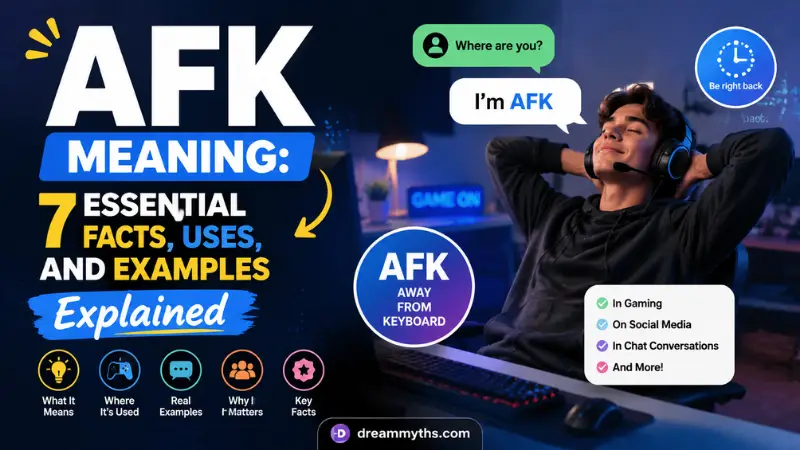
AFK means “away from keyboard.” In texting, gaming, and online chats, AFK tells others that someone is temporarily away from their device or not actively participating. The term is informal and is most commonly used in gaming communities, group chats, Discord conversations, and other casual online spaces.
What Does AFK Mean?
AFK means “away from keyboard,” which indicates that a person has stepped away from their computer or device and is temporarily inactive.
The abbreviation is part of internet shorthand, where longer phrases are shortened into a few easy-to-type letters. Instead of writing “I will be away from my computer for a few minutes,” users can simply type AFK.
This makes communication faster, especially in situations where people need to respond quickly. Online games, chat rooms, and digital communities often move at a fast pace, so short expressions like AFK became useful tools for sharing availability.
Today, the word “keyboard” in AFK is more historical than literal. A person can say they are AFK even when they are away from a phone, tablet, or console. The important meaning is that they are not currently active in the conversation or activity.
For example:
- “AFK for dinner, I’ll be back soon.”
- “Give me five minutes, AFK.”
- “My teammate went AFK during the match.”
In each example, AFK communicates a temporary break rather than a permanent departure.
What Does AFK Mean in Text Messages?
The AFK meaning in text is that someone is temporarily unavailable and may not reply immediately.
People often use AFK in casual conversations when they need to put their phone down, leave their computer, or stop responding for a short time. It works like a quick status update that tells others why a reply may be delayed.
For example:
Friend 1: Are you still coming tonight?
Friend 2: AFK right now, I’ll text you later.
Here, AFK tells the other person that the delayed response is intentional. The person is not ignoring the message; they are simply away.
Another example:
Person A: Can you check this file?
Person B: AFK, give me 10 minutes.
The abbreviation saves time and fits the fast style of digital conversations. Instead of explaining a situation in a full sentence, users can communicate their status with just three letters.
However, AFK is usually limited to informal conversations. It is common among people who regularly use internet slang but may be unclear to someone unfamiliar with online abbreviations.
What Does AFK Mean in Gaming?
In gaming, AFK means that a player is temporarily inactive or away from the game.
The term is especially common in multiplayer games where teamwork, timing, and player participation are important. When someone goes AFK, their character may stop moving, fail to complete actions, or become unavailable to teammates.
Examples of someone going AFK include:
- A player leaves their desk to answer a phone call.
- A gamer steps away to get food or a drink.
- A teammate stops responding during an online match.
Players commonly use AFK phrases such as:
- “I’ll be AFK for a minute.”
- “Our teammate is AFK.”
- “Wait, he’s AFK before starting the match.”
In competitive games, an unexpected AFK player can create problems because teammates may depend on every person being active. For this reason, many gaming communities consider it good etiquette to tell others before stepping away.
For example, saying:
“AFK for two minutes, don’t start yet.”
is usually more considerate than disappearing without explanation.
The gaming meaning of AFK remains one of the most recognized uses of the term because online games helped make the abbreviation popular.
What Does AFK Stand For?
AFK stands for “away from keyboard.”
The phrase follows a common internet abbreviation style where a longer expression is shortened into initials. Similar examples include:
- BRB — Be Right Back
- LOL — Laugh Out Loud
- FYI — For Your Information
- TTYL — Talk To You Later
Unlike some abbreviations that have several meanings depending on the situation, AFK has one dominant meaning in online communication: being away or inactive.
The phrase reflects an earlier period of internet communication when many users connected through desktop computers and keyboards. Even though many people now communicate through mobile devices, the abbreviation remains widely understood.
AFK Meaning in Online Chat and Social Media
In online communities, the AFK meaning is connected with availability. It works as a short message that tells others someone is not currently participating.
People may use AFK in:
- Gaming chats
- Discord servers
- Online communities
- Streaming chats
- Group messages
- Casual work conversations
For example:
“AFK — making coffee.”
This short message tells others that the person has stepped away and will likely return after a short break.
On platforms where conversations move quickly, abbreviations like AFK help users communicate without interrupting the flow of discussion. They are especially useful when a person wants to explain a temporary absence without writing a longer message.
However, AFK remains an informal expression. It works naturally in online spaces but may not be the best choice for formal communication.
A professional email would usually avoid:
“I’m AFK today.”
Instead, a clearer phrase would be:
“I’ll be away from my desk today and will respond when available.”
The meaning is similar, but the tone is more suitable for a workplace setting.
Is AFK Slang?
Yes, AFK is considered internet slang or online shorthand. It is mainly used in casual digital conversations rather than formal English writing.
The abbreviation became popular because online users needed quick ways to communicate their status. In chat rooms, multiplayer games, and online communities, typing a few letters was faster than writing a complete sentence.
The AFK meaning is simple, but the way people use it depends on the community. Gamers may use AFK to explain why they are not moving in a game, while someone in a group chat may use it to say they are stepping away from their phone.
Examples:
“AFK, getting some food.”
Meaning: The person is temporarily away.
“Sorry, I was AFK when you messaged me.”
Meaning: The person was not available when the message arrived.
Although AFK is widely recognized among internet users, not everyone understands online abbreviations. When communicating with someone unfamiliar with digital slang, using the full phrase or a clearer explanation may be better.
For example:
Casual:
“AFK, back soon.”
More widely understood:
“I’ll be away for a few minutes and will reply when I return.”
AFK Pronunciation: How Do You Say AFK?
AFK is usually pronounced by saying each letter separately:
A-F-K
(pronounced: “ay eff kay”)
People normally do not pronounce AFK as a single word. Instead, they spell out the three letters because it is an abbreviation.
For example, someone might say:
“I’m going AFK for a minute.”
The spoken version sounds like:
“I’m going A-F-K for a minute.”
This pronunciation style is common with many online abbreviations, including BRB, FYI, and TTYL.
AFK History and Origin
The exact first use of AFK is difficult to verify, but the abbreviation developed through early online communication and computer-based communities.
Before modern messaging apps became common, many people communicated through online chat rooms, forums, and multiplayer computer games. Because typing speed mattered, users created shortened expressions that could quickly explain their actions.
AFK became useful because it solved a common problem: telling other people that someone was temporarily leaving the conversation or activity.
The phrase originally referred specifically to being away from a keyboard because many early online activities happened on desktop computers. Over time, the meaning became broader as people started using phones, tablets, and other devices.
Today, the AFK meaning focuses less on the physical keyboard and more on the idea of temporary unavailability.
What Does AFK Mean on Discord?
On Discord, AFK means that a user is temporarily away or inactive.
Discord communities often use AFK in gaming servers, friend groups, and online communities. Users may type AFK in a chat channel, set an AFK status, or use the word to explain why they are not responding.
Examples:
“AFK for dinner.”
“I’ll be AFK for about 20 minutes.”
“The admin is AFK right now.”
In Discord servers, AFK can also refer to an AFK voice channel or an automatic status system that moves inactive users after a period of time. However, the general idea remains the same: the person is not actively participating at that moment.
AFK Etiquette: Is Going AFK Rude?
Going AFK is not automatically rude. The situation and communication matter.
In casual conversations, briefly stepping away is usually normal. People need breaks, answer calls, get food, or handle other tasks.
However, suddenly going AFK during an important activity can create problems, especially in team-based games or group tasks.
Good AFK etiquette includes:
- Informing others before leaving
- Giving an estimated return time when possible
- Avoiding unnecessary interruptions during important moments
- Returning when you said you would
For example:
Better:
“AFK for five minutes, someone is at the door.”
Less helpful:
Leaving a team game without explanation.
The AFK meaning itself is neutral. Whether the action is considered positive or negative depends on the situation.
AFK in Workplace Communication
Although AFK started in online communities, some workplaces now use it in casual internal chats.
For example, employees working remotely may write:
“AFK for lunch, back at 1.”
or:
“AFK for a meeting.”
In relaxed workplace environments, this may be completely acceptable. Team members who regularly communicate through chat platforms often understand these abbreviations.
However, AFK is not suitable for every professional situation.
Avoid using AFK in:
- Formal emails
- Client communication
- Official reports
- Job applications
- Professional documents
Instead, use clearer phrases:
- Away from my desk
- Temporarily unavailable
- Stepping away
- Out of office
For example:
Less formal:
“I’m AFK right now.”
Professional:
“I’m temporarily unavailable but will respond shortly.”
AFK vs BRB: What Is the Difference?
AFK and BRB are both common internet abbreviations, but they communicate slightly different ideas.
| Term | Meaning | Main Focus |
|---|---|---|
| AFK | Away from keyboard | The person is currently unavailable |
| BRB | Be right back | The person is leaving briefly and expects to return |
AFK describes a current state. It tells people that someone is not actively present.
Example:
“AFK, answering the phone.”
BRB focuses more on returning soon.
Example:
“BRB, grabbing water.”
A person can be AFK without saying when they will return. BRB usually suggests a shorter and more predictable absence.
Both expressions are informal, but BRB often sounds more conversational because it directly suggests coming back.
AFK vs Idle: Are They the Same?
AFK and idle are related concepts, but they are not identical.
AFK means a person is away from their device or not actively participating.
Idle means there has been little or no activity for a period of time.
A person may be idle without being AFK. For example, someone may still be looking at a screen but not interacting.
Examples:
- A gamer leaves their computer to make food → AFK
- A player watches a game without moving → idle
- A chat account shows no activity → idle
In many digital systems, inactivity may automatically create an idle status. That does not always mean the person physically walked away.
The distinction is useful because AFK describes a person’s availability, while idle describes a lack of activity.
Common Mistakes When Using AFK
Although the AFK meaning is easy to understand, some people use the abbreviation incorrectly or misunderstand what it communicates. Knowing these common mistakes helps you use AFK naturally in online conversations.
Mistake 1: Thinking AFK Means Permanently Gone
AFK usually describes a temporary absence, not someone leaving forever.
Incorrect:
“He went AFK from the community forever.”
Better:
“He went AFK during the game.”
If someone has permanently stopped participating, words like left, quit, logged off, or deleted their account are usually more accurate.
AFK simply tells others that a person is away at the moment.
Mistake 2: Using AFK in Formal Writing
AFK is mainly an informal internet abbreviation. It is not normally used in academic writing, official documents, or formal business communication.
Incorrect:
“I was AFK from work yesterday.”
Better:
“I was away from work yesterday.”
Incorrect:
“The manager is AFK today.”
Better:
“The manager is unavailable today.”
In casual workplace chats, AFK may be acceptable, but formal communication usually requires complete phrases.
Mistake 3: Assuming Everyone Knows AFK
Many people who use the internet regularly recognize AFK, especially gamers and younger users. However, some readers may not understand online abbreviations.
If you are communicating with someone unfamiliar with digital slang, provide more context.
Example:
“I’ll be away from my computer (AFK) for about 15 minutes.”
This keeps the message clear without confusing the reader.
Mistake 4: Using AFK When You Are Still Active
AFK means you are not actively participating. It should not be used simply because you are busy.
For example, if you are reading messages but not replying immediately, you may not truly be AFK.
Better choices might be:
- Busy right now
- Will reply later
- Give me a few minutes
- I’m working on something
AFK specifically suggests that you are away or unavailable.
Can AFK Be Used as a Verb?
Yes, some internet users use AFK as a verb in casual online speech.
Examples:
- “I need to AFK for a minute.”
- “He AFK’d during the match.”
- “I’m going to AFK while I make dinner.”
This usage is especially common in gaming communities, where abbreviations often become regular parts of conversation.
However, using AFK as a verb is informal. It would not normally appear in professional or academic writing.
A formal alternative would be:
“I need to step away for a moment.”
instead of:
“I need to AFK.”
AFK Examples in Real Conversations
The best way to understand the AFK meaning is to see how people use it naturally.
Example 1: Gaming Conversation
Player 1:
Are you ready for the next round?
Player 2:
AFK for two minutes. Someone is calling me.
Meaning: The player is temporarily leaving the game.
Example 2: Friend Group Chat
Friend 1:
Can you send me the photos?
Friend 2:
AFK right now. I’ll send them later.
Meaning: The person is away from their phone or not available.
Example 3: Online Community
User:
Why is nobody responding?
Moderator:
Most people are AFK right now.
Meaning: Many users are currently inactive.
Example 4: Casual Work Chat
Coworker:
Can you check this document?
Employee:
AFK for lunch. I’ll look when I’m back.
Meaning: The employee is temporarily away.
Example 5: Streaming Community
Streamer:
I’ll be AFK for a minute while I fix my setup.
Meaning: The streamer is stepping away temporarily.
Related Internet Abbreviations
AFK belongs to a larger group of internet abbreviations that help people communicate quickly.
BRB — Be Right Back
BRB tells someone that you are leaving briefly but expect to return soon.
Example:
“BRB, answering the door.”
Difference from AFK:
- AFK focuses on being away.
- BRB focuses on returning.
GTG — Got To Go
GTG is used when someone needs to leave a conversation.
Example:
“GTG, I have class tomorrow.”
It usually signals that the person is ending the conversation.
TTYL — Talk To You Later
TTYL means someone plans to continue the conversation at another time.
Example:
“I have to leave now. TTYL.”
OMW — On My Way
OMW tells someone that you are traveling toward a location.
Example:
“OMW, I’ll arrive soon.”
LOL — Laugh Out Loud
LOL is used to show laughter or amusement.
Example:
“That joke was funny LOL.”
These abbreviations all make digital conversations faster, but they are used in different situations.
Is AFK Different From Offline?
Yes, AFK and offline describe different situations.
AFK means someone is temporarily away but may still be connected to an online service.
Offline means someone is not connected or available online.
Examples:
- A gamer leaves their desk but keeps the game open → AFK
- Someone shuts down their computer → offline
A person can be AFK while still appearing online.
For example, someone may leave their computer to make coffee while their messaging app remains open. Other users may still see them as online, but they are not actively responding.
When Should You Use AFK?
AFK works best in informal digital situations where people understand internet shorthand.
Good situations for AFK:
- Multiplayer games
- Discord chats
- Online communities
- Friend group messages
- Casual team communication
Examples:
“AFK for dinner.”
“Going AFK, back soon.”
“Sorry, I was AFK.”
These messages are short, clear, and natural in online environments.
When Should You Avoid Using AFK?
Although AFK is widely understood, there are situations where clearer language is better.
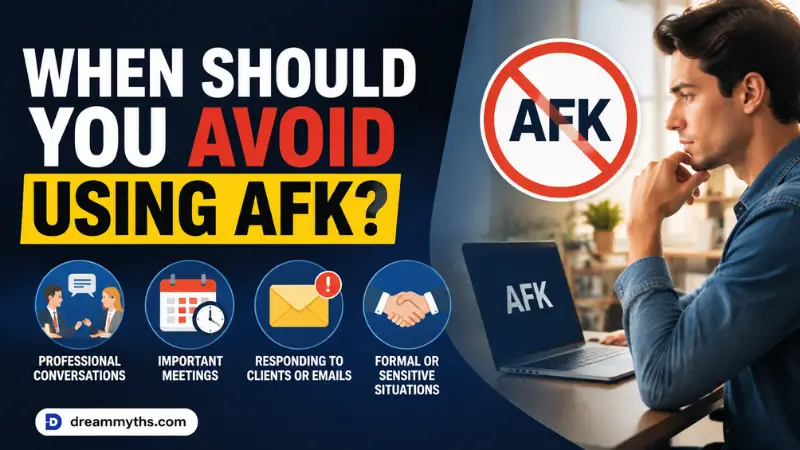
Avoid using AFK in:
- Job interviews
- Formal emails
- Academic assignments
- Customer communication
- Official documents
For example:
Instead of:
“I’ll be AFK during the meeting.”
Use:
“I’ll be unavailable during the meeting.”
The second version sounds more professional and works for a wider audience.
Frequently Asked Questions
Can I use AFK at work?
Yes, but only in casual workplace communication where internet slang is accepted.
For formal communication, phrases like “away from my desk” or “temporarily unavailable” are better choices.
Does AFK mean someone left forever?
No. AFK usually means someone is away for a short time. It does not mean that someone has permanently left a game, chat, or community.
Is AFK a bad word?
No. AFK is not offensive or inappropriate. It is a neutral internet abbreviation that describes temporary absence.
The meaning is generally harmless and depends on the situation where it is used.
What does AFK mean in gaming?
In gaming, AFK means a player is away from the game or not actively controlling their character. It is often used when someone needs to step away temporarily.
What does AFK mean in texting?
AFK means “away from keyboard” in texting. It tells someone that you are temporarily unavailable and may not respond immediately.
Even though the phrase mentions a keyboard, people commonly use AFK on phones and other devices today.
What is the opposite of AFK?
There is no single official opposite of AFK, but words like active, available, and online express the opposite idea.
For example:
“I’m online and available now.”
means the person is no longer AFK
Conclusion
The AFK meaning is “away from keyboard.” It is an informal internet abbreviation used to tell others that someone is temporarily away from their device, inactive in a conversation, or not participating in an online activity.
Although AFK started in computer and gaming communities, it has become a common expression across many digital spaces. People use it in texts, chats, gaming sessions, and online communities because it provides a quick way to explain their absence.
AFK is most appropriate for casual communication. It works well when chatting with friends, teammates, or online communities, but formal situations usually require clearer phrases such as “away from my desk” or “temporarily unavailable.”
Understanding the AFK meaning helps you communicate more naturally online and avoid confusion when someone suddenly stops responding. It is a small abbreviation, but it plays an important role in modern digital conversations.


