
If someone replies “BFFR” to a text, comment, or direct message, they are usually telling you to “be fucking for real.” In everyday language, the expression means something like “be serious,” “get real,” “stop exaggerating,” or “are you seriously saying that?” The extra profanity makes the expression more forceful than a simple “be for real.”
The BFFR meaning in text depends heavily on tone and context. Friends may use it jokingly when one person makes an obviously exaggerated claim, while strangers may use it as a blunt criticism. Because the phrase contains profanity, BFFR belongs to informal internet slang rather than professional or formal English.
Quick Answer
The BFFR meaning in text is usually “be fucking for real.” People use BFFR when they think someone is joking, exaggerating, lying, being unrealistic, or saying something difficult to believe. Depending on the relationship and context, BFFR can sound playful, sarcastic, annoyed, or confrontational. It is casual slang and is generally inappropriate for formal or professional communication.
What Does BFFR Stand For?
BFFR stands for “be fucking for real.” The phrase is an intensified version of “be for real,” which asks someone to be serious, honest, or realistic.
The BFFR meaning in text is therefore not simply “best friends forever” with an extra letter. The abbreviation uses the letters from the longer phrase:
- B = be
- F = fucking
- F = for
- R = real
Some writers censor the profanity and write “be fing for real,” “be fing for real,”** or another shortened form. Others use a cleaner interpretation such as “be for real” when they want to communicate the basic idea without explicitly writing the swear word.
Because BFFR is an initialism, people normally read the letters individually as “bee-eff-eff-are.” The abbreviation is primarily associated with casual digital communication rather than standard formal writing.
What Is the BFFR Meaning in Text?
The BFFR meaning in text is best understood as a strong request for someone to acknowledge reality or stop saying something the speaker considers unbelievable.
For example:
“You’re telling me you forgot your wallet again? BFFR.”
Here, BFFR means something close to “Seriously? Be for real.”
Another example:
“I can finish this entire project in 20 minutes.”
“BFFR 😭”
The second person is not necessarily angry. They may simply be teasing the first person because the claim sounds unrealistic.
This is an important part of the BFFR meaning in text: the abbreviation communicates attitude as well as literal meaning. The same four letters can sound funny between close friends but insulting when directed at someone during an argument.
How People Use BFFR in Text Messages
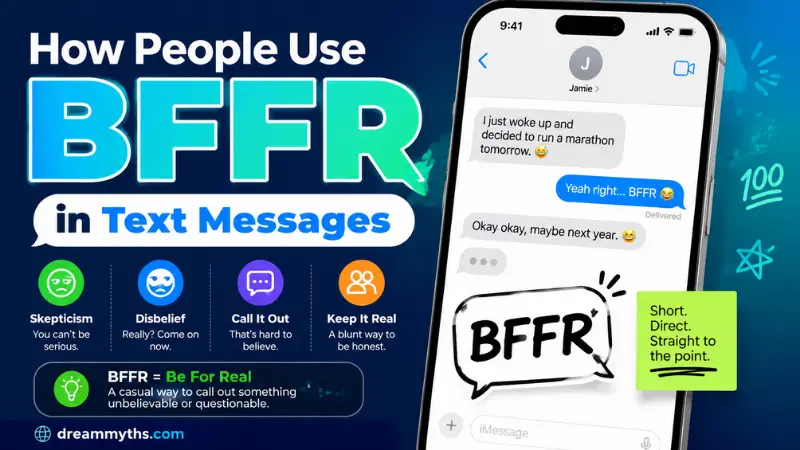
The BFFR meaning in text can appear in several closely related situations, but the common idea is disbelief or a demand for realism.
1. Calling out exaggeration
Someone might use BFFR when another person makes an exaggerated claim.
“I only studied for five minutes and got a perfect score.”
“BFFR.”
The response suggests that the speaker does not believe the claim or thinks important details are being left out.
2. Reacting to something unbelievable
BFFR can also work as a quick reaction to surprising or ridiculous information.
“He said he doesn’t know who Taylor Swift is.”
“BFFR.”
In this use, the speaker is expressing disbelief rather than literally giving a serious command.
3. Telling someone to be realistic
The expression can be more direct when someone proposes something unrealistic.
“I’m going to buy a house next month even though I have no savings.”
“BFFR.”
The intended message is essentially, “Come on, be realistic.”
4. Calling out dishonesty
The BFFR meaning in text can become more confrontational when the speaker believes someone is lying.
“I never saw your message.”
“BFFR. You replied to it.”
Here, BFFR means something like “Stop pretending that isn’t true.”
Dictionary.com specifically describes BFFR as something people use to accuse others of lying or exaggerating and to react negatively to something.
BFFR Meaning in Text Can Change With Tone
The BFFR meaning in text does not tell you exactly how the sender feels. Tone comes from the surrounding conversation, punctuation, emojis, and relationship between the people communicating.
A message such as:
“BFFR 😂”
is likely to feel lighter than:
“BFFR.”
The first may be playful teasing. The second can feel blunt or irritated.
Similarly, a friend might say:
“BFFR, you did not just eat the whole cake 😭”
That can be affectionate teasing rather than genuine hostility.
By contrast:
“BFFR. You know that’s not what happened.”
sounds much more serious.
This is why interpreting BFFR requires more than translating the letters. The BFFR meaning in text includes the social purpose of the message: disbelief, teasing, criticism, frustration, or a demand for honesty.
Is BFFR Rude?
BFFR can be rude because the full expression contains profanity and can directly challenge another person’s honesty or judgment.
The BFFR meaning in text is not automatically insulting, however. Close friends may use it casually without intending serious offense. The relationship, subject, and tone all matter.
For example, a friend who says:
“You think I’m going to wake up at 5 a.m. voluntarily? BFFR 😂”
is probably joking about themselves.
But telling a coworker:
“BFFR. That report was clearly your mistake.”
would sound disrespectful and unprofessional.
The safest rule is simple: use BFFR only in conversations where casual profanity and blunt language are already acceptable.
When Should You Use BFFR?
Use BFFR mainly in casual conversations with people who understand internet slang and are comfortable with informal language.
The BFFR meaning in text fits situations such as:
- joking with close friends
- reacting to an exaggerated claim
- expressing disbelief
- teasing someone
- calling out an obviously unrealistic statement
- reacting to a surprising social-media post
- making a sarcastic comment in a casual group chat
For example:
“You really think you’re going to run a marathon tomorrow after not training? BFFR.”
The phrase works because the situation is informal and the speaker is challenging an unrealistic expectation.
When Should You Avoid BFFR?
Avoid BFFR in professional, academic, formal, or sensitive communication.
The BFFR meaning in text includes profanity, so it can be inappropriate when you need to sound respectful or neutral.
Avoid it when messaging:
- a boss or manager
- a customer
- a professor or instructor
- a job recruiter
- a professional contact
- someone you do not know well
- someone discussing a serious or emotional issue
Instead of BFFR, use a phrase that matches the situation.
For example, replace:
“BFFR. That’s not realistic.”
with:
“I don’t think that’s realistic.”
Or replace:
“BFFR, are you serious?”
with:
“Are you serious?”
The meaning remains similar, but the tone becomes much more appropriate.
BFFR Meaning in Text vs. “Be For Real”
BFFR and “be for real” communicate nearly the same basic idea, but BFFR is more forceful because it represents a profane version of the expression.
The BFFR meaning in text is therefore closer to “be seriously for real” or “come on, be fucking serious,” depending on context.
Compare these examples:
“Be for real. You can’t expect me to believe that.”
“BFFR. You can’t expect me to believe that.”
The first sounds more neutral. The second sounds sharper and more emotionally charged.
The abbreviation BFR is also used online for “be for real.” BFFR adds the stronger profane element.
BFFR Meaning in Text vs. BFF
One common misunderstanding is confusing BFFR with BFF, which usually means “best friend forever.”
The BFFR meaning in text is completely different.
- BFF = best friend forever
- BFFR = be fucking for real
The final R changes the expression entirely. If someone writes “BFFR” after you make an unbelievable statement, they are almost certainly not talking about friendship.
For example:
“You really think I’m going to believe that? BFFR.”
That clearly expresses disbelief rather than affection.
Can BFFR Be Used as a Question?
Yes. BFFR can function as a standalone question or reaction.
For example:
“BFFR?”
In this form, the BFFR meaning in text is often close to “Are you serious?” or “You cannot be serious right now.”
The question mark can make the reaction feel more like disbelief or surprise. Without the question mark, the same abbreviation may sound more like a blunt command:
“BFFR.”
The difference is subtle, so the rest of the conversation matters more than punctuation alone.
BFFR Examples in Realistic Text Conversations
The BFFR meaning in text becomes easier to understand when you see it in different situations.
Example 1: Exaggeration
Maya: “I could totally memorize a 500-page book tonight.”
Jordan: “BFFR 😭”
Meaning: “Come on, be realistic.”
Example 2: Teasing
Alex: “I wasn’t nervous at all before the interview.”
Sam: “BFFR 😂”
Meaning: “We both know you were nervous.”
Example 3: Disbelief
Chris: “He said he has never heard of pizza.”
Taylor: “BFFR.”
Meaning: “Seriously? I don’t believe that.”
Example 4: Calling out an excuse
Riley: “I didn’t see your messages all day.”
Casey: “BFFR, you sent me a meme at noon.”
Meaning: “Stop pretending you didn’t see them.”
Example 5: Social-media reaction
Someone posts:
“I don’t think anyone likes chocolate.”
A commenter might respond:
“BFFR.”
Here, the comment expresses strong disagreement or disbelief in a casual, humorous way.
How to Reply to BFFR
How you respond to BFFR depends on why the person sent it.
If they are joking, you can joke back:
“Let me dream 😂”
If they are calling out an exaggeration, you can clarify:
“Okay, okay. I was exaggerating.”
If they misunderstood you, explain:
“I was being serious. I meant every word.”
If their message feels unnecessarily rude, you can stay neutral:
“You don’t have to be rude about it.”
Understanding the BFFR meaning in text helps you choose a response that matches the actual tone instead of assuming the sender is angry.
Does Capitalization Change BFFR?
No. BFFR and bffr generally carry the same meaning.
The BFFR meaning in text does not fundamentally change because of capitalization. Online writers may choose uppercase letters for emphasis or lowercase letters because lowercase texting feels more casual.
Compare:
“BFFR 😂”
and
“bffr lol”
Both can communicate the same basic idea. The surrounding words, punctuation, and emojis usually have more influence on tone than capitalization.
Is BFFR Slang?
Yes. BFFR is internet slang and an initialism used primarily in informal digital communication.
The BFFR meaning in text is strongly associated with texting, social-media conversations, comments, and other casual online spaces. Dictionary.com labels the expression as an abbreviation used in texting and social media, while Wiktionary classifies it as Internet slang and notes its vulgar character.
Because BFFR is slang, it should not be treated like a standard formal abbreviation. Its meaning depends partly on shared familiarity with online language.
Is BFFR Appropriate at Work?
Usually, no. BFFR is too informal and contains profanity, so it is generally a poor choice for workplace communication.
The BFFR meaning in text may be understood by a coworker, but understanding a phrase does not make it professionally appropriate. In a work message, choose language such as:
- “Are you serious?”
- “I don’t think that’s realistic.”
- “Could you clarify?”
- “I’m not sure that’s accurate.”
- “Let’s be realistic about the timeline.”
These alternatives communicate the same general idea without the profanity or confrontational edge.
Common Mistakes With BFFR
A common mistake is assuming that BFFR always means the same thing as BFF. It does not.
Incorrect:
“BFFR means best friends forever.”
Better:
“BFF means best friends forever; BFFR usually means be fucking for real.”
Another mistake is assuming that BFFR is always angry.
Incorrect assumption:
“If someone says BFFR, they are definitely mad.”
Better:
“BFFR can be playful, sarcastic, skeptical, annoyed, or confrontational depending on context.”
A third mistake is using BFFR in a formal setting simply because the recipient is familiar with slang. Familiarity does not remove the fact that BFFR is informal and profane.
Does BFFR Always Mean “Be Fucking for Real”?
In current internet slang, “be fucking for real” is the established meaning most relevant to a text-message query.
The BFFR meaning in text can occasionally be interpreted differently by individual users, especially when someone invents a personal abbreviation or uses unfamiliar slang. However, there is no good reason to assume an obscure expansion when the standard internet-slang meaning fits the conversation.
Some websites list alternative expansions, but they are not the dominant meaning supported by major slang and dictionary references. For ordinary texting, “be fucking for real” is the interpretation to recognize first.
Where Did BFFR Come From?
The exact history of BFFR is more complicated than a simple “one person invented it” story.
The BFFR meaning in text comes from the expression “be fucking for real,” which predates its current popularity as a short internet initialism. Dictionary.com notes that the underlying “be for real” expression has been used in slang for years and that the intensified form appeared in social-media use before becoming more widely recognizable online.
Some online cultural references document BFFR usage on Twitter/X years before its broader mainstream visibility. Know Your Meme, for example, documents early social-media examples and connects the later spread of the phrase with internet culture in the early 2020s.
Because internet slang develops through many communities at once, it is better to describe BFFR as an expression that developed through online slang and later became more widely recognizable than to claim a single definitive inventor.
Why Does BFFR Sound Strong?
The BFFR meaning in text feels stronger than “be for real” because the middle word adds profanity and emotional emphasis.
Compare:
“Be for real.”
with:
“BFFR.”
The second version can communicate greater disbelief, frustration, or incredulity. It is similar to adding emphasis in spoken language.
That extra force is useful when friends are joking around, but it is also why BFFR can easily sound hostile. The abbreviation may be short, but the social message behind it can be quite direct.
What Does BFFR Mean on Social Media?
On social media, BFFR often appears as a short reaction to a post, opinion, claim, or comment that someone considers ridiculous or unbelievable.
The BFFR meaning in text remains essentially the same in social-media comments: “be fucking for real.” The difference is that a public comment may be directed at someone the writer does not personally know.
For example, someone might post an obviously exaggerated opinion and receive:
“BFFR 💀”
The combination of BFFR with an emoji can make the response feel humorous, although it can still be dismissive.
The abbreviation has been documented in social-media slang references and mainstream coverage of online language.
BFFR and “FR”: What Is the Connection?
FR commonly means “for real,” while BFFR intensifies the idea into “be fucking for real.”
The BFFR meaning in text therefore belongs to the same family of informal expressions as “FR” and “BFR,” but the phrases do different jobs.
For example:
“FR?” can mean “For real?”
“BFR” can mean “Be for real.”
“BFFR” adds stronger emphasis and profanity.
You do not need to treat these expressions as exact synonyms in every sentence. Context determines which one sounds natural.
Is BFFR Offensive?
BFFR is not inherently an insult, but it is potentially offensive because it contains profanity and can be used to dismiss another person’s statement.
The BFFR meaning in text should therefore be treated as informal and potentially confrontational. Whether someone finds it offensive depends on the relationship, setting, and subject of the conversation.
Using BFFR among close friends may be completely normal for that group. Using the same phrase with a stranger, customer, teacher, or employer can create unnecessary conflict.
What Is the Best Plain-English Translation of BFFR?
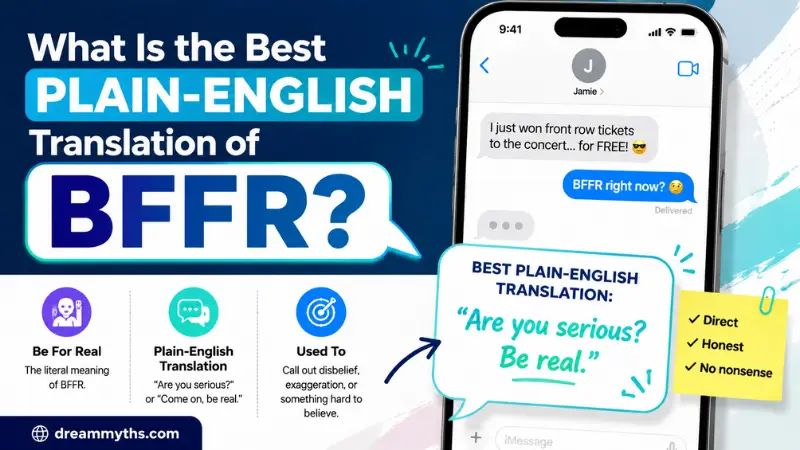
The closest plain-English translation depends on the situation.
The BFFR meaning in text can be expressed as:
- “Be serious.”
- “Get real.”
- “Are you serious?”
- “Come on.”
- “Stop exaggerating.”
- “You can’t seriously mean that.”
- “Be realistic.”
- “You’re not being serious.”
These alternatives are not exact replacements in every situation. BFFR carries a stronger, more casual attitude because of its slang form and profanity.
If you want the idea without the profanity, “be for real” is usually the closest softer alternative.
Frequently Asked Questions
What does BFFR mean from a girl or guy?
The basic BFFR meaning in text does not change based on who sends it. A girl or guy using BFFR is generally expressing disbelief, calling out exaggeration, or telling someone to be serious.
Is BFFR rude?
BFFR can be rude, but it is not always intended that way. Friends may use BFFR playfully, while the same expression can sound confrontational when used during an argument or toward someone you do not know well.
Is BFFR a bad word?
BFFR contains a swear word, so it is considered vulgar or profane slang. People often use it casually, but it should generally be avoided in professional and formal communication.
What does BFFR mean in text?
The BFFR meaning in text is usually “be fucking for real.” It is used when someone wants another person to be serious, honest, or realistic, often because a statement sounds exaggerated or unbelievable.
What should I reply when someone says BFFR?
Your response should match the context. If the person is joking, you can joke back; if they are challenging an exaggeration, you can clarify; and if the message feels disrespectful, you can respond calmly rather than escalating the conversation.
Is BFFR the same as BFF?
No. BFF normally means “best friend forever,” while BFFR usually means “be fucking for real.” The two abbreviations have different meanings and are used in different situations.
Can BFFR be used jokingly?
Yes. BFFR is often used jokingly between people who have a casual relationship. An emoji, laughing phrase, or obviously silly situation can make the message feel playful rather than hostile.
Conclusion
The BFFR meaning in text is usually “be fucking for real,” a blunt internet-slang expression used to show disbelief, call out exaggeration, or tell someone to be serious. It can be playful among friends, but it can also sound rude or confrontational.
The most important point is tone. BFFR is casual, profane, and context-dependent, so it works best in informal conversations where that style of language is already accepted. For work, school, customer service, or sensitive conversations, phrases such as “Are you serious?” or “I don’t think that’s realistic” are safer choices.


