
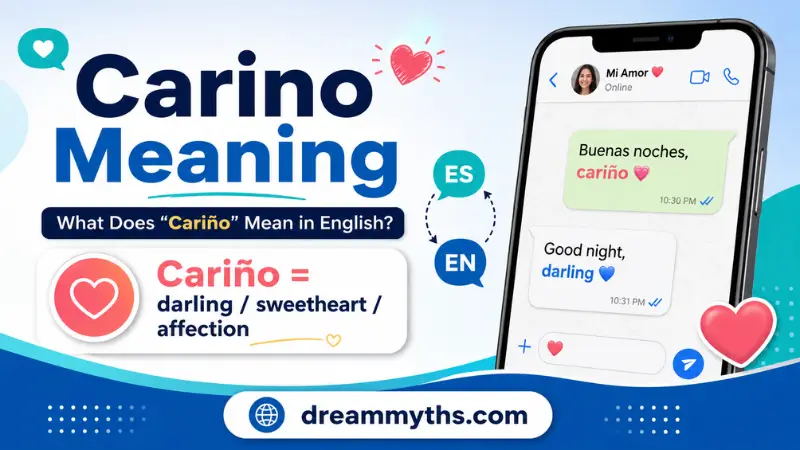
The carino meaning is most commonly connected with affection, fondness, tenderness, care, or a loving form of address. The correct Spanish spelling is cariño, with the letter ñ, although English speakers often type “carino” when they do not have an easy way to enter ñ. Spanish dictionaries translate cariño with words such as “affection,” “care,” “dear,” “honey,” “darling,” and “sweetheart,” depending on the context.
The carino meaning is broader than one simple English translation. Spanish speakers can use cariño to describe a feeling of affection toward a person, animal, or thing, to describe an affectionate gesture, or to address someone warmly. That range is important because “cariño” does not automatically mean romantic love.
In everyday Spanish, you might encounter cariño in a message from a romantic partner, a conversation between family members, or an affectionate expression toward someone close to you. Understanding the relationship and sentence around the word is the best way to identify the intended carino meaning.
Quick Answer
The carino meaning is usually affection, fondness, tenderness, or care. In Spanish, cariño can also be used as a term of endearment meaning “dear,” “darling,” “honey,” “sweetheart,” or “love.” It is not limited to romantic relationships. Depending on context, cariño can describe affection itself, affectionate treatment, or the person being addressed warmly.
What Is the Main Carino Meaning?
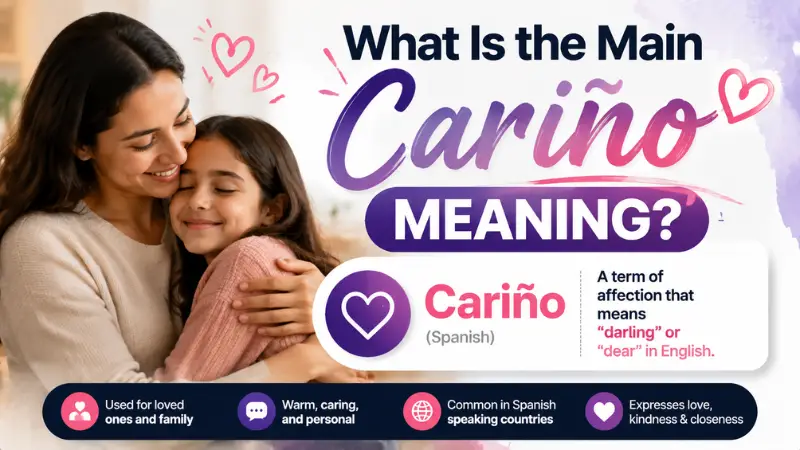
The main carino meaning is affection or fondness toward someone or something. As a Spanish noun, cariño describes a warm emotional attachment rather than a single specific type of love.
For example:
Siento mucho cariño por mi familia.
“I feel a lot of affection for my family.”
Here, the carino meaning refers to the speaker’s feelings toward their family. The word does not necessarily suggest romance. It can describe the emotional warmth someone feels for relatives, friends, animals, or even meaningful possessions. Spanish-language dictionaries define cariño in terms of affection, love, fondness, or attachment.
This is one reason a direct word-for-word translation can be misleading. Depending on the sentence, cariño may be better translated as affection, fondness, care, or love.
The broader carino meaning therefore centers on a feeling of warmth and attachment.
What Does Cariño Mean When Someone Calls You Cariño?
When someone calls you cariño, the carino meaning is usually a term of affection such as “dear,” “honey,” “darling,” “sweetheart,” or “love.” The word is being used to address a person rather than simply describe an emotion.
For example:
Hola, cariño.
“Hi, darling.”
Or:
¿Cómo estás, cariño?
“How are you, sweetheart?”
In these examples, cariño works similarly to affectionate forms of address in English.
The exact emotional tone depends on the relationship. A romantic partner may use cariño as a pet name, while a parent can use it with a child. SpanishDictionary also lists English equivalents such as “dear,” “honey,” “darling,” “sweetheart,” “love,” “baby,” and “babe,” showing how much the translation depends on context.
So, if someone sends you “Hola, cariño,” the carino meaning is probably closer to “Hi, dear” or “Hi, sweetheart” than the abstract noun “affection.”
Does Cariño Mean “Love”?
Yes, cariño can sometimes be translated as “love,” but the carino meaning is not exactly the same as the English word love in every situation.
SpanishDictionary gives “love” as one possible English translation when cariño is used as a term of endearment. Collins also translates the word as “darling” or “honey” in informal address.
Consider:
Te quiero mucho, cariño.
A natural translation could be:
“I love you very much, darling.”
Here, cariño adds an affectionate form of address. The phrase is not simply saying “affection”; it is addressing someone lovingly.
By contrast:
Tengo cariño por ese lugar.
would be closer to:
“I have affection for that place.”
The carino meaning changes because the grammatical and emotional context changes.
This is why translating cariño as “love” every time can create an unnatural English sentence.
Can Cariño Mean “Darling” or “Sweetheart”?
Yes. “Darling,” “sweetheart,” and “honey” are common English equivalents when cariño is used to address someone affectionately. This is one of the most recognizable uses of the carino meaning for English speakers.
For example:
Gracias, cariño.
“Thank you, sweetheart.”
Buenas noches, cariño.
“Good night, darling.”
Ven aquí, cariño.
“Come here, honey.”
The English translation can change depending on the speaker, listener, and situation. There is no single English equivalent that works naturally in every sentence.
That flexibility is a key feature of the carino meaning. The Spanish word carries the basic idea of affection, while English chooses a more specific expression based on context.
Is Cariño Romantic?
Cariño can be romantic, but it is not exclusively romantic. The carino meaning can express affection between romantic partners, but it can also appear in family relationships and other affectionate interactions. Spanish dictionaries explicitly describe cariño as a term of endearment and as a feeling of affection toward people, animals, or things.
For example, a romantic partner might say:
Te extraño, cariño.
“I miss you, darling.”
But a parent might also say:
¿Dormiste bien, cariño?
“Did you sleep well, sweetheart?”
The word itself does not prove that two people are romantically involved.
This matters when interpreting a text message. If someone calls you cariño, you should consider the entire relationship rather than assuming romantic interest from the word alone.
The carino meaning communicates affection, but the type of relationship supplies the additional meaning.
What Does Cariño Mean in Text Messages?
In text messages, the carino meaning is often a warm form of address similar to “dear,” “honey,” “darling,” or “sweetheart.” The same Spanish word used in speech can appear naturally in texting.
For example:
Buenos días, cariño ❤️
A natural English interpretation would be:
“Good morning, sweetheart ❤️”
Another message might say:
Gracias por ayudarme, cariño.
This could mean:
“Thanks for helping me, dear.”
The heart emoji can add warmth, but the word itself already carries an affectionate meaning.
Texting also makes context especially important. A romantic partner, parent, close relative, or friend may use cariño differently. The carino meaning should therefore be interpreted from the whole message rather than from the word alone.
What Does Cariño Mean on Social Media?
On social media, cariño can function as an affectionate form of address or as a way of expressing fondness. The carino meaning remains essentially the same, although the tone can become playful, warm, romantic, or conversational depending on the post and relationship.
For example:
Gracias por todo, cariño.
might be translated as:
“Thanks for everything, dear.”
Someone might also write:
Mi cariño para todos ustedes.
Here, the meaning is closer to “my affection” or “my love” for the people being addressed.
Unlike some internet abbreviations, cariño is not simply a piece of texting slang. It is a normal Spanish word that can be used in everyday speech and writing. The carino meaning therefore remains rooted in standard Spanish vocabulary.
How Do You Pronounce Cariño?
Cariño is commonly pronounced approximately “kah-REE-nyoh.” The ñ represents a sound similar to the “ny” sound heard in the English word “canyon.” Cambridge gives the pronunciation in phonetic form as /ka’ɾiɲo/.
A simple English approximation is:
kah-REE-nyoh
The middle sound is important. Cariño is not normally pronounced like an English word ending in “no.”
The spelling also matters. The standard Spanish form is:
cariño
not:
carino
When English speakers type without access to the ñ character, “carino” is commonly used as a simplified spelling. For accurate Spanish writing, however, cariño is the standard form.
Knowing the pronunciation helps clarify the carino meaning when you hear the word spoken rather than see it written.
Why Does the Letter Ñ Matter in Cariño?
The ñ in cariño is a distinct Spanish letter and represents the “ny” sound in the word. Therefore, the standard spelling of the word is cariño, not carino.
This distinction can be easy for English speakers to miss because English does not use ñ as a regular letter.
The spelling difference is especially relevant when someone searches for the carino meaning online. Searchers may omit the ñ because their keyboard does not make it convenient to type. That does not mean carino is the standard Spanish spelling.
For example:
Cariño, ¿cómo estás?
is the standard written form.
The missing ñ in:
Carino, ¿cómo estás?
is best understood as an informal keyboard substitution or spelling simplification when someone intended the Spanish word cariño.
Can Cariño Mean “Care”?
Yes. Cariño can mean “care” when it describes the gentle or attentive way someone treats a person or thing. This is another important part of the carino meaning that can disappear when the word is translated only as “darling.”
SpanishDictionary gives “care” as a translation in contexts involving particular or special attention.
For example:
La enfermera trató al paciente con cariño.
A natural translation is:
“The nurse treated the patient with care.”
The sentence is not necessarily romantic or intimate. Instead, cariño describes kindness, tenderness, and attentive treatment.
This illustrates why the carino meaning depends heavily on grammar and context.
Compare:
Hola, cariño.
with:
Lo hizo con cariño.
The first uses cariño as an affectionate form of address. The second means that something was done with care or affection.
Can Cariño Describe Affection Toward an Object?
Yes. The carino meaning can extend beyond people. Spanish uses cariño for affection or fondness toward animals, places, objects, and other things that someone feels attached to.
For example:
Tengo mucho cariño por este libro.
could be translated as:
“I have a lot of affection for this book.”
The speaker is not treating the book as a romantic partner. Instead, the object has emotional value to the speaker.
Another example:
Le tengo cariño a esta casa.
could mean:
“I’m fond of this house.”
This broader use shows that the carino meaning is fundamentally about emotional attachment and affection rather than romance alone.
Can Cariño Mean an Affectionate Gesture?
Yes. In some contexts, cariño can refer to an expression or gesture of affection, not just the feeling itself. Spanish dictionaries distinguish between the feeling of affection and its outward expression.
For example, hacer cariños can refer to showing affection through affectionate gestures or caresses.
This sense is less likely to be the intended carino meaning when an English speaker encounters cariño in a simple text such as:
Hola, cariño.
There, the word is almost certainly functioning as a term of endearment.
Context determines which sense is active.
What Is the Difference Between Cariño and Amor?
Cariño and amor both involve affection and love, but they are not interchangeable in every sentence. The carino meaning often emphasizes affection, tenderness, fondness, or an affectionate way of addressing someone, while amor more directly refers to love.
For example:
Siento cariño por mi perro.
means:
“I feel affection for my dog.”
A speaker could also use amor in a different construction to express love.
When cariño is used as a form of address:
Ven aquí, cariño.
the natural English equivalent is usually:
“Come here, sweetheart.”
The distinction is useful because someone learning Spanish may assume that every affectionate word means exactly the same thing as amor. The carino meaning is often softer or more focused on fondness and tenderness.
Is Cariño a Slang Word?
No, cariño is not simply slang. The carino meaning comes from an ordinary Spanish noun that is used in both everyday and affectionate contexts. It can function as standard vocabulary while also serving as an informal term of endearment. Spanish and English dictionaries list these uses directly.
That means cariño should not be treated like a temporary internet expression.
For English speakers, the closest comparison may be words such as honey, dear, or sweetheart. Those English expressions can also be ordinary words that take on an affectionate function.
The carino meaning is therefore better described as affectionate and conversational, rather than simply “slang.”
Is Cariño Formal or Informal?
The carino meaning can occur in normal Spanish, but using cariño as a direct form of address is generally affectionate and conversational. SpanishDictionary and WordReference identify this use as conversational or informal.
For example:
Gracias, cariño.
sounds personal and warm.
In a formal business setting, addressing a stranger as cariño would not normally be the safest choice. The appropriate level of familiarity depends on the relationship and regional language habits.
This does not make the word inappropriate. It simply means that the carino meaning carries interpersonal warmth that may not fit every situation.
Is Cariño Always a Romantic Nickname?
No. Cariño is not automatically a romantic nickname. The carino meaning can apply to partners, family members, children, friends, and other people toward whom someone feels affection.
For example, a parent could say:
Ven, cariño.
meaning:
“Come here, sweetheart.”
A partner might say:
Buenas noches, cariño.
meaning:
“Good night, darling.”
The same Spanish word appears in both examples, but the relationship changes the emotional interpretation.
If you receive cariño from someone, avoid assuming that the word alone proves romantic interest. The carino meaning establishes affection, while the broader context determines what kind of affection is intended.
Common Phrases Using Cariño
Learning common expressions is one of the easiest ways to understand the carino meaning in real Spanish.
Hola, cariño
Meaning: “Hi, dear,” “Hi, sweetheart,” or “Hi, darling.”
This is a common affectionate greeting.
Gracias, cariño
Meaning: “Thanks, honey,” “Thanks, dear,” or “Thank you, sweetheart.”
The exact English choice depends on the relationship.
Buenas noches, cariño
Meaning: “Good night, darling” or “Good night, sweetheart.”
This expression is often affectionate and personal.
Te extraño, cariño
Meaning: “I miss you, darling.”
Here, cariño adds an affectionate form of address.
Con cariño
Meaning: “With affection,” “with love,” or “affectionately.”
This expression focuses on the feeling rather than directly addressing a person.
Con todo mi cariño
Meaning: “With all my affection” or “with all my love.”
The phrase can be used in personal messages and other warm contexts.
These examples show how the carino meaning can shift slightly depending on whether the word describes a feeling, an action, or a person being addressed.
How to Use Cariño Correctly
If you want to use cariño in Spanish, the safest approach is to match the word to the relationship and sentence.
When addressing someone affectionately, you can say:
Hola, cariño.
When describing affection, you can say:
Siento mucho cariño por ella.
When describing care or tenderness:
Lo hizo con cariño.
These three sentences demonstrate different parts of the carino meaning.
The word can also appear after another phrase:
Gracias, cariño.
Spanish does not require you to translate cariño into one fixed English word. Choose the English equivalent that best matches the context.
Common Mistakes With the Carino Meaning
Mistake 1: Assuming Cariño always means “love”
Better: Think of cariño as a word covering affection, fondness, care, tenderness, and affectionate address.
“Love” can be correct in some contexts, but it is not the only translation. The carino meaning is broader.
Mistake 2: Assuming Cariño always means “darling”
Better: Check whether cariño is describing a feeling or addressing someone.
In:
Hola, cariño.
“darling” works naturally.
But:
Siento cariño por mi familia.
means something closer to:
“I feel affection for my family.”
Mistake 3: Assuming Cariño is always romantic
Better: Look at the relationship.
Family members and other close people can use affectionate forms of address. The carino meaning does not automatically indicate romance.
Mistake 4: Forgetting the ñ
Better: Write cariño when using standard Spanish spelling.
“Carino” is a common way English speakers search for or type the word, but the standard Spanish spelling contains ñ.
Mistake 5: Treating Cariño as internet slang
Better: Recognize cariño as an established Spanish word that can be used affectionately in everyday communication.
Its use in texts and social media does not make the carino meaning purely internet slang.
Carino Meaning in Different Contexts
| Context | Likely meaning | Natural English equivalent |
|---|---|---|
| Cariño, ven aquí. | Affectionate address | Dear, sweetheart |
| Siento cariño por él. | Affection or fondness | Affection, fondness |
| Lo trató con cariño. | Care and tenderness | With care |
| Gracias, cariño. | Affectionate address | Thanks, honey |
| Tengo cariño a esa casa. | Emotional attachment | I’m fond of that house |
| Con cariño | Affectionate manner | With affection, with love |
The table makes the carino meaning easier to understand because the English translation changes according to the role of the word in the sentence.
What Does “Con Cariño” Mean?
“Con cariño” means “with affection,” “with love,” or “affectionately,” depending on the context. It expresses the manner in which something is done or communicated.
For example:
Hice este regalo con cariño.
A natural translation is:
“I made this gift with love.”
Here, the carino meaning is about the affection behind the action rather than a nickname.
This phrase can be useful for understanding why translating every occurrence of cariño as “darling” is inaccurate.
What Does “Mi Cariño” Mean?
“Mi cariño” literally means “my affection” or “my love,” although the most natural English translation depends on the sentence. The carino meaning here is possessive: mi means “my,” while cariño refers to affection or an affectionate feeling.
For example:
Te mando todo mi cariño.
can be translated naturally as:
“I’m sending you all my love.”
or:
“Sending you all my affection.”
The English translation changes because English and Spanish do not divide affectionate vocabulary in exactly the same way.
What Does “Cariños” Mean?
Cariños is the plural of cariño and can refer to expressions or acts of affection. SpanishDictionary lists cariños as the plural form and provides examples involving affectionate gestures and expressions.
For example:
Muchos cariños.
can be used to convey warm affection or loving regards in appropriate contexts.
The plural form should not be confused with the singular term used as a direct form of address:
Cariño, ¿cómo estás?
Here, cariño is singular.
Understanding the plural helps complete the broader carino meaning and its grammatical use.
What Is the Best English Translation of Cariño?
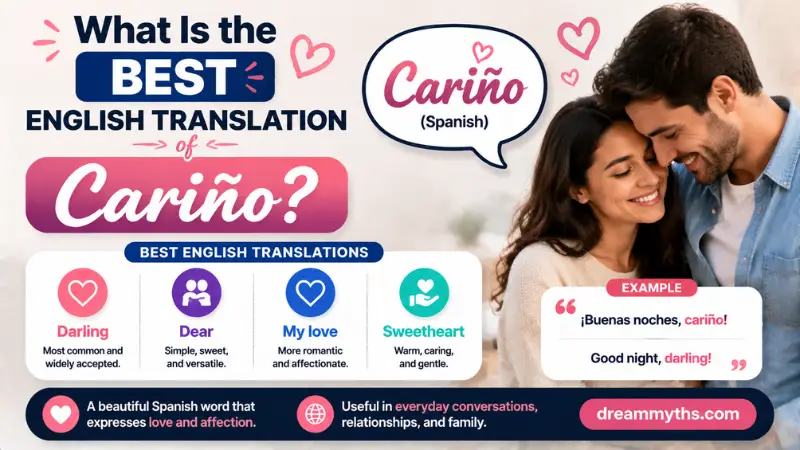
There is no single English translation that works in every situation. The carino meaning can correspond to affection, fondness, care, love, dear, darling, honey, sweetheart, babe, or similar affectionate expressions, depending on how the Spanish word is used.
A useful translation guide is:
- Feeling toward someone: affection, fondness, love
- Affectionate treatment: care, tenderness
- Addressing someone: dear, darling, honey, sweetheart
- Warm sign-off or expression: love, affection
Rather than memorizing one English equivalent, focus on the situation.
That approach gives you a much more accurate understanding of the carino meaning.
Frequently Asked Questions
What does carino mean in Spanish?
The carino meaning is usually affection, fondness, tenderness, or care. With the standard Spanish spelling cariño, the word can also be used as an affectionate form of address meaning “dear,” “darling,” “honey,” or “sweetheart.”
Is cariño a romantic word?
Not necessarily. The carino meaning can be romantic when used between partners, but family members and other close people can also use cariño affectionately. The relationship and surrounding conversation determine the tone.
What does cariño mean from a girl or guy?
If someone calls you cariño, the carino meaning is generally an affectionate form of address such as “dear,” “sweetheart,” or “honey.” The word alone does not establish whether the person has romantic feelings for you.
What does cariño mean in a text?
In a text, cariño often means “dear,” “darling,” “honey,” or “sweetheart.” The carino meaning depends on who sent the message and the relationship between the people communicating.
Is carino the correct spelling?
The standard Spanish spelling is cariño, with ñ. “Carino” is commonly typed by people using keyboards without easy access to ñ, which also explains why many English-language searches use the spelling “carino meaning.”
Does cariño mean “I love you”?
No, not by itself. Cariño can express affection and can be used alongside expressions of love, but it does not literally mean the complete phrase “I love you.” The carino meaning is broader and can refer to affection, fondness, care, or an affectionate nickname.
Is cariño formal?
Cariño is generally warm and personal rather than formal when used as a form of address. The carino meaning is appropriate in many personal and conversational situations, but using it with a stranger or in a formal professional setting may be too familiar.
Conclusion
The carino meaning is centered on affection, fondness, tenderness, care, and emotional warmth. The standard Spanish spelling is cariño, and the word can function as a noun describing affection or as an affectionate way of addressing someone.
When cariño is used as a nickname, natural English translations include “dear,” “darling,” “honey,” “sweetheart,” and “love.” When it describes a feeling, translations such as “affection,” “fondness,” or “care” are often more accurate.
The most important point is that the carino meaning is not automatically romantic. A partner, parent, family member, or another close person may use cariño affectionately. Context, relationship, and sentence structure determine the intended meaning.
If you remember one rule, make it this: cariño expresses affection, but English chooses the exact translation according to context. That simple distinction makes the carino meaning much easier to understand and use correctly.