

Anjin (按針, あんじん) is a historical Japanese maritime term meaning “pilot,” “ship’s pilot,” or “navigator.” The word is associated with the person responsible for determining and guiding a vessel’s course, particularly through navigation methods involving a magnetic compass.
For English-speaking readers, Anjin is best known because of William Adams, the English navigator who arrived in Japan in 1600 and later became known as Miura Anjin. The term gained even wider recognition through James Clavell’s Shōgun and its television adaptations, where the fictional character John Blackthorne is based on Adams.
One important distinction clears up much of the confusion surrounding the word:
Anjin does not mean “samurai.”
Its historical meaning is connected to ship piloting and navigation. William Adams’s later status in Japan is a separate part of his story.
Quick Answer: What Does Anjin Mean?
Anjin meaning is primarily “pilot,” “ship’s pilot,” or “navigator” when written 按針 in Japanese.
It is a historical maritime term rather than common modern Japanese slang. The word is strongly associated with William Adams, who became known as Miura Anjin after arriving in Japan in 1600.
In Shōgun, Anjin refers to John Blackthorne’s profession as an English pilot and navigator. Blackthorne is a fictional character based on William Adams.
There is also another Japanese word that can be pronounced anjin: 安心. In Buddhist contexts, this reading can describe spiritual peace or a settled state of faith. In everyday modern Japanese, however, 安心 is normally pronounced anshin and means peace of mind, reassurance, or relief.
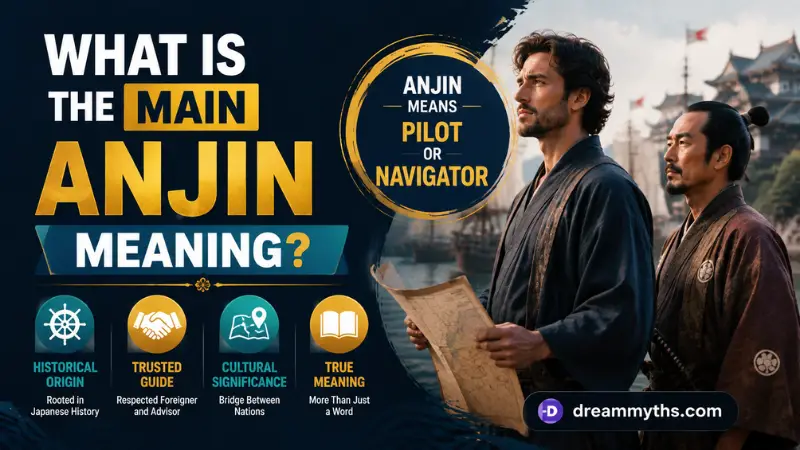
What Is the Main Anjin Meaning?
The primary historical anjin meaning is a ship’s pilot or navigator.
The Japanese term 按針 belongs to older maritime vocabulary. Japanese dictionary definitions connect it with determining a ship’s course and using a magnetic compass for navigation. The word can describe both the navigation work itself and the person responsible for performing it.
For an English-speaking audience, several translations can work depending on the context:
- Pilot
- Ship’s pilot
- Navigator
- Navigation officer
Of these, pilot is particularly useful when discussing Shōgun, while navigator can make the historical responsibility clearer to modern readers.
The important point is that an anjin was not simply any person who worked on a ship.
A sailor could perform many different duties aboard a vessel. An anjin had a more specialized role involving navigation and the guidance of the ship.
What Did an Anjin Do?
An anjin was associated with determining the vessel’s direction and managing its course during a voyage.
Historical navigation could involve tools such as:
- Magnetic compasses
- Astronomical observations
- Knowledge of sea routes
- Direction and distance calculations
- Experience with maritime conditions
This helps explain why translating anjin simply as “sailor” can be misleading.
A more precise definition is:
Anjin (按針) = a historical Japanese term for a ship’s pilot or navigator.
Is Anjin a Japanese Word or a Personal Name?
Anjin is both a Japanese word and part of a famous historical name.
When written 按針, it has its own lexical meaning related to navigation. In Miura Anjin (三浦按針), however, it appears as part of the name associated with William Adams.
This dual use can be confusing for English readers.
Someone unfamiliar with Japanese history may assume that Anjin was simply William Adams’s Japanese first name. That is not the complete story.
The historical word existed independently of Adams.
William Adams became strongly associated with it because he was a navigator. His Japanese name, Miura Anjin, preserved that connection.
So these two statements are not equivalent:
Anjin means William Adams.
and:
William Adams became known as Miura Anjin.
The second is accurate. The first incorrectly turns a historical occupational term into a person’s name.
Why Is Anjin Associated With William Adams?
The most famous person connected with anjin is William Adams, an English navigator who reached Japan in 1600.
Adams arrived aboard the Dutch ship Liefde during a period when Japan was entering a major political transition. His knowledge of ships, navigation, and European maritime practices made him unusual and valuable to Japanese authorities.
He eventually became associated with Miura Anjin, the name by which he was known in Japan.
His story is therefore central to understanding why the word anjin remains familiar to English-speaking readers.
The connection can be simplified as:
William Adams → English navigator → Miura Anjin → historical association with 按針
Did Anjin Originally Mean William Adams?
No.
Anjin was a maritime term before it became closely associated with William Adams.
Adams did not create the word. Instead, his profession and historical circumstances made him one of the most famous people associated with it.
This distinction matters because many modern references introduce the word through Adams rather than through Japanese maritime history.
A useful way to remember it is:
Anjin is the word; Miura Anjin is the historical name associated with William Adams.
Does Anjin Mean Samurai?
No. Anjin does not mean samurai.
This is probably the most common misunderstanding surrounding the term.
William Adams eventually received an important position under Tokugawa Ieyasu and is often described in English-language historical accounts as a foreigner who became a samurai. That part of his biography is real and historically significant.
However, it does not change what 按針 means.
The two concepts describe different things:
| Term | Meaning |
|---|---|
| Anjin (按針) | Historical ship pilot or navigator |
| Samurai | A member of Japan’s historical warrior class |
William Adams can therefore be discussed in connection with both terms without treating them as synonyms.
His anjin identity relates to his maritime expertise.
His later samurai status relates to his position in Japanese society.
Why Does This Confusion Happen?
The confusion largely comes from modern retellings of Adams’s life.
People often encounter Adams through stories about his remarkable transformation from a foreign navigator into someone who gained status in Tokugawa Japan. Because those stories emphasize his later position, readers may accidentally associate the word Anjin with the samurai identity.
But historically, the meanings should remain separate.
Anjin = navigator or pilot.
Samurai = warrior status.
What Does Anjin Mean in Shōgun?
If you discovered the word through Shōgun, Anjin means “pilot.”
John Blackthorne is the fictional protagonist of the story and is based on William Adams. He arrives in Japan as an English pilot, and his maritime expertise becomes an important part of his identity.
The name Anjin therefore reflects his occupation.
It does not mean:
- Foreigner
- Englishman
- Samurai
- Warrior
- Prisoner
- Sailor in general
It refers specifically to his role as a pilot or navigator.
Why Is Blackthorne Called Anjin?
Blackthorne arrives in Japan with professional knowledge that is valuable precisely because he understands ships and navigation.
Calling him Anjin identifies him through that expertise.
This also creates a direct historical connection to William Adams, whose Japanese name was Miura Anjin.
For a viewer who does not know Japanese history, the title may initially seem like a personal name. Once the meaning is understood, however, the connection becomes much clearer.
Why Is the First Episode Called “Anjin”?
The title “Anjin” highlights Blackthorne’s identity as a pilot.
It also signals the historical foundation of the character. Blackthorne is fictional, but his circumstances and profession draw heavily from the life of William Adams.
Understanding the word therefore adds another layer to the opening of Shōgun.
Is Anjin a Modern Japanese Word?
按針 is primarily a historical and specialized Japanese term.
It should not be treated as the ordinary modern Japanese word for every kind of pilot.
Japanese has modern vocabulary for contemporary occupations and forms of navigation. The historical term 按針 belongs to a particular maritime and historical context.
You are most likely to encounter it when reading about:
- William Adams
- Miura Anjin
- Tokugawa-era Japan
- Historical navigation
- Chinese or Western ships entering Japan
- Early Japanese-European contact
- Japanese maritime history
- Shōgun
This is why the word can feel familiar in historical English-language writing while being unfamiliar in ordinary modern Japanese conversation.
Is Anjin Slang?
No. 按針 is not best understood as modern Japanese slang.
It is a historical maritime term with a specific meaning.
If someone uses anjin in an online username, fictional setting, game, fan community, or modern conversation, the context could give it a different intended meaning. But there is no strong reason to treat the historical word 按針 itself as mainstream Japanese slang.
For historical discussions, the safest definition remains:
Anjin (按針) is a historical Japanese term for a ship’s pilot or navigator.
What Is the Difference Between Anjin and Sailor?
Anjin and sailor are not exact synonyms.
The English word sailor is broad. It can describe almost anyone who works aboard a ship.
An anjin, by contrast, had a more specialized connection with navigation and piloting.
| Word | Basic meaning |
|---|---|
| Sailor | General person who works aboard a ship |
| Navigator | Person responsible for determining or managing a vessel’s course |
| Pilot | Person who guides a vessel |
| Anjin (按針) | Historical Japanese term for a ship’s pilot or navigator |
This distinction is especially important when writing about William Adams.
Calling him simply a “sailor” is not necessarily wrong in a broad sense, but it does not explain why he was called Anjin.
His specialized navigation knowledge was central to the term.
Can Anjin Have Another Meaning?
Yes.
This is where Japanese writing becomes especially important.
The Romanized spelling anjin can represent different Japanese words. The historical maritime term is 按針, but another word, 安心, can also be read anjin in certain Buddhist contexts.
These words are not interchangeable.
按針 — Anjin
按針 (あんじん) refers to the historical maritime role of a pilot or navigator.
Its context is navigation, ships, and maritime history.
安心 — Anjin in Buddhist Usage
安心 (あんじん) can have a Buddhist meaning related to spiritual peace, freedom from doubt, or settled faith.
This is a different word from maritime 按針.
The same kanji, 安心, is normally read anshin (あんしん) in modern everyday Japanese. In that common usage, it can mean:
- Peace of mind
- Relief
- Reassurance
- Security
- A feeling of being safe
Anjin Meaning by Kanji
| Japanese | Reading | Meaning | Context |
|---|---|---|---|
| 按針 | anjin | Pilot or navigator | Historical maritime |
| 安心 | anjin | Spiritual peace or settled faith | Buddhist terminology |
| 安心 | anshin | Peace of mind or reassurance | Modern everyday Japanese |
This is why context and kanji matter when interpreting the word.
Why Does the Kanji Matter?
Japanese romanization can hide distinctions that are obvious in Japanese writing.
If someone writes only:
anjin
an English reader cannot immediately know which Japanese word is intended.
But:
按針
clearly points toward the historical maritime term.
Meanwhile:
安心
belongs to a different vocabulary item.
The distinction becomes even more important because 安心 is normally pronounced anshin in modern Japanese, while its Buddhist usage can be read anjin.
Therefore, the spelling in Roman letters alone is not always enough.
When possible, include the kanji and context when explaining the word.
How Do You Pronounce Anjin?
Anjin is written あんじん in hiragana.
For English speakers, a rough pronunciation is:
ahn-jeen
This is only an approximate guide because Japanese pronunciation does not map perfectly onto English spelling.
The word should also be distinguished from anshin:
- Anjin — あんじん
- Anshin — あんしん
The historical maritime term 按針 is pronounced anjin.
The common modern word 安心 is normally pronounced anshin, although Japanese Buddhist terminology can use the reading anjin.
How Do You Use Anjin Correctly?
Use anjin when the Japanese historical term itself is important to the discussion.
For example:
William Adams became known as Miura Anjin in Japan.
The historical anjin was responsible for navigating the vessel.
In Shōgun, Blackthorne is called Anjin because he is a pilot.
The term anjin referred to a specialized maritime role.
These examples make the historical meaning clear.
When Should You Use “Pilot” Instead?
If your readers are unfamiliar with Japanese history, pilot or navigator will usually be easier to understand.
For example:
The anjin guided the ship.
is understandable, but:
The ship’s pilot guided the vessel.
is clearer for a general English audience.
When your article is specifically explaining Japanese vocabulary, however, anjin is the correct term to discuss.
A useful rule is:
Use anjin when discussing the Japanese term; use pilot or navigator when simply describing the occupation in English.
What Does Miura Anjin Mean?
Miura Anjin (三浦按針) is the historical name associated with William Adams.
The name is important because it combines the name Miura with Anjin, the maritime designation connected with his profession.
For English-speaking readers, it is useful to separate the historical name from the dictionary meaning:
Miura Anjin = the name associated with William Adams.
Anjin (按針) = a historical Japanese term meaning pilot or navigator.
This distinction prevents the word from being misunderstood as though it were simply a Japanese personal name with no independent meaning.
Why Is Anjin Important to Understanding Shōgun?
Knowing the meaning of Anjin makes Shōgun easier to understand.
John Blackthorne is introduced as an English pilot whose knowledge of navigation and European ships becomes important after his arrival in Japan.
Because Anjin means pilot in this historical context, the name immediately identifies a central part of Blackthorne’s role.
The word also connects the fictional story with the real history of William Adams.
This is one reason the term has become much more recognizable among English-speaking audiences in recent years.
Anjin and William Adams: Historical vs. Fictional
The distinction between history and fiction is important.
William Adams was a real English navigator who arrived in Japan in 1600.
John Blackthorne is the fictional character created for Shōgun and is based on Adams.
Therefore:
- Adams was a real historical figure.
- Blackthorne is a fictional character.
- Miura Anjin is the historical name associated with Adams.
- Anjin is the maritime term connected with piloting or navigation.
Understanding these four points prevents several common misconceptions.
Is Anjin Used Outside Shōgun?
Yes.
Although Shōgun has introduced the term to many modern English-speaking viewers, anjin is not a word created for the series.
Its historical use predates the novel and television adaptations by centuries.
You may encounter Anjin in discussions of:
- William Adams
- Japanese maritime history
- Tokugawa Japan
- Early Western contact with Japan
- Historical navigation
- Japanese historical names
- Museums and historical sites connected with Adams
- Shōgun
The television series simply provides a highly visible modern context for a much older historical term.
When Should You Avoid Using Anjin?
Avoid using anjin as a decorative substitute for ordinary English words when the Japanese term adds no useful information.
For example:
The anjin was responsible for the ship’s route.
For a general audience, this is less clear than:
The navigator was responsible for the ship’s route.
However, if you are specifically explaining Japanese maritime history, the original term is valuable:
In historical Japanese sources, an anjin was a navigator or ship’s pilot.
The basic rule is straightforward:
Use the Japanese term when the term itself matters. Use the English equivalent when clarity matters more than terminology.
Common Misunderstandings About Anjin
1. Anjin Means Samurai
This is incorrect.
Anjin (按針) means a historical ship pilot or navigator.
William Adams’s later association with the samurai class is a separate historical fact.
2. Anjin Means Sailor
This is only partly accurate and lacks precision.
A sailor is a general member of a ship’s crew. Anjin refers more specifically to navigation and piloting.
3. Anjin Is Modern Japanese Slang
There is no strong basis for treating historical 按針 as ordinary modern slang.
It is better classified as historical or specialized maritime vocabulary.
4. Every Anjin Has the Same Meaning
Not necessarily.
按針 and 安心 can both be represented as anjin in Roman letters, but they are different Japanese words.
The kanji and context must be checked.
5. Anjin Is Simply William Adams’s First Name
This is incomplete.
Miura Anjin is the historical name associated with William Adams, but 按針 also exists as an independent Japanese maritime term.
6. Anjin Means “Foreigner”
It does not.
Blackthorne is a foreigner in Shōgun, but Anjin identifies him through his occupation as a pilot, not his nationality.
Anjin vs. Pilot: Which Word Should You Use?
For most American English readers, pilot is the simplest translation of historical anjin.
| Situation | Best wording |
|---|---|
| Discussing William Adams | Miura Anjin |
| Explaining the Japanese term | anjin (按針) |
| Writing for a general audience | pilot |
| Explaining navigation duties | navigator |
| Discussing historical Japanese ships | anjin, with an English explanation |
| Explaining Shōgun | pilot |
A strong sentence for general readers is:
William Adams became known in Japan as Miura Anjin, a name connected with his role as a ship’s pilot.
This gives readers both the historical term and its English meaning without creating unnecessary confusion.
Anjin Meaning in Plain English
If you need the shortest explanation, remember:
Anjin (按針) is an old Japanese term for a ship’s pilot or navigator.
The William Adams connection can then be added:
William Adams became known as Miura Anjin after arriving in Japan.
And the Shōgun connection follows:
John Blackthorne is the fictional character based on Adams and is called Anjin because he is a pilot.
That is the core meaning without the extra confusion surrounding samurai status or modern Japanese slang.
Related Japanese Terms and Historical Ideas
Several names and words commonly appear alongside anjin.
Miura Anjin
The historical name associated with William Adams.
William Adams
The English navigator who arrived in Japan in 1600 and became an important historical figure during the Tokugawa period.
按針
The kanji for the historical maritime term meaning pilot or navigator.
安心
A different Japanese word. In modern everyday Japanese it is normally pronounced anshin and refers to peace of mind, reassurance, or relief. In Buddhist terminology, it can be read anjin and carry a spiritual meaning.
John Blackthorne
The fictional English pilot in Shōgun, based on William Adams.
These terms are related through history and storytelling, but they should not be treated as interchangeable.
Frequently Asked Questions About Anjin
Why is William Adams called Anjin?
William Adams was an English navigator who arrived in Japan in 1600. He became known as Miura Anjin, with Anjin referring to the maritime role associated with his navigation expertise.
What does Anjin mean in Shōgun?
In Shōgun, Anjin means “pilot.” It refers to John Blackthorne’s profession as an English ship pilot and navigator.
What does anjin mean in Japanese?
Anjin (按針) is a historical Japanese maritime term meaning pilot, ship’s pilot, or navigator.
Does Anjin mean samurai?
No. Anjin means pilot or navigator in the historical maritime sense. William Adams’s later status as a samurai is separate from the meaning of the word.
Is Anjin a Japanese name?
It can appear as part of a historical name, especially Miura Anjin, but 按針 also has an independent dictionary meaning connected with navigation.
Is Anjin Japanese slang?
No. 按針 is best understood as historical or specialized maritime vocabulary, not mainstream modern Japanese slang.
Is Anjin still commonly used in Japan?
The historical maritime term 按針 is not ordinary everyday vocabulary. It is more likely to appear in historical discussions, names, literature, and material related to William Adams.
How do you pronounce Anjin?
Anjin is written あんじん and can be approximated in English as “ahn-jeen.”
Can Anjin mean peace of mind?
A different Japanese word, 安心, can be read anjin in Buddhist contexts and can refer to spiritual peace or settled faith. In modern everyday Japanese, 安心 is normally pronounced anshin and means peace of mind, reassurance, or relief.
Is Anjin the same as navigator?
In the historical maritime sense, anjin can be translated as navigator or pilot. “Pilot” is particularly appropriate when explaining its use in Shōgun.
Conclusion
Core Definition: Anjin (按針) is a historical Japanese maritime term meaning “ship’s pilot” or “navigator.”
Historical Connection: Associated with William Adams (Miura Anjin), the English navigator who landed in Japan in 1600.
Pop Culture: Used in Shōgun to refer to John Blackthorne’s role as a pilot.
Key Distinction: Anjin describes an occupation, not a rank. It does not mean samurai, even though Adams later became one.
Kanji Variations: Written as 安心 (usually pronounced anshin), it can mean “peace of mind” or “spiritual faith” in Buddhist contexts, making context essential when reading Romanized Japanese.


