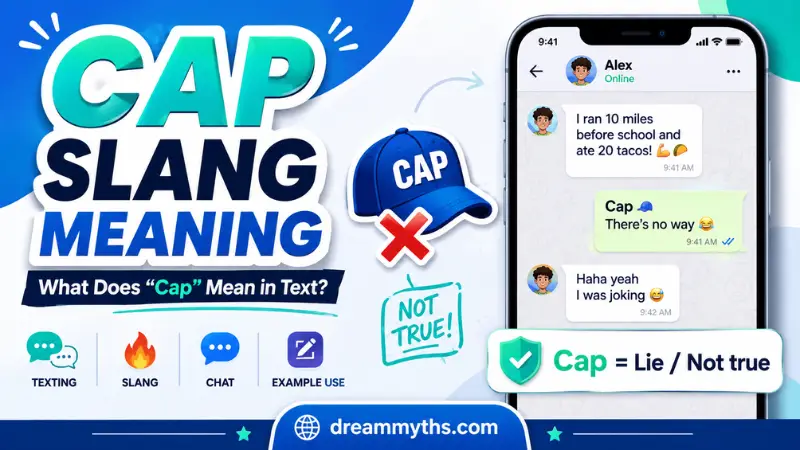
The cap slang meaning usually refers to a lie, false claim, or exaggeration. When someone responds to a message with “cap” or “that’s cap,” they are usually saying that they do not believe what another person has said.
The word can be confusing because cap already has several standard meanings in American English. A cap can be a hat, a cover, or a limit. In informal slang, however, cap has a different meaning connected with truthfulness, boasting, and exaggeration.
You may encounter cap, capping, capped, and no cap in texts, social media comments, memes, videos, and casual conversations. The expressions are closely related, but each has a slightly different grammatical role and use.
Understanding the cap slang meaning is especially useful when a short online reply seems confusing. A single word such as “cap” can effectively mean, “I don’t believe you,” while “no cap” can mean, “I’m being completely serious.”
Quick Answer
The cap slang meaning is usually a lie, false statement, or exaggeration. “That’s cap” means “That’s not true” or “I don’t believe you,” while “you’re capping” means “You’re lying or exaggerating.” The opposite phrase, “no cap,” means “seriously,” “honestly,” or “I’m telling the truth.” Cap is informal slang used mainly in casual speech, texting, and social media.
What Does Cap Mean in Slang?
The main cap slang meaning is something that is not true, especially a claim that sounds like a lie, boast, or exaggeration. Cambridge Dictionary lists the slang noun cap as something someone says that is not true, while its slang verb means to tell a lie.
For example:
“I finished the entire project in 15 minutes.”
Someone might answer:
“Cap.”
The person responding is saying that the claim sounds untrue or exaggerated.
The expression does not always mean the speaker is deliberately deceiving someone. In casual conversation, cap can also be used when a person thinks someone is boasting or stretching the truth.
For example:
“I can beat anyone here at basketball.”
A friend might respond:
“Bro, that’s cap.”
The friend may not be accusing the speaker of serious dishonesty. The response could simply mean, “You’re exaggerating.”
That difference is important. The cap slang meaning depends partly on tone, relationship, and context.
What Does “That’s Cap” Mean?
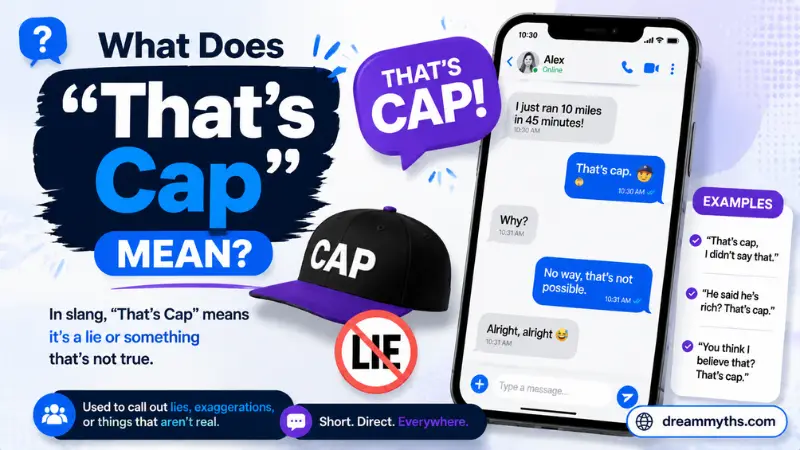
“That’s cap” means “That’s not true,” “I don’t believe that,” or “You’re exaggerating.” It is one of the clearest and most common sentence patterns using the slang sense of cap.
Consider this conversation:
Alex: I got a perfect score without studying.
Jordan: That’s cap.
Jordan is questioning Alex’s claim.
The phrase can also be used when the speaker believes there is direct evidence that contradicts a statement:
Mia: I never said that.
Chris: That’s cap. I have the message.
In a more playful conversation, the same phrase may sound much lighter:
“I can eat five burgers in one sitting.”
“That’s cap 😂.”
The laughing emoji signals that the response may be teasing rather than hostile.
So, when you see cap slang meaning used in a conversation, do not automatically interpret it as a serious accusation. The surrounding language often tells you whether the speaker is joking, teasing, or genuinely calling someone dishonest.
What Does “No Cap” Mean?
“No cap” means “no lie,” “seriously,” “honestly,” or “I’m telling the truth.” It is commonly used to emphasize that the speaker considers a statement sincere. Merriam-Webster describes no cap as an informal expression used to emphasize the truthfulness or seriousness of a statement.
For example:
“No cap, that was the best concert I’ve ever seen.”
The speaker is emphasizing that the opinion is genuine.
Another example:
“No cap, I was nervous before the interview.”
Here, no cap signals that the speaker is being honest rather than exaggerating.
It can appear at either end of a sentence:
“No cap, this is the best pizza in town.”
or:
“This is the best pizza in town, no cap.”
Both sentences communicate essentially the same idea.
The simplest way to remember the relationship is:
| Expression | Common meaning |
|---|---|
| cap | a lie or exaggeration |
| that’s cap | that’s not true |
| capping | lying or exaggerating |
| no cap | honestly; seriously; no lie |
| 🧢 | often a visual way to call something cap |
The cap slang meaning and no cap meaning are therefore closely connected but opposite in direction.
What Does “Capping” Mean?
Capping means lying, exaggerating, or making a claim that someone believes is untrue. It is the informal verb form associated with the slang sense of cap. Cambridge Dictionary specifically records the slang verb cap as meaning “to tell a lie.”
For example:
“You’re capping.”
This can mean:
“You’re lying.”
It can also mean:
“You’re exaggerating.”
Another common expression is:
“Stop capping.”
That means the speaker wants someone to stop making claims they consider false or exaggerated.
The tone can change dramatically depending on the setting:
“Bro, you’re capping 😂.”
This is likely playful.
But:
“You’re capping. I was there.”
sounds more serious because the speaker is directly challenging the statement.
The cap slang meaning is therefore not limited to one emotional tone. It can be humorous, skeptical, confrontational, or simply dismissive.
What Does Cap Mean in Texting?
In texting, cap is a short informal way to challenge a statement that seems false or exaggerated. It allows someone to express disbelief without writing a full sentence.
For example:
Sam: I just met a famous actor at the grocery store.
Taylor: Cap 😂
Taylor is essentially saying, “I don’t believe you.”
Another conversation could be:
Sam: I didn’t eat the last cookie.
Taylor: That’s cap.
Here, Taylor believes Sam is lying.
You might also see:
“No cap?”
In this context, the person is asking whether the speaker is serious or telling the truth.
For example:
A: I actually finished the whole book tonight.
B: No cap?
A: No cap.
The second speaker is confirming the claim.
The cap slang meaning works particularly well in texting because it can express a complete reaction with only one word. It is short, casual, and easy to recognize in informal conversations.
How Is Cap Used on Social Media?
The cap slang meaning is widely understandable in casual online communication, where people may use it in comments, replies, captions, and messages to challenge claims or express disbelief.
For example, someone might post:
“I can run 10 miles without stopping.”
A commenter could reply:
“Cap.”
Another person might write:
“Bro is capping.”
Both responses communicate doubt about the original statement.
The expression can also appear after an opinion:
“That movie was terrible, no cap.”
Here, no cap emphasizes that the writer genuinely means the opinion.
Social media context can make tone harder to judge. A short response such as “cap” may be playful between friends but insulting when directed at a stranger.
The important point is that cap slang meaning is not limited to one particular website or application. The expression can appear across different forms of informal communication.
What Does the 🧢 Emoji Mean?
The 🧢 emoji can represent the slang idea of cap, particularly when someone uses it to suggest that a statement is false or exaggerated.
For example:
“He says he never lies. 🧢”
The emoji can communicate:
“That’s cap.”
A person might also respond to an unbelievable claim with nothing except:
🧢
In that situation, the emoji functions as a visual shorthand for calling the statement false or exaggerated.
However, context still matters. The 🧢 emoji does not automatically have a slang meaning. It can literally represent a hat.
For example:
“I bought a new 🧢 for the summer.”
Here, the emoji probably refers to an actual cap.
The cap slang meaning is therefore one possible interpretation of the emoji, not its only meaning.
Is Cap Formal or Informal?
Cap is informal slang when it means a lie or exaggeration. It is most natural in casual conversations, texts, social media comments, memes, and relaxed speech.
Examples include:
“That’s cap.”
“You’re capping.”
“No cap, that was amazing.”
These expressions would normally sound out of place in formal writing.
For example, instead of writing:
“That information is cap.”
a professional writer would normally say:
“That information is inaccurate.”
Or:
“That claim is not supported by the available evidence.”
Standard words are better when the audience expects precise and professional language.
Cambridge describes slang as very informal language associated with particular groups or social settings, and notes that slang can be inappropriate outside those settings.
The cap slang meaning is therefore best understood as a register issue as well as a vocabulary issue. Knowing what cap means is useful, but knowing when not to use it is equally important.
Is Cap a Bad Word?
Cap is not a profanity or inherently offensive word. However, saying “that’s cap” directly questions whether another person is telling the truth, so it can sound rude depending on the situation.
Among close friends:
“You’re capping 😂.”
may be completely harmless.
During a serious disagreement:
“You’re capping.”
may sound confrontational.
A person’s age, relationship with the speaker, and communication style can also affect how the expression is received.
Appropriateness note: Cap is best reserved for informal communication. Avoid using it in professional, academic, legal, or other situations where clear and formal wording is expected.
Understanding the cap slang meaning does not mean you need to use the expression yourself. Recognizing slang and choosing to use slang are two different skills.
Does Cap Always Mean a Lie?
No. Cap does not always have the slang meaning of a lie. The word has several established meanings in standard English.
The most familiar literal meaning is a type of hat:
“He wore a baseball cap.”
Cap can also mean a cover:
“Put the cap back on the bottle.”
As a verb, cap can mean to place a limit on something:
“The company capped the amount employees could spend.”
Cambridge lists standard meanings involving hats, covers, limits, and other uses, alongside the slang meaning connected with lying.
That means the surrounding sentence matters.
Compare:
“I need a new cap.”
This probably means a hat.
With:
“That’s cap.”
This almost certainly refers to slang when the conversation concerns someone’s claim.
The cap slang meaning becomes especially clear when cap appears in expressions such as that’s cap, you’re capping, or no cap.
Does Cap Mean the Same Thing as Fake?
Cap and fake can overlap, but they are not exact synonyms. Cap usually focuses on a person’s statement, claim, boast, or assertion, while fake is a much broader word.
For example:
“He’s capping.”
means that the person is lying or exaggerating.
But:
“That account is fake.”
means the account itself is not genuine.
Likewise:
“That’s cap.”
usually challenges the truth of something someone said.
“That’s fake.”
could describe an object, account, identity, image, document, or other thing that is not genuine.
The cap slang meaning is therefore more closely tied to what someone says or claims.
This distinction helps prevent a common misunderstanding. You cannot automatically replace every use of fake with cap.
Can Cap Be Used as a Verb?
Yes. Cap can function as a slang verb, particularly in expressions such as “don’t cap” and “you’re capping.”
Examples include:
“Don’t cap.”
“You’re capping.”
“He capped about what happened.”
The slang verb generally refers to lying, exaggerating, boasting, or making an untrue claim.
The verb is separate from the standard noun in:
“She bought a cap.”
It is also separate from the standard verb meaning “to limit”:
“The company capped expenses.”
The spelling remains the same, but the meaning comes from context.
This is one reason the cap slang meaning can be confusing for people who already know the standard English word. A reader has to identify which sense is being used before interpreting the sentence.
Why Do People Say “No Cap”?
People say “no cap” to emphasize sincerity or truthfulness. The expression tells the listener that the speaker wants a statement to be taken seriously.
For example:
“No cap, I was exhausted after that workout.”
The speaker is emphasizing that the statement is genuine.
Another example:
“That was the hardest exam I’ve taken, no cap.”
Here, the phrase adds emphasis to the speaker’s opinion.
Merriam-Webster notes that no cap can occur at the beginning or end of a statement and functions as an informal marker of sincerity.
An interesting feature of the expression is that no cap does not guarantee that the statement is objectively true. It tells you that the speaker is presenting the statement sincerely. A person can sincerely believe something and still be mistaken.
That distinction makes the phrase more precise than simply treating “no cap” as proof that a claim is factually correct.
Where Did the Slang Meaning of Cap Come From?
The modern slang sense of cap is associated with African American English (AAE) and has a longer history than its recent popularity online might suggest. Merriam-Webster notes that the usage originated in African American English and later became widespread.
The history is not as simple as saying that the expression was invented by the internet. Merriam-Webster’s discussion of the word explains that forms of capping have been used in African American English for decades, with older meanings connected to boasting, insulting, or verbally challenging someone.
The expression no cap became especially prominent through hip-hop and popular culture before spreading more broadly into informal American English. Merriam-Webster notes its development and popularization through music and later mainstream use.
Because slang develops through speech communities over time, there is no need to reduce the history to one supposed inventor or one exact starting moment.
For today’s reader, the practical point is simple: the cap slang meaning has roots in African American English and is now widely recognized in informal American communication.
Is “Cappin’” the Same as “Capping”?
Yes. “Cappin’” is an informal spelling of “capping,” usually representing the pronunciation or casual style of the word.
For example:
“You cappin’.”
and:
“You’re capping.”
communicate essentially the same idea.
The shortened spelling is more casual and may appear in lyrics, memes, social media, or informal messages.
It should not be confused with formal written English. In professional writing, lying, exaggerating, or another precise standard-English expression would usually be preferable.
The different spellings do not normally create a completely different cap slang meaning. They mainly signal an informal style.
Examples of Cap in Everyday Conversations
The easiest way to understand the cap slang meaning is to see how it works in different situations.
Example 1: Calling out exaggeration
A: I finished a 500-page book in an hour.
B: Cap.
The second person thinks the first claim is exaggerated or unbelievable.
Example 2: Playful disbelief
A: I never sleep past 6 a.m.
B: You’re capping 😂.
The response is probably friendly teasing.
Example 3: Serious disagreement
A: I never sent you that message.
B: That’s cap. I still have the screenshot.
Here, the speaker is directly accusing the other person of making a false statement.
Example 4: Emphasizing an opinion
“No cap, that was the best burger I’ve had in years.”
The speaker is emphasizing sincerity.
Example 5: Asking for confirmation
“No cap? You actually won?”
Here, no cap? means something like “Seriously?” or “Are you really telling the truth?”
Example 6: Social media reaction
“I can run a mile in four minutes.”
Reply:
“🧢”
The emoji is being used to communicate disbelief.
Example 7: Telling someone to stop exaggerating
“Stop capping and tell me what really happened.”
The speaker wants a more truthful or straightforward answer.
These examples show why the cap slang meaning cannot be reduced to only one translation. Depending on context, cap can communicate disbelief, accusation, teasing, or skepticism.
Common Mistakes With Cap
Mistake 1: Assuming cap always means a hat
The ordinary noun cap can mean a hat, while slang cap can mean a lie or false claim.
“Nice cap.”
may refer to someone’s hat.
“That’s cap.”
usually refers to someone’s statement.
Context determines the intended meaning.
Mistake 2: Thinking “no cap” means “no hat”
In slang, no cap means something like “honestly” or “seriously.”
It normally has nothing to do with clothing.
Mistake 3: Using cap in formal writing
Cap is informal slang when used to mean lying or exaggerating.
Instead of:
“The report is cap.”
write:
“The report contains inaccurate information.”
The formal alternative is clearer and more appropriate.
Mistake 4: Assuming “cap” always means intentional deception
Someone may use cap when they think another person is exaggerating, even if the person genuinely believes what they are saying.
So:
“That’s cap.”
does not necessarily prove that the original speaker intentionally lied.
Mistake 5: Assuming cap and fake are interchangeable
The words overlap in some situations but have different typical uses.
Cap generally challenges a claim or statement.
Fake generally describes something that is not genuine.
Mistake 6: Treating every 🧢 emoji as slang
The 🧢 emoji can literally mean a hat.
The surrounding conversation determines whether the emoji is being used to express the cap slang meaning.
When Should You Use Cap?
Use cap when the setting is casual and the people involved understand informal slang.
Natural settings include:
- Texting friends
- Group chats
- Casual conversations
- Social media comments
- Memes
- Informal online discussions
- Playful conversations
For example:
“That’s cap 😂.”
sounds natural in a casual group chat.
The expression may be less appropriate when speaking with someone you do not know well, especially if the relationship is formal.
Knowing the cap slang meaning also helps you understand when the expression is likely to sound natural rather than forced.
When Should You Avoid Cap?
Avoid slang cap when the situation requires professional, academic, legal, or highly precise language.
For example, a workplace email would normally be better with:
“I don’t believe that information is accurate.”
rather than:
“That’s cap.”
An academic paper might say:
“The claim is unsupported.”
rather than:
“The claim is cap.”
A formal complaint might use:
“The statement appears to be false.”
rather than:
“You’re capping.”
The issue is not that slang is bad English. Slang is a legitimate part of language, but it belongs to a particular register. The cap slang meaning works best when the audience and setting are informal.
Cap Meaning in American English vs. Other Uses
In American English, cap has several unrelated meanings, so readers should not assume every occurrence refers to slang.
A few common meanings include:
Cap as a hat:
“He wore a blue cap.”
Cap as a cover:
“Put the cap back on the bottle.”
Cap as a limit:
“There is a spending cap.”
Cap as slang for a lie:
“That’s cap.”
Cap as a slang verb:
“You’re capping.”
These meanings are grammatically and semantically different.
The cap slang meaning is especially recognizable when the word appears in a reaction to someone’s statement. Phrases such as that’s cap, stop capping, and no cap provide strong contextual clues.
What Is the Opposite of Cap Slang?
The closest common opposite expression is “no cap.” Understanding the cap slang meaning also means understanding this contrast. While cap slang meaning signals that someone considers a statement false, exaggerated, or dishonest, “no cap” signals sincerity or truthfulness.
For example:
“That’s cap.”
means:
“I don’t believe that.”
This is a simple example of the cap slang meaning in everyday conversation.
While:
“No cap.”
means:
“I’m serious.”
The contrast becomes even clearer in a longer sentence:
“This is the best pizza ever.”
“Cap.”
The listener rejects the claim, which shows the cap slang meaning as a response to something they believe is exaggerated or untrue.
But:
“No cap, this is the best pizza I’ve ever had.”
The speaker emphasizes that they genuinely mean the statement. In this case, “no cap” works as the opposite side of the cap slang meaning.
This contrast is one of the most useful parts of understanding cap slang meaning, because these two expressions often appear together in casual texts, conversations, and social media posts. Remembering cap = not true or exaggerated and no cap = sincere or truthful makes the slang much easier to understand. the cap slang meaning because the two expressions often appear together in informal conversations.
How to Tell What Cap Means From Context
When you see cap, first look at the words around it.
If the conversation is about clothing:
“Where did you get that cap?”
the word probably means a hat.
If someone is reacting to a claim:
“I won the lottery.”
“Cap.”
the slang meaning is likely.
If someone writes:
“No cap, I’m serious.”
the expression clearly refers to honesty.
If someone says:
“The company capped spending.”
the standard verb meaning of setting a limit is intended.
This context-first approach is more reliable than a single fixed definition because cap slang meaning changes depending on how the word is used. Looking at the sentence, tone, and surrounding conversation helps you decide whether cap means a hat, a limit, or an informal expression for a false or exaggerated claim.ssuming that every use of cap has the same meaning.
Cap Slang Meaning in One Simple Rule
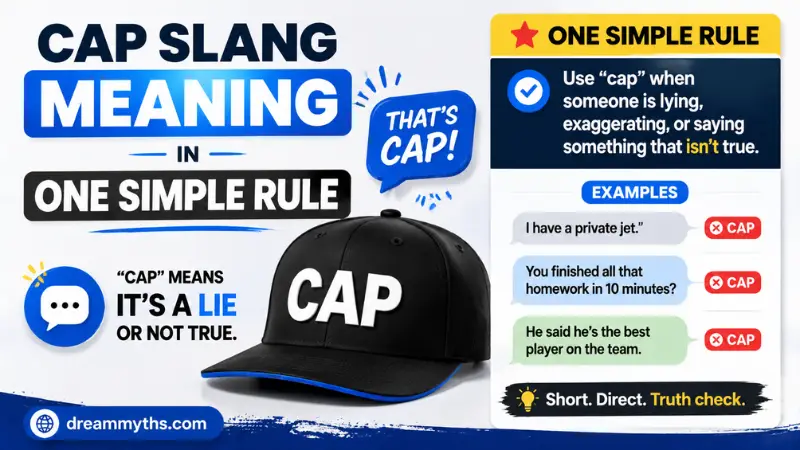
A simple rule can help you remember the cap slang meaning:
If someone says “cap” about a person’s claim, they usually mean the claim is false, exaggerated, or unbelievable.
The three most useful forms are:
Cap:
A lie, false claim, or exaggeration.
Capping:
Lying or exaggerating.
No cap:
Being serious, honest, or truthful.
For example:
“You’re capping.”
= “You’re lying or exaggerating.”
“That’s cap.”
= “That’s not true.”
“No cap.”
= “I’m being serious.”
Once these patterns become familiar, most uses of the slang become easy to interpret.
Frequently Asked Questions
What does “capping” mean?
Capping means lying or exaggerating. For example, “You’re capping” can mean “You’re not telling the truth” or “You’re exaggerating.”
What does “no cap” mean?
No cap means “honestly,” “seriously,” or “I’m telling the truth.” It is used to emphasize that the speaker considers a statement sincere.
What does cap mean in texting?
In texting, cap usually means that a statement is false, exaggerated, or unbelievable. A one-word reply such as “cap” can mean “I don’t believe you.”
What is the cap slang meaning?
The cap slang meaning is usually a lie, false claim, or exaggeration. When someone says “that’s cap,” they generally mean that they do not believe what another person has said.
Does the 🧢 emoji mean cap?
The 🧢 emoji can be used to communicate the slang idea of cap, especially when someone is calling a statement false or exaggerated. However, it can also simply represent a physical hat.
Is cap appropriate in professional English?
Usually, no when cap has its slang meaning. It is better to use standard expressions such as “false,” “inaccurate,” “untrue,” or “exaggerated” in professional and academic writing.
Is cap slang or a regular English word?
Both. Cap is a regular English word with meanings such as a hat, cover, or limit. In informal slang, cap can mean a lie or false claim.
Conclusion
The cap slang meaning is mainly connected with lying, exaggerating, boasting, or making a claim that someone believes is untrue. In a text or social media conversation, “cap” can be a quick way to say, “I don’t believe you,” while “that’s cap” directly challenges a statement.
The related form capping means lying or exaggerating, and no cap is used to emphasize honesty or seriousness. The 🧢 emoji can also represent the slang idea in online conversations, which is why understanding the cap slang meaning can make casual messages easier to interpret.
At the same time, remember that cap has several standard English meanings, including a type of hat and a limit. Context tells you which meaning is intended, so the cap slang meaning should not be confused with the ordinary dictionary uses of the word.
Most importantly, cap is informal slang. It works naturally in casual conversations, texts, group chats, and social media, while standard expressions such as “false,” “inaccurate,” or “exaggerated” are better for professional and academic situations. This difference in register is an important part of the cap slang meaning.
When someone says “that’s cap,” they usually mean that they do not believe another person’s statement. If someone says “you’re capping,” they are suggesting that the other person is lying or exaggerating. These common expressions help explain how the cap slang meaning works in everyday communication.
The opposite phrase, “no cap,” signals that the speaker is being honest or serious. For example, “No cap, that was the best concert I’ve seen” emphasizes that the speaker genuinely means what they said. This is one of the most recognizable uses connected with the cap slang meaning.
The term can also appear as a one-word response. If someone makes an unbelievable claim and another person replies “Cap,” the response usually means “I don’t believe that” or “You’re exaggerating.” In this setting, the cap slang meaning depends heavily on the surrounding conversation and the relationship between the speakers.
Once you understand these distinctions, the cap slang meaning becomes straightforward: cap usually signals disbelief in a claim, while no cap signals that the speaker is being serious or truthful. Because the expression is informal, it is best used in relaxed conversations rather than formal writing.