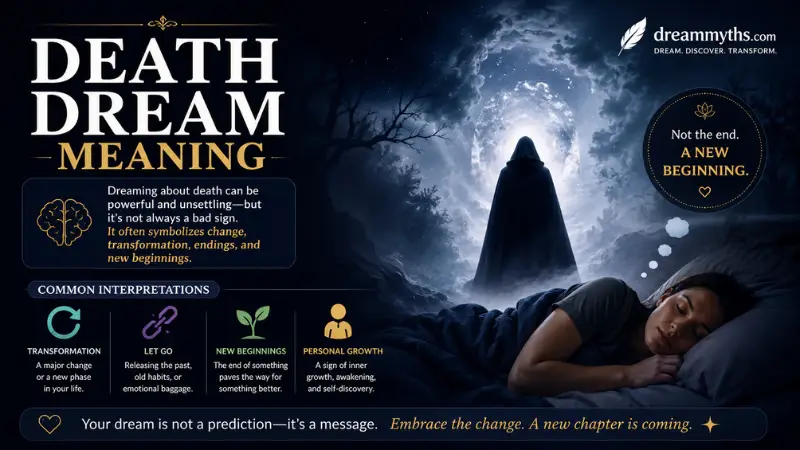
A death dream can be frightening, especially when the dream involves you, someone you love, or a person who is still alive. The death dream meaning is usually connected with emotions, change, grief, stress, fear, or personal transformation rather than a literal prediction of death. Psychological interpretations commonly treat death as a symbol of endings, transitions, or something changing in waking life.
The exact death dream meaning depends on who died, what happened, how you felt, and what was happening in your life at the time. Spiritual and religious traditions can offer different interpretations, so those views should be separated from psychological explanations.
Key takeaway: Death dreams usually do not mean someone will literally die. They can reflect change, loss, anxiety, grief, relationship shifts, personal growth, or the end of a life phase.
- A living person’s death may symbolize fear of loss or relationship change.
- Your own death may symbolize transformation or the end of an old phase.
- Dreams about deceased people can connect with grief and memories.
- Spiritual interpretations vary across Islam, Hinduism, Christianity, and other traditions.
- Repeated distressing dreams may be connected with stress, trauma, or disrupted sleep.
What Does Death in a Dream Mean?
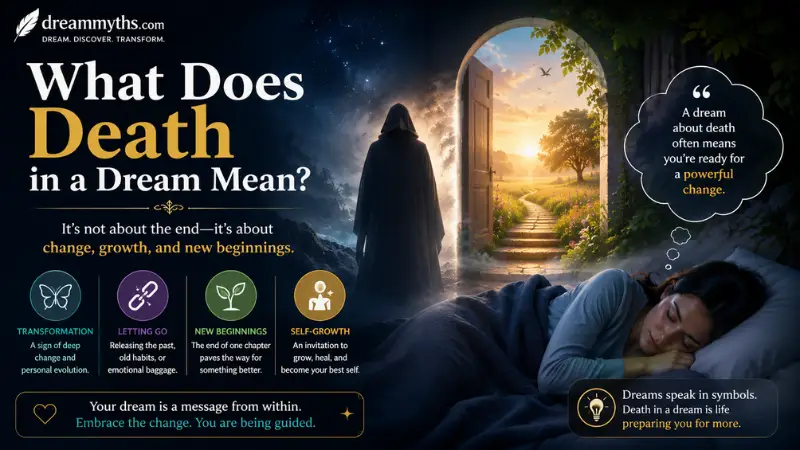
Death dreams usually symbolize change, endings, grief, stress, or personal transformation rather than literal death. The meaning depends on the person, dream context, and emotions involved. A frightening dream may reflect fear or uncertainty, while a calm dream may reflect acceptance, closure, or readiness for a new beginning.
The death dream meaning is rarely as literal as the dream image suggests. Death can represent the ending of a relationship, habit, belief, role, job, identity, or period of life. A dream may also reflect uncertainty about what comes next.
The emotions in the dream matter. Feeling frightened can point toward fear, anxiety, or uncertainty. Feeling peaceful may suggest acceptance or closure. Feeling confused may show that a waking-life change has not yet been fully understood.
Dreams can also process experiences from waking life. Stress, grief, illness, breakups, major transitions, and unresolved emotions can all become part of dream imagery. Psychological sources describe death dreams as common and generally unrelated to actual danger.
Why Do People Dream About Death?
Death dreams often appear during stress, anxiety, grief, relationship changes, major transitions, unresolved conflict, or poor sleep. Death can become a powerful dream symbol for something ending or changing. Movies, books, news, cultural beliefs, spiritual beliefs, and repeated thoughts about loss can also influence dream content.
The death dream meaning can become clearer when you look at what was happening before sleep. A stressful day can produce emotionally intense dreams. Grief can bring memories of someone who has died. A relationship problem can appear through symbolic separation or death.
Common triggers include:
- Stress and anxiety
- Grief and fear of loss
- Major life transitions
- Relationship problems
- Unresolved conflict
- Guilt and regret
- Trauma or difficult emotional experiences
- Health-related worries
- Poor or disrupted sleep
- Repetitive thoughts about the same problem
- Movies, books, news, or other death-related content
- Cultural and spiritual beliefs
Research-based psychological explanations also connect dream content with waking emotions and experiences. Recurring dreams may be especially likely when stress or emotional concerns remain unresolved.
What Does It Mean When You Dream About Your Own Death?
Dreams about your own death often symbolize personal transformation, the end of an old life phase, stress, exhaustion, or a feeling of losing control. They can also represent personal growth, rebirth, spiritual renewal, or a new beginning. They are not reliable evidence that your actual death is approaching.
The death dream meaning can be especially powerful when the dream involves your own death. An old identity may be changing. You may be letting go of outdated habits, beliefs, relationships, or expectations.
Your own death may also appear during periods of exhaustion or feeling overwhelmed. A major decision can create uncertainty about the future. A relationship, career, routine, or personal role may be changing even when the change has not been completed.
Some spiritual interpretations view death as rebirth or renewal. Psychological interpretations usually focus on transformation, stress, identity, and life circumstances. Death imagery can therefore represent an ending that makes space for something new.
What Does It Mean When You Dream About Someone Dying Who Is Still Alive?
Dreams about someone dying who is still alive usually reflect fear of loss, relationship changes, emotional distance, unresolved conflict, guilt, or personal transformation. The dream does not establish that the living person will die. The person may also symbolize a quality, role, memory, or part of your identity.
The death dream meaning becomes different when the person is still alive. The dream may reflect concern about their wellbeing, fear of losing them, or a relationship changing form.
A living person can also symbolize something within you. Their personality, role, qualities, or connection to your past may represent a part of your identity. The dream can therefore show an internal shift rather than an external event.
Unfinished conversations, guilt, emotional distance, or unresolved conflict can also influence the dream. A death image can symbolize the end of an old version of the relationship.
Psychological interpretations generally describe these dreams as metaphors rather than predictions.
What Does It Mean When You Dream About a Family Member Dying?
Dreams about a family member dying can reflect fear of loss, anxiety, changing family roles, growing independence, emotional dependence, unresolved family issues, or concern about wellbeing. The family member can also symbolize personality traits, identity, or a role that is changing in your life.
The death dream meaning involving family often depends on the relationship. A parent, child, sibling, partner, or friend can represent different emotional connections.
Family death dreams may appear during major family decisions or periods of emotional change. They can also occur when a person is becoming more independent or when a familiar family role is changing.
A family member’s death in a dream does not prove that the person will die. Instead, the dream may represent a changing relationship, fear of loss, or a symbolic shift in identity.
Dreaming About Your Parent Dying
A parent dying in a dream can relate to a changing parent-child relationship, growing independence, major family decisions, identity, personality, or role. The parent may also symbolize a part of your own identity or responsibilities.
The death dream meaning here can involve becoming more independent. A parent can represent security, authority, guidance, or a familiar family role. When that role changes, the dream may use death as a symbol for transition.
A parent death dream can also arise from concern about the parent’s wellbeing. The emotional response matters. Fear may reflect anxiety, while calmness may reflect acceptance of a changing relationship.
Psychological interpretations similarly connect parent-death dreams with changes in the relationship or changes in the dreamer’s own role and identity.
Dreaming About Your Child Dying
A child dying in a dream can represent fear, protectiveness, anxiety about the child’s safety, milestones, growing independence, or the end of a stage of childhood. The dream image does not mean literal death.
The death dream meaning can relate to emotional realization. A child growing older changes the parent-child relationship. Childhood ends in stages, and dreams may turn those transitions into dramatic death imagery.
Milestones such as increasing independence can make these dreams particularly emotional. The fear can come from recognizing that a familiar stage is ending rather than from a real expectation of death.
Dreaming About Your Sibling Dying
A sibling death dream can relate to a changing sibling relationship, changes in the sibling’s life, emotional distance, or personal identity. The sibling may also represent personality traits or qualities that you share.
The death dream meaning can therefore involve both the relationship and the self. If your sibling is entering a new life stage, the dream may symbolize that change. If the sibling represents a part of your personality, the death image may symbolize personal change.
The central themes are relationship changes, emotional experiences, identity, and personal growth rather than literal death.
Dreaming About Your Partner Dying
A partner dying in a dream can reflect fear of losing the partner, emotional distance, relationship changes, an ending, or a change in how you perceive the relationship.
The death dream meaning may point toward an emotional connection that feels different from before. The relationship itself may be changing form. The dream may also reflect anxiety about separation or loss.
A death dream involving a partner should not automatically be treated as evidence that the relationship will end. The waking relationship, recent conversations, emotions, and circumstances provide better context.
Dreaming About a Friend Dying
A friend dying in a dream can symbolize changing friendship, fading friendship, emotional distance, closure, or personal change. The friend’s qualities may also represent something within your own personality.
The death dream meaning can therefore involve a friendship that no longer feels the same. A friend’s life may be changing, or your own priorities may be changing.
The dream may represent the end of an old dynamic rather than the end of the friendship itself.
Dreaming About Someone Who Has Already Died
A dream about someone who has already died can involve grief, mourning, missing someone, unresolved memories, unresolved emotions, delayed grieving, emotional healing, and memories from the past.
The death dream meaning in this situation may be closely connected with emotional processing. The deceased person can appear because the dreamer is remembering the relationship or working through loss.
Some people experience these dreams as comforting. Others find them upsetting. Spiritual traditions may interpret deceased-person dreams as spiritually meaningful, while psychological interpretations can view them as part of memory and grief processing.
A dream involving a deceased person does not have one universal meaning. The relationship, memories, emotional response, and circumstances around the loss all matter.
What Different Death Dream Symbols Can Mean
The death dream meaning can change depending on the exact symbol. A dead body, funeral, murder, or return to life can create different interpretations.
| Dream symbol | Common interpretation | Emotional focus |
|---|---|---|
| Dead body | Finality or an ending | Exhaustion, closure |
| Funeral | Closure or transition | Grief, reflection |
| Being killed | Feeling pressured or powerless | Fear, control |
| Dying and returning | Renewal or transformation | Hope, rebirth |
Seeing a Dead Body in a Dream
A dead body can symbolize finality, a natural conclusion, or something that is no longer working. The symbol may relate to a relationship, job, idea, habit, or situation.
The death dream meaning may point toward moving forward. Emotional fatigue can make an ending feel especially vivid. A dead body can represent something the dreamer needs to accept, release, or leave behind.
The interpretation depends on the surrounding dream details. A peaceful scene can feel different from a frightening or chaotic one.
Dreaming About a Funeral or Burial
A funeral or burial can symbolize an ending, a chapter closing, letting go, closure, mortality, reflection, or a major life transition.
The death dream meaning may involve emotional acceptance. A funeral can represent the process of acknowledging that something has changed. Burial can symbolize putting an old issue, relationship, habit, or expectation behind you.
Spiritual interpretations may connect funerals and burial with mortality, spiritual accountability, responsibilities, or spiritual reflection. Psychological interpretations focus more on closure and emotional processing.
Dreaming About Being Murdered or Killed
Being murdered or killed in a dream can symbolize fear of losing control, feeling powerless, feeling trapped, suppressed anger, emotional pain, or pressure to change.
The death dream meaning may involve a situation that feels forced. If another person is controlling the change, the dream can represent pressure or resistance. A murder dream can also symbolize the destruction of an old habit or personality trait.
The dream should be considered in its full context rather than interpreted as a literal threat.
Dreaming About Dying and Coming Back to Life
Dying and returning to life is often interpreted symbolically as rebirth, renewal, a second chance, recovery, repentance, or a new phase.
The death dream meaning here can be more positive than frightening. The dream may represent recovery after hardship or the decision to leave an old version of yourself behind.
Spiritual interpretations may connect the experience with spiritual renewal or repentance. Psychological interpretations can connect it with personal growth and major life transitions.
Recurring Dreams About Death
Recurring death dreams can involve ongoing stress, unresolved emotional experiences, repetitive thought patterns, trauma, poor sleep, emotional processing, distressing dreams, and sleep disruption.
The death dream meaning may remain connected to an issue that has not been emotionally processed. Repetition does not prove that the dream is predicting an event. It can mean the same concern continues to affect the dreamer’s emotional state.
Recurring dreams can also become more vivid when sleep quality is poor. Stress, trauma, grief, and repeated thoughts can contribute to recurring dream themes.
If recurring dreams interfere with sleep or everyday functioning, professional support can be useful. Psychological sources recommend seeking help when dreams become frequent, severely distressing, or disruptive.
Spiritual Meaning of Death in a Dream
The death dream meaning can have a spiritual interpretation involving transformation, spiritual awakening, an old identity, letting go, a new beginning, repentance, mortality, spiritual growth, spiritual reflection, a warning, or a spiritual message.
Spiritual traditions do not all interpret death dreams in the same way. Some view death as transformation or rebirth. Others treat it as a reminder about mortality, personal conduct, or spiritual responsibility.
A spiritual interpretation is different from a psychological explanation. Psychology focuses on emotions, memory, stress, relationships, and waking-life experiences. Spiritual interpretations depend on the beliefs and tradition being used.
A dream can feel spiritually meaningful without proving that a supernatural event has occurred.
Death Dream Meaning in Islam
The death dream meaning in Islam should be approached through Islamic teachings about dreams rather than a fixed dream dictionary. Islamic sources describe dreams as falling into different categories, including good dreams, distressing dreams, and dreams connected with what a person is thinking about.
Islamic interpretation does not support treating every frightening dream as a prediction of actual death. A disturbing dream may involve thoughts, emotions, fear, or a distressing dream experience.
Islamic teachings also distinguish between meaningful dreams and ordinary thoughts that appear during sleep. Some Islamic sources discuss dreams as potentially carrying good news or warnings, but knowledge gained from dreams is not treated as certain knowledge for making major decisions.
For a frightening dream, Islamic guidance includes seeking refuge with Allah and following the established etiquette for unpleasant dreams.
Seeing Yourself Die
Seeing yourself die can be interpreted in some traditional Islamic dream literature through transformation, repentance, a change in life phase, or spiritual reflection.
The death dream meaning should not automatically be understood as literal death. Islamic dream interpretation can depend on context, personal circumstances, and the nature of the dream.
Themes such as repentance, spiritual condition, change, renewal, and personal development may appear in traditional interpretations. These interpretations should not be presented as guaranteed predictions.
Seeing Someone Alive Die
Seeing a living person die in a dream can involve fear of loss, concern, relationship changes, emotional distance, personal reflection, or spiritual reflection.
The death dream meaning does not establish that the living person will die. Islamic teachings recognize that some dreams can arise from a person’s own thoughts and concerns during waking life.
Dying and Returning to Life
Dying and returning to life can be interpreted symbolically through repentance, renewal, righteousness, a second chance, transformation, spiritual change, rebirth, recovery, and a new beginning.
The death dream meaning in this context may center on returning from an old pattern or beginning a different phase. Traditional interpretations can vary, so the dream should not be treated as a guaranteed prediction.
Funeral, Grave, or Burial Dreams
Funeral, grave, and burial dreams can bring themes of mortality, accountability, the Hereafter, responsibilities, spiritual reflection, circumstances, dream details, death, and spiritual meaning.
The death dream meaning depends heavily on the dream’s circumstances. Islamic interpretation should be distinguished from modern psychological symbolism. A frightening dream is not automatically a divine warning or forecast.
Death Dream Meaning in Hinduism
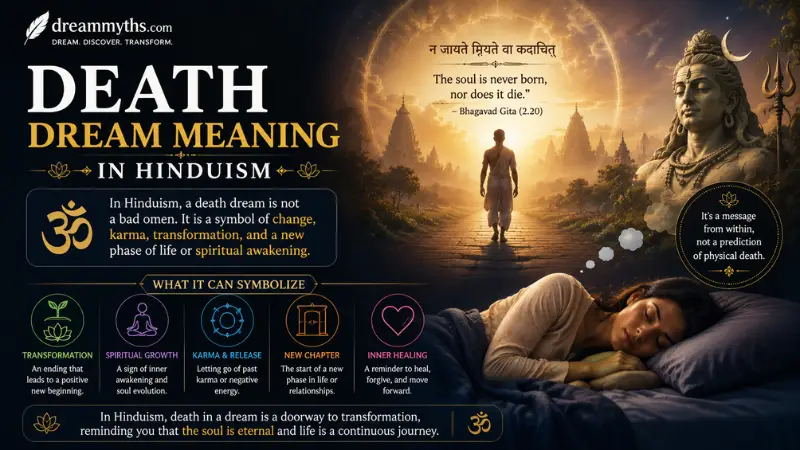
The death dream meaning in Hinduism can be discussed through traditional dream symbolism, including ideas associated with Svapna Shastra. Interpretations may connect death imagery with transformation, an ending, a beginning, a new chapter, renewal, rebirth, personal development, spiritual awakening, and spiritual change.
Some traditional interpretations may treat certain death dreams as auspicious. Others may describe particular forms of death imagery as warnings or negative omens.
This variation matters. There is no single interpretation for every death dream in Hinduism. The dream’s circumstances, symbolism, cultural context, and the dreamer’s beliefs can influence how it is understood.
Traditional spiritual interpretations should not be confused with scientific evidence about what dreams predict.
Biblical Meaning of Death in a Dream
The death dream meaning in biblical or Christian interpretation can involve spiritual examination, judgment, mortality, correction, afterlife themes, spiritual warfare, prophetic symbolism, and reflection on one’s life.
The supplied dream-interpretation material gives particular attention to Enoch and treats death dreams as spiritual symbolism. That approach should be described as an interpretive tradition rather than a universal biblical rule. Biblical texts contain many dreams and visions, but that does not create one fixed meaning for every modern death dream.
A person using a biblical framework may therefore focus on spiritual reflection, repentance, personal conduct, mortality, or faith rather than assuming that a dream predicts a literal death.
Does a Death Dream Predict Actual Death?
A death dream does not reliably predict an actual death. Psychological interpretations usually connect these dreams with emotions, stress, grief, uncertainty, and change. Some religious traditions allow for meaningful dreams, but a single dream should not be treated as certain evidence about another person’s future.
The death dream meaning should therefore be separated from fortune-telling. A dream can feel extremely vivid without providing reliable information about what will happen.
If a dream involves a living family member, friend, partner, or child, fear can make the dream feel like a warning. That emotional reaction is understandable, but the dream itself cannot establish that the person is in danger.
Religious interpretations can differ. Islamic teachings, for example, distinguish between good dreams, distressing dreams, and dreams arising from a person’s own thoughts.
Is It Good Luck to Dream About Someone Dying?
Good luck is not a universal meaning of a death dream. Some spiritual and traditional interpretations view death as transformation, renewal, or an ending that creates room for growth. Psychological interpretations focus on emotions and life circumstances instead, so whether a dream feels lucky depends on its context and belief system.
The death dream meaning can be viewed positively when death symbolizes an old phase ending. A person may associate the dream with growth, a new beginning, or transformation.
Other traditions may view particular death dreams as warnings or bad omens. Psychological interpretation does not classify dreams as lucky or unlucky. It looks at stress, emotions, relationships, life circumstances, and personal meaning.
What Symbolizes Death in Dreams?
The death dream meaning can involve many symbols:
- Endings
- Transformation
- Rebirth
- Change
- Letting go
- Closure
- Loss
- Fear
- Grief
- Personal growth
- Relationship changes
- Identity changes
- Old habits
- New beginnings
- Spiritual reflection
The strongest psychological theme is often transition. A death image can represent something that has ended, is ending, or needs to change.
Are Death Dreams Normal?
Death dreams are common and are not automatically signs of a mental health condition. Recurring or distressing dreams can become important when they interfere with sleep, mood, energy, daily functioning, or emotional wellbeing. In those cases, professional support may help identify triggers and coping strategies.
The death dream meaning is not automatically pathological. People can experience frightening or vivid dreams during ordinary periods of stress, grief, uncertainty, or change.
Psychological sources also note that recurring and severely distressing nightmares may require closer attention, especially when they interfere with daily functioning.
What Triggers Death Dreams?
Death dreams can be triggered by stress, anxiety, grief, fear of loss, life transitions, relationship problems, unresolved conflict, trauma, health worries, poor sleep, repetitive thoughts, emotional experiences, and exposure to death-related content. Cultural and spiritual beliefs can also shape dream themes.
The death dream meaning can be easier to understand by identifying the trigger.
Common triggers include:
- Stress and anxiety
- Grief
- Fear of loss
- Relationship problems
- Major life transitions
- Unresolved conflict
- Trauma
- Health worries
- Poor sleep
- Repetitive thoughts
- Movies, books, and news
- Death-related content
- Cultural beliefs
- Spiritual beliefs
- Emotional experiences
Psychological sources identify stress, grief, fears, life changes, unresolved issues, traumatic experiences, health-related worries, emotional experiences, and media content among possible triggers.
Early Morning Dreams About Death
Early morning dreams about death may feel unusually vivid because dream recall can be strong when a person wakes soon after dreaming. The death dream meaning is not automatically different because the dream happened early in the morning.
Dream recall can also make the dream seem more detailed than dreams remembered later. The emotional experience may remain after waking, especially when the dream involves death, grief, fear, or someone close to you.
Rather than focusing only on the time, consider the dream’s content, emotional response, recent experiences, sleep quality, and waking-life concerns.
Death Dream Number
A death dream number can refer to numbers that appear in a dream or numbers that someone associates with death symbolism. The death dream meaning does not have one universal numerical system.
Numerical symbolism can vary according to culture, spiritual tradition, personal experience, and individual beliefs. A number may be meaningful because it relates to a date, age, memory, relationship, or personal event.
Dream numbers should not be treated as guaranteed predictions. If a number repeatedly appears, recording the dream and noting the surrounding circumstances can help identify personal associations.
How to Cope With a Death Dream
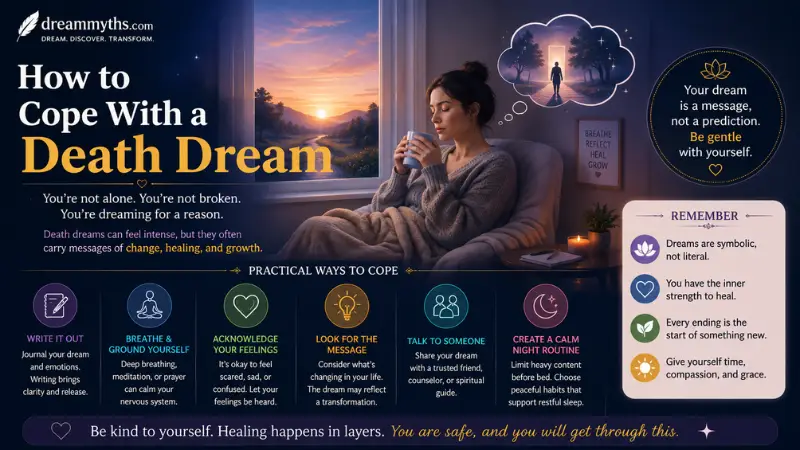
The death dream meaning becomes less frightening when the dream is treated as an emotional experience rather than an automatic prediction.
Useful steps include:
- Write down the dream. Record the main events, people, symbols, and emotions soon after waking.
- Consider waking life. Look for stress, grief, relationship changes, unresolved issues, or major transitions.
- Keep a calming bedtime routine. Consistent sleep habits can support better rest.
- Manage daytime stress. Walking, breathing exercises, journaling, and other calming practices may help.
- Ground yourself after waking. Notice your surroundings and remind yourself that you are awake.
- Reframe recurring nightmares carefully. Imagery rehearsal is one approach used for some nightmares.
- Seek professional support when needed. Frequent distressing dreams that disrupt sleep or daily life deserve attention.
These approaches are consistent with psychological guidance on journaling, stress management, grounding, sleep routines, imagery rehearsal, and professional support.
FAQs
Is it good luck to dream about someone dying?
A death dream is not universally considered good luck or bad luck. Some traditions interpret death as renewal, transformation, or a positive ending, while others attach warning symbolism to particular dreams. Psychological interpretations focus on emotions and waking-life circumstances instead of luck.
Are death dreams normal?
Yes, death dreams can be normal and common. They may appear during stress, grief, major changes, relationship problems, or periods of poor sleep. Professional support can help when recurring dreams become highly distressing or interfere with sleep and everyday functioning.
What triggers death dreams?
Death dreams can be triggered by stress, anxiety, grief, fear of loss, major life transitions, relationship problems, unresolved conflict, trauma, health worries, poor sleep, repetitive thoughts, and emotional experiences. Movies, books, news, cultural beliefs, and spiritual beliefs can also influence dream content.
Does dreaming about someone dying mean they will die?
No. Dreaming about someone dying does not reliably mean that person will die. Death dreams are commonly associated with emotions, stress, grief, fear, relationships, and change. Some religious traditions discuss meaningful dreams, but one dream should not be treated as certain evidence about another person’s future.
Why do I dream about my own death?
Dreams about your own death often relate to major changes, stress, exhaustion, identity concerns, or the end of an old life phase. They can also symbolize personal growth, renewal, or a new beginning. The dream is not reliable evidence that your actual death is approaching.
What does it mean when you dream about someone dying who is still alive?
A dream about someone dying who is still alive usually reflects fear of loss, relationship changes, emotional distance, unresolved conflict, guilt, or personal transformation. The person may symbolize a quality or part of your identity. The dream does not establish that the
What does it mean when you dream about a family member dying?
A family member’s death in a dream can reflect fear of loss, anxiety, changing family roles, independence, emotional dependence, or unresolved family issues. The family member may also symbolize part of your identity. The dream does not reliably predict their death.
What does it mean when you dream about death?
Death dreams commonly symbolize change, endings, grief, stress, fear, or personal transformation rather than literal death. The meaning depends on the dream’s context and your emotional response. A death dream does not automatically predict that you or another person will die.
Conclusion
The death dream meaning is usually more connected with emotional change than literal death. Death can symbolize endings, transformation, grief, fear, closure, personal growth, relationship changes, or a new beginning.
The most useful interpretation starts with context. Ask who died, how you felt, what changed recently, and whether the dream connects with an unresolved concern.
Spiritual interpretations can add another layer, but Islam, Hinduism, biblical traditions, and other belief systems do not all interpret death dreams in the same way. Psychological interpretations likewise focus on emotions and waking-life experiences rather than treating dreams as certain predictions.
A frightening dream can feel real without being a forecast. Understanding the emotional context can make the dream easier to process and may reveal what your mind is trying to work through.