

Fifteen years of readings taught me something that contradicts almost every dream dictionary online: the bear dream meaning you’re looking for is rarely about the bear. It’s about who walked beside you last week.
When someone books a session after a bear dream, I don’t start with the animal. I ask two questions. Was there an overbearing person in your week? And were you in stressful situations you couldn’t step out of? About seven times in ten, the answer to one of those explains the whole dream before we ever discuss fur, size, or colour.
This guide gives you the full symbolic layer — psychological, spiritual, biblical, Islamic, and cultural — but it puts that layer in the right order. Emotion first. Behaviour second. Symbol last. That ordering is why my clients arrive frightened and leave calm, usually inside forty minutes.
Key Takeaways
- Emotion outranks symbol. How you felt during and after the dream carries more interpretive weight than the bear’s colour, species, or size.
- The bear is often a person. Dream analyst Lauri Loewenberg’s wordplay principle — an overbearing person appearing as a bear — resolves more real cases than any prognostic omen ever has.
- A frightening bear is not a bad omen. Threatening bears usually track suppressed anger, crossed boundaries, or unresolved conflict, not future disaster.
- Nothing here predicts events. Not a dead bear, not an attack. Dreams reflect processing, not prophecy.
- Recurring bear dreams reward tracking. What changes between them tells you more than the fact they repeat.
Bear Dream Meaning at a Glance
Find what the bear did, then read across. This table answers the question fast; the sections below explain why.
| What the bear did | Most common waking-life link | The question I ask first |
|---|---|---|
| Attacked you | Boundary violation; a dominant person | “Who ignored a limit you’d set?” |
| Chased you | Avoided responsibility or conversation | “What are you postponing?” |
| Watched you silently | Being assessed — appraisal, in-laws, scrutiny | “Who’s evaluating you right now?” |
| Protected you | Boundaries strengthening; caregiving instincts | “What have you started defending?” |
| Stayed calm nearby | Inner balance restored after strain | “What stopped scaring you?” |
| Slept or hibernated | Dormant anger; postponed decision | “What have you shelved?” |
| Appeared with cubs | Family protection; maternal protection | “Who are you carrying?” |
| Was killed by you | Overcoming fear; reclaiming control | “What did you finally confront?” |
| Was already dead | Endings, exhaustion, transformation | “What just finished?” |
| Was caught in a bear trap | Feeling stuck; a habit you can’t exit | “Where are you cornered?” |
What Does Dreaming of Bears Mean?
Dreaming of bears most often means your mind is processing power — who holds it, who’s using it, and whether you still have access to yours. That’s the through-line under almost every variation.
Five readings cover the bulk of real cases:
- Psychological strength under question. When the animal appears quietly and doesn’t threaten, I ask whether a dominant figure has recently made the dreamer doubt their assurance, autonomy, or decision-making in ordinary routines. A manager who overrides you in meetings produces this dream reliably.
- Rivalry. A tense scene often echoes competition with a colleague, relative, or partner — especially when the dreamer feels watched, tested, or pressured but hasn’t named that friction out loud. This is where older dream books reach for deceit, slander, gossip, and rivals nearby — enemies quietly plotting misfortune. They’re not entirely wrong; they’re just literal about something emotional.
- Survival and emotional strength. Calmer scenes fit best when the dreamer remembers steadiness rather than panic and wakes with unusual clarity. This reading shows up after a demanding period ends, not during it.
- Self-reliance. Lone bear imagery raises questions about independence. That isn’t automatically isolation — it often marks someone learning to trust their own assessment and stop seeking constant external reassurance.
- Stamina. When the scene repeats through prolonged strain, repetition usually signals unfinished processing rather than a forecast.
A case from practice (composite): A client — a project lead, three months into an impossible deadline — dreamt of a bear pacing outside her office door for six nights. Not attacking. Pacing. We didn’t discuss bears for the first twenty minutes. We discussed her director, who had a habit of standing in her doorway without speaking. The dreams stopped the week after she asked him to email instead of hover.
What Do Bears Symbolize in Dreams?
Bears symbolize seven things with real consistency. Read them as overlapping layers, not a menu of one.
| Symbol | How it shows up | Strongest signal it’s the right reading |
|---|---|---|
| Boundaries and personal space | Feeling crowded, watched, or emotionally compressed | The bear’s distance changes during the dream |
| Inner strength rebuilding | A formidable creature appears while you’re making hard choices | You feel respect, not terror |
| Suppressed anger | Tension with no clear cause in the dream | You woke tense but couldn’t say why |
| Independence — or withdrawal | A solitary encounter, wide landscape | Solitude in the dream feels either restorative or lonely |
| Personal power and authority | The bear dominates the frame | Someone in waking life dominates attention the same way |
| Instinct ahead of judgment | Defensive movement, no thought | You reacted before deciding to react |
| An overbearing person | The bear behaves like someone you know | You can name the person within ten seconds |
That last row deserves emphasis. The single most under-used tool in bear dream interpretation is the pun. Loewenberg’s insight is that the unconscious is a lazy punster — it will build an entire eight-hour narrative around overbearing, can’t bear it, or bearing the weight. In my own notes, wordplay explains the dream outright in roughly a third of the sessions I run.
Psychological Meaning of Bear Dreams

Psychologically, bear dreams surface suppressed emotions more often than they signal danger. The animal tends to arrive during stress, carrying subconscious material that wants attention before your waking reactions get harder to explain to yourself. In session, identifying whichever suppressed rage the animal is guarding is usually what dissolves the fear — and it dissolves fast.
Four frameworks are genuinely useful here:
- Jungian shadow. Carl Jung’s shadow describes traits pushed outside conscious identity — aggression, appetite, ambition, refusal. A bear is an efficient container for all four. Meeting one calmly in a dream often maps onto integrating a feared trait rather than being threatened by it. When my clients dream of standing still while a bear walks past, something has usually just been accepted.
- Primal power and instinct. The bear can express raw power the dreamer hasn’t acknowledged owning. Its presence may suggest taking control while reconsidering how personal authority gets expressed.
- Projection in relationships. A threatening bear sometimes reflects aggression, dominance, or controlling behaviour from someone else — and sometimes reflects the dreamer’s own jealousy, possessiveness, or part in an interpersonal conflict. Both directions are worth testing before you settle.
- Threat-simulation and continuity. Antti Revonsuo’s threat-simulation theory proposes that dreams rehearse responses to danger; Calvin Hall’s continuity hypothesis holds that dreams continue waking concerns rather than departing from them. Together they explain why a stressful month produces predators and a calm month produces almost none.
A case from practice (composite): A man in his fifties dreamt repeatedly of a bear in his garage that he kept feeding to keep quiet. He had been avoiding a conversation with his brother about their father’s estate for eleven months. He described the dream as “not scary, just expensive.” That phrase did the work — the bear was the cost of his own avoidance, not a threat.
Spiritual Meaning of Bears in Dreams

Long before clinics existed, bears already carried spiritual weight. Palaeolithic rock paintings at Chauvet include bear imagery; ancient shamanism in Siberia ranked bears among spiritual guides and totem animals credited with protecting communities through brutal winters; Norse tradition borrowed bear courage directly into its berserker warriors, whose name most likely traces to bear-shirt. Seven generations of oral transmission can pass a symbol forward almost intact, which is why the animal still feels charged in a dream even to people with no belief system attached to it.
Read spiritually, bear dreams cluster into four messages:
- Groundedness and wisdom. A calm bear can indicate inner strength and steadiness — but its usual instruction is inward. Introspection, rest, and patient spiritual development, rather than action.
- Protection and intuition. When the bear feels protective, instinct and nurturing move to the centre. Some dreamers experience it as a guiding animal or totemic animal, reflecting leadership, authority, and a need for standing up for yourself firmly.
- Imbalance asking to be seen. Aggressive bear imagery still carries spiritual meaning. Anger, withdrawal, and enforced solitude can expose emotional imbalance; recognition is where the repair starts.
- Transformation through stamina. Bear symbolism consistently links growth to endurance rather than instant answers — hibernation, return, renewed protection after disruption.
One caution I give every client: spiritual strength and prognostic omen are not the same category. A guide can point you inward. It does not hand you next month’s calendar.
How Your Emotions Change the Meaning of a Bear Dream

This is the section most dream guides skip, and it’s the one that actually works. Identical imagery carries sharply different meaning depending on dreamer emotions — so build the reading from feeling outward.
Three emotional readings, in order:
- Feelings during the dream. Fear, ease, anger, or attraction changes what the encounter emphasises, before you consider species or colour at all.
- Feelings after waking. Lingering tension points to unfinished concerns; relief indicates release. Ernest Hartmann’s work on central image intensity suggests the emotional charge of the strongest image tracks real emotional load — which is why how hard the dream hit you is data, not decoration.
- Personal associations. Family stories, media, travel, or a real encounter with wildlife reshape symbolism permanently. A dreamer mauled by a dog at seven reads any large animal differently at forty.
| Emotion in the dream | What it usually emphasises | What it rarely means |
|---|---|---|
| Fear | Pressure, intimidation, crossed boundaries | Literal physical danger ahead |
| Calm | Restored inner balance; recovery | Complacency |
| Protected | Boundaries strengthening; caregiving | Rescue arriving from outside |
| Anger | Suppressed anger, power struggle | That you’re in the wrong |
| Curiosity | Readiness to examine unconscious material | Recklessness |
| Sadness | Endings, grief, exhaustion | Prediction of loss |
Feeling Afraid of the Bear
Fear does not make the dream negative. A dangerous bear tends to concentrate intimidation that already exists in waking life, magnifying it so the mind can process it more vividly during sleep.
Where I look, in order: whether the dreamer felt cornered (external pressure usually matters more than the animal); whether an approaching bear dramatised urgency without harm ever occurring; and whether a bear attack marked a boundary violation — someone ignoring limits, creating insecurity, or forcing a confrontation.
Repeated fearful dreams deserve attention when they pair with anxiety, overwhelming stress, or avoidance. Track what triggers the fear and you’ll usually find a persistent concern, a shifting responsibility, or recurring emotional tension underneath.
Feeling Calm or Safe Around the Bear
Feeling safe beside a calm bear flips the entire reading. Instead of threat, the scene emphasises inner balance — evidence that you can stay composed around strong emotions, strong personalities, or responsibilities that used to intimidate you.
A peaceful bear often follows a demanding period rather than preceding one. When the animal stays close without aggression, look for emotional steadiness, greater trust in your own judgement, or renewed comfort with your personal strength.
If the bear seems outright harmless, ask whether an old fear has quietly lost its grip. These dreams frequently mark acceptance of a situation you’d misread as dangerous — perspective changing before circumstances do.
Feeling Protected by the Bear
When a bear acts as a guardian, protection matters more than aggression. The dream usually reflects growing confidence in boundaries, particularly while you’re learning to defend time, privacy, relationships, or emotional energy.
A protective bear expresses inner strength rather than outside rescue. If cubs or family members appear, family protection and maternal protection shape the scene — caregiving instincts and responsibility for someone vulnerable, without implying a real threat exists.
Some dreamers read the guardian as spiritual guidance; others as plain self-belief. Both can hold at once, as long as protection doesn’t harden into rigidity or control.
Feeling Angry or Threatened
Anger shifts the focus from fear to confrontation. Aggression exposes a struggle over limits, and suppressed anger surfaces dramatically when frustration has no constructive outlet in conversation.
Three things to check. Whether resentment has accumulated around an unresolved conflict — the dream doesn’t prove who’s right, only that pressure exists. Whether a power struggle is in play, with a dominant person appearing indirectly through the bear. And whether the anger is actually yours; repressed anger becomes a threatening animal presence remarkably often, especially for people who find confrontation unacceptable.
When anger and fear arrive together, check for a controlling person, a possessive person, or an overbearing person in the picture. Those dynamics make bear imagery feel threatening because autonomy is genuinely under negotiation.
Feeling Curious or Drawn to the Bear
Curiosity turns the dream from avoidance into engagement. Intuition becomes louder when you approach rather than escape — especially when the animal carries mystery without producing fear.
Being drawn toward the bear suggests interest in the unknown or an unexplored psyche. Notice observation, distance, and setting: quiet curiosity often surfaces questions about identity or choices you’re still examining. If the bear communicates, treat the dream message, knowledge, and guidance as usable clues, while keeping an open mind about what quality, memory, or unresolved question made the encounter compelling.
Common Bear Dream Scenarios and Their Meanings
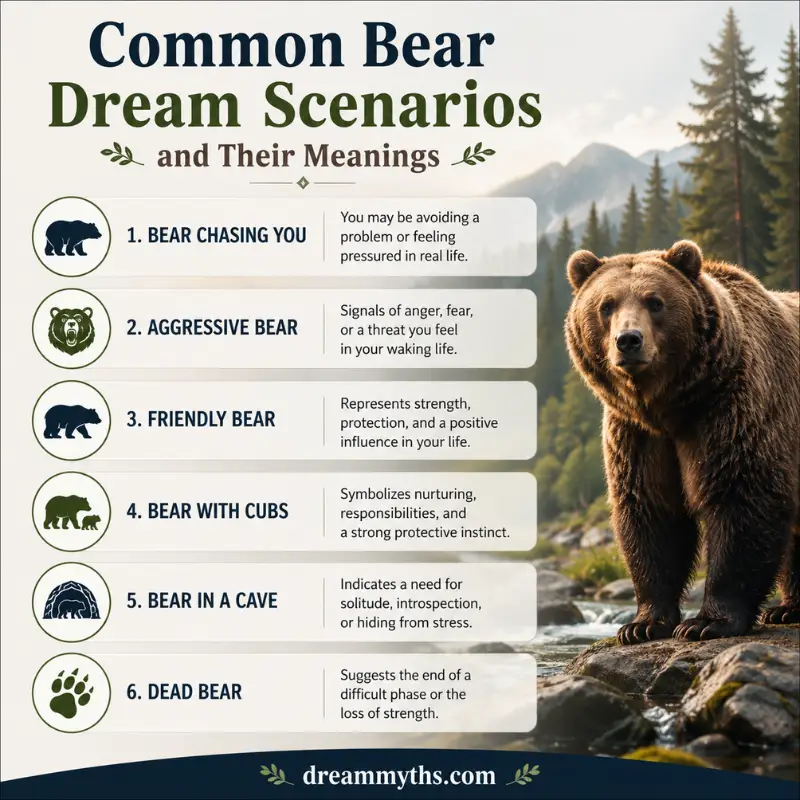
Behaviour is the second-strongest clue after emotion. Here’s the scenario map, then each one in detail.
| Scenario | Core theme | Most likely trigger in the past 14 days |
|---|---|---|
| Bear attacking you | Boundary violation | A confrontation you didn’t choose |
| Bear chasing you | Avoidance | Something you keep postponing |
| Bear watching you | Being assessed | Scrutiny, review, judgement |
| Bear protecting you | Boundaries forming | You defended someone or something |
| Friendly or calm bear | Resolution | Pressure genuinely eased |
| Bear cub | Vulnerability, new beginnings | A new responsibility or project |
| Mother bear with cubs | Caregiving under threat | Family pressure |
| Sleeping or hibernating bear | Dormant anger, delay | A decision you shelved |
| Talking bear | Insight surfacing | A realisation you haven’t voiced |
| Fighting a bear | Direct conflict | An argument in progress |
| Killing a bear | Reclaiming control | You finally said no |
| Dead bear | Endings, exhaustion | Something concluded |
| Bear trap | Feeling stuck | A habit or contract you can’t exit |
Dreaming of a Bear Attacking You
A bear attack is the most-searched bear dream and the most misread. It very rarely concerns physical danger. In my casework it correlates with boundary violation — someone ignored a limit, and your mind rendered that as a body being breached.
Look at where the bear made contact. A bear bite to the hand often shows up alongside work being taken over or credit being claimed. Contact to the back appears more with people who describe feeling undermined by someone they can’t confront. That mapping isn’t a rule, but it’s a useful question to ask.
Then check for internal conflict. Sometimes the attacker is a threatening person, a jealous person, or a selfish person you can name immediately. Sometimes it’s your own unresolved anger, arriving with teeth because you gave it nowhere else to go. Ask yourself which one you’d bet on. Dreamers are usually right on the first guess.
Composite example: A teacher dreamt of a bear breaking through her classroom window and pinning her to the desk. She woke convinced something terrible was coming. Nothing was. A parent had spent three weeks emailing her line manager instead of her. Once she wrote a single direct reply, the dream didn’t return.
What Does It Mean When a Bear Chases You?
A chase is about the thing you’re moving away from, not the thing behind you. Ask what you’re postponing — a conversation, a resignation, a diagnosis, a bill, a decision about a relationship.
Two details change the reading sharply. Whether you look back, which often marks readiness to face the issue. And whether you get away, because escape can mean genuine relief or continued avoidance depending on how you felt when you woke. Relief points to a resolved pressure; dread points to an unfinished one.
Chases also carry grief more often than people expect. When a client is inside the first year after a loss, the pursuing figure frequently isn’t a threat at all — it’s an emotion they haven’t had space to sit with. If the chase leaves you tearful rather than panicked, read for grief before reading for conflict.
Dreaming of a Bear Watching or Staring at You
A watching bear is the appraisal dream. There’s no action, and that’s the point — you’re being evaluated, and the absence of movement is what unsettles you.
This scenario clusters around performance reviews, in-laws, new relationships, immigration or visa processes, and any situation where authority is present but silent. The bear’s stillness reflects a person who has power over an outcome and hasn’t said what they think yet.
Read the bear’s quality of attention. Neutral watching often maps onto wisdom, intelligence, or authority you actually respect — and dreamers frequently describe feeling assessed rather than hunted. Hostile watching points instead toward surveillance, control, or personal material you feel exposed about. Distance matters here too: a bear across a river reads very differently from one at the foot of your bed.
Dreaming of a Bear Protecting You
A bear standing between you and something else is usually the healthiest bear dream there is. It signals boundaries under construction.
I see this most in three groups: people who recently ended a draining relationship, people newly responsible for a vulnerable relative, and people who just enforced a limit at work for the first time in years. Protective instincts show up as a large animal because that’s the scale at which the psyche registers finally, something is on my side.
The reading shifts if the protection feels excessive. When the bear won’t let anyone approach — including people you love — check whether self-protection is hardening into emotional distance. Strong protection and forced isolation look nearly identical from the inside.
Friendly or Calm Bear Dream Meaning
A friendly bear reads best as confirmation rather than instruction. Something that used to frighten you doesn’t anymore.
These dreams often arrive after a genuine shift: healthier boundaries, a resolved argument, a difficult person leaving your orbit. The animal keeps its raw power — nothing about it becomes small — but your nervous system stops flagging it. That’s the whole message, and it’s a good one.
Watch for nurturing traits in the scene, especially if the bear shares food, leads you somewhere, or sits beside you. Those details tilt the reading toward companionship, trust, and emotional connection rather than resolved conflict.
Bear Cub Dream Meaning
Bear cubs shift the frame from power to vulnerability. Something in your life is new, real, and not yet able to defend itself.
Most often that’s a literal new beginning — a business, a pregnancy, a relocation, a course of study, a relationship six weeks old. Cubs carry the emotional signature of promising but fragile. If you felt protective, you’re already invested. If you felt anxious, you’re probably underestimating your own capacity.
Playful bear cubs bring a lighter tone entirely; several clients have described one behaving like a puppy and becoming an approaching companion rather than a threat. Read that as developing abilities and maturity rather than danger. If you hugged the cub, closeness and affection are doing the work, not power.
Mother Bear With Cubs Dream Meaning
The mama bear is the most emotionally consistent image in this entire topic. It means caregiving under pressure.
It appears for parents of teenagers, for adult children managing an ailing parent, for anyone recently made responsible for someone who cannot advocate for themselves. Maternal protection here isn’t gentle — a mother bear is dangerous precisely because she’s protective, and dreamers often report feeling both safe and frightened at once. That contradiction is accurate to the waking situation.
Also consider whether the mother is you. When clients describe watching a mother bear defend cubs from a distance, we usually find they’re witnessing their own protectiveness and haven’t recognised it as theirs. Fertility, a child, children, or someone of personal importance may sit at the centre of the dream without ever appearing in it.
Sleeping or Hibernating Bear Dream Meaning
A hibernating bear is a decision you shelved, and it’s still there.
Hibernation maps onto dormancy with unusual precision: postponed action, an issue temporarily outside conscious attention, energy withdrawn for recovery. The critical question is whether you felt relieved or uneasy watching it sleep. Relief suggests genuine rest and renewal. Unease suggests dormant anger waiting for spring.
Whether you wake the bear matters more than anything else in the scene. If you wake it up in the dream, you’re rehearsing the confrontation. If you tiptoe past, you’re rehearsing avoidance. Either way, personal transformation is on the table — you’re just deciding on the timing.
Dreaming of a Bear Talking to You
A talking bear means a realisation has finished forming and hasn’t been said out loud yet.
Dreams rarely give speech to an animal unless the content is important enough to need words. Note exactly what it said, in its own phrasing, before you interpret anything. Clients who write the sentence down in the first two minutes almost always recognise the source — a piece of advice, a self-criticism, or something they’ve been refusing to admit.
Tone separates the readings. A calm speaking bear points toward wisdom and guidance emerging from unconscious material. A mocking or threatening one usually voices a specific person’s habitual criticism. And a bear whose words you can’t remember is worth revisiting the next night; unfinished messages tend to repeat.
Fighting a Bear in a Dream
Fighting is engagement, and engagement is progress — even when you lose.
This dream shows up during live conflict rather than anticipated conflict. A dispute is actually happening: a legal matter, a family rupture, a workplace escalation, a divorce. The fight reflects an internal struggle over dominance more than a prediction of who wins.
How the fight ends is the whole interpretation. Holding your ground reflects growing confidence. Being overpowered points to a major challenge that currently exceeds your resources — which is information, not a verdict. Fighting to a standstill often appears at a personal crossroads where neither concession nor victory is available yet.
Killing a Bear in a Dream
Killing a bear is the reclaiming dream. Something you feared no longer holds authority over you.
It commonly follows a real act of resistance in the previous week or two — a resignation, a boundary finally enforced, a confrontation you’d delayed for years. Overcoming fear is the dominant theme, and dreamers usually wake feeling capable rather than guilty.
When guilt is present, look again. Occasionally the bear represented something valuable — instinct, appetite, ambition, or a relationship — that you’ve suppressed to gain control. In those cases the same image points toward a goal achieved at a cost you haven’t priced yet.
Seeing a Dead Bear in a Dream
A dead bear is an ending, not a death. In fifteen years I have never once found a credible link between this image and literal physical death.
What it does track: loss of power, exhaustion, and the close of a difficult period. Clients see dead bears after burnout, after a company folds, after an era of caregiving ends. There’s often relief mixed with grief, and both belong.
Transformation is the more hopeful reading, and it’s frequently the right one. Something formidable in your life stopped being formidable. If the dream disturbed you because of a recent bereavement, treat grief and memory as more relevant than symbolism — the mind reaches for large, final images while it processes loss.
Bear Trap Dream Meaning
A bear trap means feeling stuck, and it specifies how.
Notice who’s caught. If the bear is trapped, you’re likely watching your own strength immobilised by circumstances — a contract, a visa, a mortgage, a caregiving duty. If you’re caught, difficult obstacles have become personal rather than situational. If you set the trap, examine whether you’re trying to control something that’s actually interfering with your own progress.
Habits belong in this reading too. Several clients have brought bear-trap dreams while trying to break a pattern they described as bigger than willpower. The trap image captures that exactly: the mechanism was set long ago, and stepping out requires more than intention.
Other Bear Dream Scenarios
Shorter readings for the scenes that come up less often:
- Bears playing — social ease returning; tension you expected didn’t materialise.
- Bear running away — a fear losing its power, or a confrontation you avoided by luck rather than choice.
- An injured bear — impaired strength; often your own energy after a long illness or an exhausting stretch.
- A dancing bear — performance and constraint. Strength made to entertain. Frequently appears for people masking distress at work.
- Feeding a bear — sustaining something demanding. Plans and new ventures if it feels generous; appeasement if it feels obligatory.
- A bear as a pet — managing strong impulses or difficult social interactions. Adaptation, usually with effort.
- A bear standing on its hind legs — intimidation, or making yourself heard. Also defending beliefs.
- A bear looking for food — need, resources, appetite, or literal financial concern.
- A bear attacking a dog — relationship symbolism. The dog usually stands for loyalty, a friend, or a dependent.
- Hugging a bear — a tough exterior meeting acceptance. Often about someone difficult you’ve decided to love anyway.
- Being dragged by a bear — pulled into unwanted circumstances; helplessness intensifies the further you’re dragged.
- A sick bear — exhaustion and impaired strength. Watch your own recovery.
Bear Dream Meaning by Location
Location tells you which part of your life the dream concerns. It’s the fastest way to narrow a reading.
| Where the dream happened | Area of life it usually points to |
|---|---|
| Your house | Family, privacy, the inner circle |
| A cave | Withdrawal, inward change, hidden concerns |
| Forest or wilderness | Instinct, independence, unfamiliar territory |
| Your workplace | Authority, professional pressure |
| Childhood home | Old patterns, family-of-origin material |
| Open water or ice | Emotional distance, frozen emotions |
| A road or vehicle | Direction, life transitions |
Dreams About Bears in the House
A bear indoors is a boundary story. Something powerful got into private space.
The room matters. Kitchen and dining areas tend to appear alongside family concerns and provision; bedrooms alongside intimacy, privacy, or a partner’s behaviour; hallways and doorways alongside people who arrive uninvited. A bear in the house makes the dream feel more intimate than a bear glimpsed across a field, and dreamers report far more distress from it even when nothing happens.
Ask who has recently entered your emotional space without permission — physically, digitally, or conversationally. In-laws, a landlord, a group chat, an ex, a manager who messages at midnight. The domestic setting is the clue that this concerns your personal circle rather than the outside world.
Bear in a Cave Dream Meaning
A cave points inward. This is the introspection dream, and it’s usually not unpleasant.
Caves carry withdrawal, recovery, and hidden material. A bear resting in one often reflects a legitimate need to retreat — after illness, after grief, after months of being available to everyone. Isolation here is functional rather than sad, provided you woke feeling restored.
The reading changes if you were reluctant to enter or unable to leave. Then examine whether solitude has stopped restoring perspective and started avoiding relationships. That distinction — restorative solitude versus forced isolation — decides the entire interpretation.
Dreaming of a Bear in a Forest or Wilderness
Wilderness is the bear’s natural setting, which makes this the most neutral version of the dream. Nothing is out of place, so read the dreamer’s position instead of the animal’s.
If you felt like a visitor, the dream leans toward unfamiliar territory: a new job, a new country, an unfamiliar role. If you felt at home, it leans toward instinct and independence — trusting your own judgement without external input.
Harsh landscapes strengthen themes of adaptation, persistence, and survival. Clients navigating genuinely difficult environments — a hostile workplace, a first winter abroad, single parenthood — dream of bears in snow and scrub far more than in gentle woodland.
Bear Dream Meanings by Color and Type
Colour is a real layer, but it’s the last one. Coat shade adds nuanced depth; emotional tone still decides the interpretation. Treat colour as refinement after emotion, behaviour, and setting are settled — and let your own associations outrank any tradition below.
| Bear type | Traditional association | What I look for in session |
|---|---|---|
| Black bear | Intelligence, authority, the unseen | Isolation; something you’re keeping private |
| Brown bear | Grounded strength, earth connection | Practical matters; dominance in a real relationship |
| White or polar bear | Purity, clarity, resilience | Emotional coldness; frozen emotions; distance |
| Grizzly bear | Pride, raw power, confidence | A challenge that genuinely outmatches you |
| Panda bear | Balance, good fortune, prosperity | Gentleness, persistence, needing calm |
| Sun bear | Masculine energy, self-development | Smaller-than-expected strength; underestimation |
| Gray bear | Ambiguity, ageing, in-between states | Uncertainty; a decision without a clear answer |
| Teddy bear | Nostalgia, childhood, innocence | Safety-seeking; comfort you’ve outgrown or need again |
Black Bear Dream Meaning
Black bear dream meaning leans toward the unseen — material you’re carrying privately. Black bears are also the most adaptable and intelligent of North American species, and dreamers often describe them as watchful rather than aggressive.
In practice this bear shows up around secrecy more than danger: an undisclosed diagnosis, a job application nobody knows about, a doubt you haven’t shared. Authority features too, particularly quiet authority — the person whose opinion decides things without them raising their voice.
Brown Bear Dream Meaning
Brown bears bring grounded strength and earth connection. This is the most physical of the readings: practical matters, money, property, the body, work that requires stamina.
Dominance is the second theme. A brown bear that blocks a path rather than attacking usually maps onto someone immovable in a real negotiation — a landlord, a bureaucracy, a parent. The image emphasises weight and persistence rather than malice.
White or Polar Bear Dream Meaning
Polar bears combine resilience with cold, and dreamers almost always report the cold first. Frozen emotions, emotional distance, and clarity-without-warmth dominate this reading.
I ask two things: whether someone has gone cold on them, and whether they have. A polar bear on ice frequently appears for people who describe managing an unbearable situation by shutting feeling down. Purity and clarity are the traditional associations, and they fit — clarity of that kind usually costs something.
Grizzly Bear Dream Meaning
Grizzlies represent a challenge that outmatches you, and they’re honest about it. Pride, raw power, and confidence sit in this reading, but so does realistic fear.
The useful question isn’t how to defeat it. It’s whether the thing you’re facing genuinely requires this much from you — because sometimes the dream is inflating a manageable problem, and sometimes it’s correctly sizing one you’ve been minimising.
Panda Bear Dream Meaning
Pandas break the pattern, and that’s their value. They carry gentleness, balance, patience, good fortune, and prosperity in Chinese-influenced symbolism, and modern dreamers bring their own affectionate associations too.
A panda in an otherwise tense dream usually signals a need for calm rather than confrontation. Black-and-white symbolism can also point to a situation you’ve been framing in absolutes when it isn’t one.
Sun Bear Dream Meaning
Sun bears are the smallest bear species, and that detail does the interpretive work: strength that gets underestimated, including your own. Masculine energy and self-development feature in traditional readings.
This bear appears for people who feel dismissed on the basis of size, age, seniority, or volume. The dream tends to insist that capability and presentation aren’t the same thing.
Gray Bear Dream Meaning
Grey occupies the space between, so this reading centres on ambiguity. Bear types blur, colouring is uncertain, and dreamers often can’t say what species they saw.
That uncertainty is the message. Grey bear dreams cluster around decisions with no clear right answer, ageing, and personal qualities you’re re-evaluating. Don’t force clarity onto dream imagery that arrived deliberately unclear.
Teddy Bear Dream Meaning
A teddy bear dream is a comfort dream, and it’s almost always about a specific era of your life. Nostalgia, childhood, safety, and innocence are all in play.
Two readings compete. A teddy bear that comforts you signals a legitimate need for reassurance during strain. A teddy bear that unsettles you — worn, damaged, or oddly animate — usually points to a childhood association that hasn’t finished resolving. Note whether you were your current age in the dream.
Accuracy note worth keeping: a koala is not a bear. Koalas are marsupials. If a koala appears in your dream, interpret it separately rather than folding it into bear symbolism.
Bear Dream Meaning by Size and Number
Size and number set the emotional scale. One large bear concentrates attention on a single powerful problem; multiple bears suggest several pressures operating at once.
Giant Bear Dream Meaning
A giant bear makes an issue impossible to ignore. Its exaggerated size reflects intimidating circumstances, an overpowering person, an authority figure, or professional pressure that currently feels bigger than your available resources.
Position tells you which reading applies. A giant bear that blocks you mirrors an obstacle; one that follows you mirrors pressure; one that simply stands nearby often reflects greater strength and untapped psychological resilience rather than danger. A calm giant is frequently the most encouraging bear dream in this entire guide — enormous power, no threat.
Multiple Bears or a Group of Bears Dream Meaning
A group of bears points toward several people or pressures competing for attention. Two bears confronting each other resembles divided loyalties, opponents, conflicting habits, or two competing sides of an inner conflict; bears fighting highlights tension that hasn’t settled.
Crowded bear dreams also reflect social dynamics. Controlling personalities, extreme possessiveness, jealousy, or someone monopolising attention can leave a dreamer feeling surrounded. But many bears may equally symbolise family, collective support, or complicated social interactions rather than hostility.
The distinction is simple: do the bears cooperate, compete, or refuse to share? Cooperation reads as community. Competition reads as rivalry. Unwillingness to share reads as possessiveness — and that version appears most often for people negotiating inheritance, custody, or credit at work.
Recurring Bear Dreams: Why the Bear Keeps Coming Back
Recurring bear dreams mean something in the pattern is still emotionally active. They cluster around stress, major transitions, a repeated relationship problem, or an issue that returns after periods of apparent dormancy.
A bear that disappears and returns resembles re-emergence and new cycles — in relationships, work, health, or personal development. A hibernating bear suggests postponed action or an issue temporarily outside conscious attention. Recurrence also rises during sleep problems and periods of heightened strain, which is worth ruling out before reaching for symbolism.
From a psychological angle, repeating bears surface around suppressed emotion, unconscious instincts, or unresolved shadow self material. Jungian shadow interpretation is one useful framework here — not a universal explanation.
What Changes Between Recurring Bear Dreams?
The changes matter more than the repetition. Compare movement, distance, size, behaviour, and setting. Note whether another person appears, whether the animal grows calmer or more aggressive, and whether the ending differs.
Those shifts usually track real developments. A bear that once chased you and now watches quietly suggests an overwhelming concern has become manageable. Rising aggression mirrors growing pressure, strong emotions, or a problem that’s become harder to avoid. Most recurring dreams evolve gradually, so the most informative clue is often a change in distance, in your reaction, or in the ending — not in the bear.
How to Track Recurring Bear Dreams
Keep a simple dream record, and write it before you check your phone. This is the single highest-value habit in dream interpretation, and it takes ninety seconds.
Log these seven fields:
- Bear’s behaviour — what it actually did, in order
- Location — and whether it resembles a real place
- Size, colour, and number
- Who else was there
- Emotion during — one word is enough
- Emotion on waking — often different from the above
- Waking context — stress, deadlines, arguments, health, decisions in the past 72 hours
| Date | Behaviour | Location | Emotion during | Emotion on waking | What was happening that week |
|---|---|---|---|---|---|
After three or four entries, patterns surface that no single dream reveals. Also account for dreamer identity: bear imagery reads differently for parents, pregnant women, professionals, creative people, grieving people, athletes, young adults, and children, because their immediate concerns differ. Those differences matter far more than any generic interpretation copied from a symbol dictionary.
Religious Meanings of Bear Dreams
Religious interpretations need care, because religious symbolism, spiritual symbolism, and cultural dream traditions are not interchangeable — and interpretive variation exists inside every faith community. What follows is presented as interpretive tradition, not doctrine.
Bear Dream Meaning in Islam
Classical Islamic dream interpretation has a genuine literature behind it. Muhammad ibn Sirin (d. 728 CE), whose name is attached to the best-known early corpus, and Abd al-Ghani al-Nabulsi (d. 1731), author of Ta’tir al-Anam, are the two figures most often cited. In that tradition, the bear (dubb) is commonly associated with a hostile, deceptive, or treacherous enemy — sometimes specifically a foolish adversary, or one acting with malicious intent.
Two qualifications matter more than the symbol itself. First, the tradition classifies dreams into categories — a true dream, dreams arising from one’s own thoughts, and disturbing dreams — so not every dream is treated as meaningful in the first place. Second, classical interpreters weighed the dreamer’s character, circumstances, and situation heavily, rather than applying one symbol to everyone.
So a frightening bear does not establish that a particular person is dangerous. Online summaries that present hostility, deception, or treachery as a fixed Islamic rule are overstating a tradition that was consistently context-dependent. For religious guidance specific to your situation, a qualified scholar is the appropriate source.
Biblical Meaning of Bears in Dreams
Scripture uses bears in several distinct ways, and knowing which one your dream resembles is more useful than a general symbol.
| Passage | How the bear functions |
|---|---|
| 1 Samuel 17:34–37 | David recounts killing a bear defending his flock — courage and protection |
| 2 Kings 2:23–24 | Two bears come out after Elisha is mocked — judgement |
| Proverbs 17:12 | A bear robbed of her cubs, invoked as more approachable than a fool — maternal fury |
| Hosea 13:8 | Divine judgement pictured as a bear robbed of her cubs |
| Daniel 7:5 | The second beast in Daniel’s vision resembles a bear — imperial power |
| Amos 5:19, Lamentations 3:10 | The bear as inescapable danger |
Read together, biblical bears carry wild power, protection, judgement, and imperial strength depending entirely on setting. A modern Christian reading of a bear dream might therefore focus on strength, caution, spiritual testing, or confronting fear — while recognising that Scripture doesn’t supply a dream dictionary. The dream can prompt reflection, prayer, courage, or moral examination without being treated as a guaranteed divine message.
Bear Symbolism in Dreams Across Cultures
Bear imagery appears across North America, Europe, China, Russia, and northern Eurasia, and the meanings genuinely differ. Cultural symbolism should not flatten distinct traditions into one universal idea.
| Tradition | Association most often documented |
|---|---|
| Indigenous North American (nation-specific) | Protection, medicine, healing, leadership |
| Norse | Warrior courage, primal force, endurance |
| Greek and Roman | Transformation, the constellations, rites of passage |
| Chinese | Strength, status, endurance, honour |
| Japanese (incl. Ainu) | Divinity, wilderness, reciprocity with nature |
| Celtic | Sovereignty, protection, wilderness |
| Russian and Slavic folklore | Strength, land, national identity |
| Siberian and Inuit | Survival, respect, ecological relationship |
Native American and Indigenous Bear Symbolism
There is no single Indigenous belief system about bears. Different nations have distinct histories, ceremonies, stories, and relationships with local bear species, and treating them as one tradition produces misleading interpretations.
Some specifics, offered as examples rather than a general rule: among the Anishinaabe, the Bear clan (Makwa doodem) is traditionally associated with protection and medicine knowledge. Zuni carving traditions include bear figures linked with healing directions. Strength, medicine, protection, leadership, and healing all appear in the wider literature — but they belong to particular nations, not to a generic “Native American symbolism.”
If Indigenous symbolism matters to your reading, work from the specific cultural source rather than a pan-tribal summary.
Norse Bear Symbolism
In Norse tradition the bear sits close to warrior identity. The berserkers — whose name is usually traced to ber-serkr, “bear-shirt” — supply most of the modern association with primal force, endurance, and battle courage. The legendary hero Bödvar Bjarki, whose name means “little bear,” fights in bear form in Hrólfs saga kraka.
These themes enrich a reading when they’re relevant to the dreamer. They shouldn’t be imposed on every bear dream simply because they sound dramatic. Your own experience remains more useful than a borrowed mythology.
Greek and Roman Bear Symbolism
Greek tradition gives us the oldest surviving bear-transformation story in Europe: Callisto, transformed into a bear and placed among the stars as Ursa Major — the Great Bear — with Ursa Minor nearby. Young Athenian girls serving Artemis at Brauron were called arktoi, “little bears,” as part of a rite of passage.
That inheritance is why bear imagery still carries transformation and threshold associations in European interpretation. If your dream involved changing form, being watched from above, or a girl or young woman alongside the bear, this layer may be worth considering.
Chinese Bear Symbolism
In Chinese tradition, bears have been associated with strength, status, endurance, and honour, while pandas carry largely modern associations with balance, patience, positive energy, good fortune, and prosperity.
China contains long and varied cultural traditions, so no single symbolic reading represents every period or community. Context still decides whether a dream emphasises authority, gentleness, or endurance.
Japanese Bear Symbolism
Bear symbolism in Japan varies sharply by region and period. The clearest documented tradition is Ainu rather than mainland: in Ainu cosmology bears were understood as kamuy — divine beings visiting in animal form — and the iyomante ceremony returned the bear’s spirit to its own world with honour.
Shinto perspectives on animals and nature can’t be reduced to a single dream meaning. If Japanese symbolism matters personally to you, use the specific tradition as context rather than decoration.
Celtic Bear Symbolism
Evidence here is real but uneven. The bear goddess Artio is attested in a bronze group from Muri, near Bern, and the divine epithet Artaios appears in Gaulish inscriptions. The Celtic root art- meaning “bear” is often connected to the name Arthur, though that link remains debated.
Modern discussions connect Celtic bears with strength, protection, authority, sovereignty, and wilderness. Those themes can be useful when they resonate with your background — but Europe contained many separate traditions, not one shared symbolic system, and sweeping claims about a single ancient Celtic bear meaning should be treated sceptically.
Russian Bear Symbolism
The bear is woven deep into Russian culture — folklore, popular culture, political imagery, and representations of the land itself. The Russian word medved literally means “honey-eater,” a substitution that suggests the animal’s real name was once avoided out of respect or fear, a pattern found across northern Eurasia.
For a dreamer with Russian cultural connection, a bear dream may feel tied to identity, homeland, endurance, or power. Those associations shouldn’t override personal experience, and they certainly shouldn’t be assumed to apply to every Russian dreamer identically.
Siberian and Inuit Bear Symbolism
Circumpolar cultures have lived alongside bears in demanding environments for millennia, which makes survival, respect, hunting ethics, and ecological relationship central. Siberian bear ceremonialism is widely documented across multiple peoples; in Inuit tradition, Nanuq — the polar bear — holds a particularly significant place, and Siberian healers named bears among the totem animals credited with protecting communities.
These traditions are diverse and should never be described as one shared belief. For some dreamers, northern bear imagery evokes survival, adaptation, and endurance through adversity — meanings that strengthen considerably when they connect to actual heritage or experience rather than generic spiritual claims.
What Your Bear Dream Does Not Automatically Mean
A vivid bear dream can feel important without carrying a literal message. This section exists because most of the anxiety I encounter comes from claims that were never true in the first place.
A Bear Dream Is Not Automatically a Bad Omen
A frightening dream is not automatically a bad sign, and calm peaceful bears do not guarantee a good sign. Threatening bears usually reflect stress, fear, unresolved conflict, or ordinary emotional processing rather than an external warning.
Context decides. Before you conclude a dream is ominous or favourable, check recent events, relationships, and unresolved issues. The dream is commentary on your week, not a forecast of your month.
A Bear Dream Does Not Have One Universal Meaning
No single interpretation works for everyone. Dreams involving loneliness, extreme independence, possessiveness, growth, or protective traits can look nearly identical on the surface while reflecting entirely different waking concerns.
Personal history changes everything. Childhood qualities, family relationships, cultural background, fears, wildlife experiences, and spiritual beliefs all shift meaning. Someone who associates bears with danger will read the same dream very differently from someone who connects them with affection or growing confidence — and both readings can be correct for their own dreamer.
A Bear Dream Is Not Necessarily a Prediction
Dream imagery is not evidence that a specific event will occur. A bear may feel like a warning, but the feeling alone establishes nothing. Even disturbing death-related imagery does not indicate approaching physical death.
Dreams reflect memory, emotional processing, stress, expectation, fear, dormancy, and unresolved concerns. Treat symbolic readings as possibilities, never forecasts. That distinction matters most when a dream triggers real anxiety or tempts you toward a major decision based only on symbolism.
How to Interpret Your Bear Dream: A 7-Step Method
This is the sequence I use in session. Work through it in order — the order is what keeps the reading grounded.
- Write down what happened before you interpret anything.
- Name the emotion during the dream in one word.
- Name the emotion on waking.
- Identify the bear’s behaviour.
- Identify the location.
- Note size, colour, and number last.
- Compare all of it against the past two weeks of your life.
What Was the Bear Doing?
Behaviour changes meaning dramatically. An attack, biting, or bear bite feels confrontational; hugging a bear or showing affection describes an entirely different relationship with the same animal. A tough exterior paired with friendliness can even suggest acceptance and understanding.
Smaller details carry weight. A bear standing on its hind legs may read as intimidation or as making yourself heard — including defending beliefs. A bear looking for food shifts attention toward need, resources, appetite, or literal financial concerns. Being dragged reflects being pulled into unwanted circumstances, and being dragged toward danger intensifies helplessness. A bear hunt focuses on pursuit, control, or challenge rather than fear.
Two actions deserve special attention. If you wake up a bear, the scene often symbolises reviving something dormant — a forgotten talent, a neglected skill, a buried personality trait. And a bear as a pet creates its own dynamic: adaptation, managing strong impulses, and navigating difficult social interactions. Even a bear attacking a dog introduces relationship symbolism through what the dog represents to you.
How Did You Feel?
Emotion usually tells you more than the animal. Fear suggests threat or pressure; happiness, pleasure, and enjoyment turn the same bear into a positive presence. Strong emotions after waking are the most useful clues you’ll get all day, which is exactly why they need writing down before they fade.
A gentle bear brings affection, comfort, and relaxed traits. Discomfort points toward mistrust, control, or unresolved tension. Dreams can also mark the process of releasing stress, or show you becoming gradually more comfortable with something difficult.
If the dream left you feeling small, trapped, or isolated, consider loneliness, discomfort, or an imbalance in a relationship. If you woke feeling capable, read for psychological strength, emerging strengths, and growing confidence instead.
What Kind of Bear Was It?
Species, age, and appearance add personal associations. A young bear, baby bears, or a bear cub emphasises vulnerability, developing abilities, family concerns, or maturity. A mama bear with cubs pulls attention toward fertility, caregiving, a child, children, or someone of personal importance.
Colour matters only insofar as it means something to you. Brown bears may suggest earthiness and practical matters; polar imagery may evoke emotional coldness, distance, or frozen emotions; pandas may bring gentleness, prosperity, or persistence. Compare inherited meanings against what you actually felt.
Where Did the Dream Happen?
Location establishes emotional context. A bear in the home or bear in the house brings the dream directly into your personal circle, family life, privacy, or domestic circle — which is why home settings feel far more intimate than a bear seen at a distance.
Cave imagery suggests withdrawal, inward change, recovery, or hidden concerns. A forest emphasises uncertainty, instinct, independence, or entering unfamiliar territory. Harsh landscapes strengthen adaptation, persistence, and survival.
Then ask the practical question: does the setting resemble work, childhood, travel, home, or a place tied to a particular relationship, project, or family member? That resemblance is often the fastest route to the answer.
Was the Bear Large, Small, Alone, or in a Group?
Size and number set intensity. A large bear magnifies a challenge; a small or young bear makes the same theme feel manageable or still developing. Several bears may represent multiple concerns, family dynamics, or social pressure.
A solitary bear may relate to extreme independence. A group can suggest community or collective tension. If the bears compete, themes of unwillingness to share, possessiveness, or social rivalry move to the front.
How Did the Dream End?
Endings reveal whether the dream moved toward resolution or stayed in tension. An escape can reflect genuine relief — or avoiding problems instead of confronting them, which your waking mood will usually clarify. Becoming restricted or overwhelmed suggests the central issue still feels unresolved.
If you were unable to progress, look for waking-life obstacles, restriction, or stagnation. A sick bear reinforces exhaustion or impaired strength; recovery imagery suggests healing. Setting a trap in the dream may symbolise attempts to control circumstances that are actually interfering with your progress. A peaceful ending signals adjustment, emotional acceptance, or movement past a difficult period.
What Is Happening in Your Waking Life?
This is the most important question in the guide, and the one most dream dictionaries never ask.
Bear dreams coincide with professional pressure, a difficult person, a demanding authority figure, financial concerns, or financial restraint. They arrive during practical matters, family changes, and major projects. Relationships deserve attention too — a sibling, child, family member, or influential female figure may connect with caregiving, conflict, or protection, and dreams involving a mother and cubs can reflect fertility, parenting, dependency, or responsibility.
Life stage shapes everything. Pregnant women, parents, young adults, professionals, creative people, athletes, and grieving people bring very different concerns into sleep, and periods of major transition intensify symbolic imagery because identity and priorities are actively changing.
Finally, ask whether you’re suppressing yourself, dealing with crossed boundaries, or managing controlling personalities and overbearing behaviour. More often than not, the dream is pointing toward personal authority, growth, or stronger limits — not toward an external omen.
When a Bear Dream Is Worth Taking to a Professional
Most bear dreams are ordinary emotional processing. A few are worth mentioning to a doctor or therapist rather than a dream interpreter:
- Nightmares that recur several times a week and disrupt your sleep quality
- Waking distress that lasts into the day, or dread about falling asleep
- Bear dreams that began after a frightening or traumatic event
- Dreams accompanied by daytime anxiety that’s getting harder to manage
Recurrent, distressing nightmares are treatable — imagery rehearsal therapy has a solid evidence base — and a symbolic reading is not a substitute for that. If your dreams are costing you sleep, treat the sleep first. The symbolism will still be there afterwards.
Frequently Asked Questions
Is Dreaming About a Bear a Good or Bad Sign?
It can be either, or neither. Calm, friendly behaviour supports a positive interpretation; aggressive or threatening bears may reflect fear, stress, or unresolved issues. Neither guarantees a good sign or a bad sign — the bear’s behaviour, your feelings, and your current context decide.
Does a Bear Dream Predict Something Will Happen?
Not reliably. A vivid dream can feel meaningful without being predictive. Traditional dream-book interpretations often assign future-oriented meanings, but those belong to symbolic tradition rather than fact. Use the dream as a prompt for reflection on current life instead.
Does Dreaming About a Bear Mean Death?
Usually no. A bear dream does not predict death or physical death. Even a dead bear or death-related imagery more commonly symbolises endings, exhaustion, transformation, dormancy, or the close of a difficult period. If the dream upset you because of a recent loss, grief and memory are likely more relevant than symbolism.
Can Stress or Anxiety Cause Bear Dreams?
Yes, frequently. Stress influences dream content, especially when you feel pressured, threatened, or emotionally overloaded — and recurring bear dreams often cluster in intense stress periods alongside other pursuit, conflict, or threatening dreams. Anxiety amplifies suppressed emotion, inner conflict, and fear of a major difficulty.
Why Did the Bear Dream Feel So Real?
Vividness tracks emotional intensity, not prophecy. Dreams involving powerful forces, fear, or raw power produce an intense emotional response that keeps the imagery memorable long after waking. The bear may also tap unconscious instincts, fear of opponents, loneliness, or concerns about safety and control.
What Should I Write Down After a Bear Dream?
Record the bear’s appearance, size, behaviour, movement, location, your emotions, and how the dream ended. Note whether anyone else appeared and what happened immediately before you woke. Then add waking-life details — relationships, work, stress, health, recent changes, decisions. Comparing several entries reveals recurring themes far more clearly than analysing one dream in isolation.
Can Two People Have the Same Bear Dream and Different Meanings?
Yes, and they usually do. Identical imagery carries different meaning because personal associations differ. A wildlife biologist, a parent of a newborn, and someone raised on bear-attack news stories will each produce a legitimate but distinct reading of the same scene.
Does the Bear’s Colour Really Matter?
Less than most guides claim. Colour is a refining layer, not a determining one. If you can’t remember the colour, you haven’t lost anything important — emotion and behaviour carry the reading. If the colour was unusually vivid, then it’s worth weighing.
Final Thoughts on Bear Dream Meaning
The most reliable bear dream meaning is the one built in the right order: emotion, then behaviour, then setting, then symbol. Reverse that order and you get a horoscope. Keep it and you get something genuinely useful — a readable account of what your own mind was working on while you slept.
Bears earned their place in dreams honestly. They sit in Palaeolithic cave art, in Siberian shamanism, in Norse warrior identity, in Greek constellations, in Ainu ceremony, in Russian folklore, and in Jung’s account of the shadow, because human beings have always used the largest animal in the landscape to think about the largest forces in a life — power, protection, appetite, and endurance.
What that means for your dream is smaller and more practical. Somewhere in the last two weeks, something powerful stood close to you. Keep a journal beside your bed, write down the feeling before the details, and look for the overbearing person or the pressure you haven’t named yet. In fifteen years, that has explained more bear dreams than every symbol dictionary put together.