
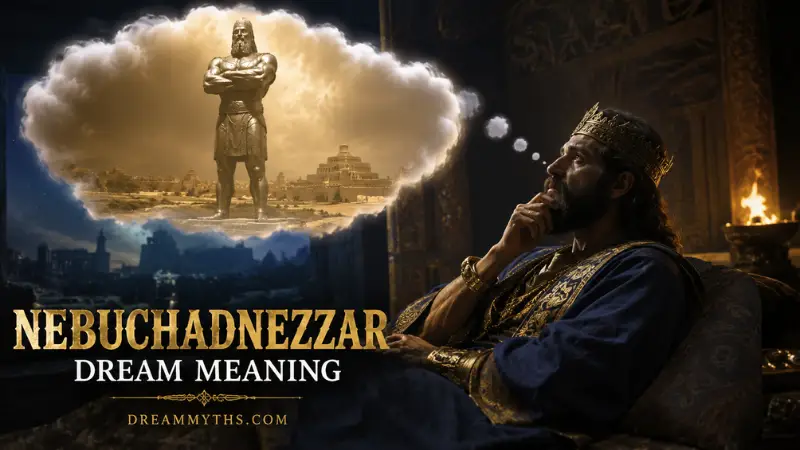
Nebuchadnezzar dream meaning is closely connected with power, pride, divine authority, future kingdoms, judgment, and the lasting rule of God. In the Book of Daniel, King Nebuchadnezzar receives more than one important dream, and Daniel becomes the person who explains what the visions mean. The best-known vision is the enormous statue in Daniel 2, while Daniel 4 records a later dream about a great tree.
The two dreams share an important message: human power does not last forever, and God remains sovereign over kings and kingdoms. Daniel does not present himself as the source of supernatural wisdom. Instead, he gives credit to God for revealing mysteries that human advisers could not understand.
If you are researching Nebuchadnezzar dream meaning because you had a dream involving a king, statue, tree, gold, destruction, or a message about the future, the biblical account offers useful symbolic themes. However, a personal dream should not automatically be treated as a prophecy. Biblical dream interpretation belongs to its specific historical and religious setting.
Quick answer: Nebuchadnezzar dream meaning centers on the limits of human power and the sovereignty of God. Daniel 2 uses a giant statue to represent successive kingdoms, while Daniel 4 uses a great tree to represent Nebuchadnezzar’s pride and downfall. Together, the dreams emphasize humility, judgment, repentance, and the enduring authority of God.
What Is the Nebuchadnezzar Dream Meaning in the Bible?
The biblical Nebuchadnezzar dream meaning is that earthly kingdoms rise and fall under God’s authority. Daniel 2 describes a huge image made from several materials, while Daniel 4 describes a massive tree that is eventually cut down. Both visions place a powerful king in a larger story about divine sovereignty.
Nebuchadnezzar was the king of Babylon. In Daniel 2, he becomes deeply troubled after a dream and demands that his advisers tell him both the dream and its interpretation. The advisers cannot satisfy his demand. Daniel then seeks God, and the mystery is revealed to him.
The account is unusual because Daniel does not simply interpret information that Nebuchadnezzar has already supplied. Daniel first describes the dream and then explains its meaning. According to the biblical narrative, the revelation comes from God.
This detail is central to Nebuchadnezzar dream meaning. The story is not mainly about decoding random symbols. It is about the difference between human knowledge and divine revelation.
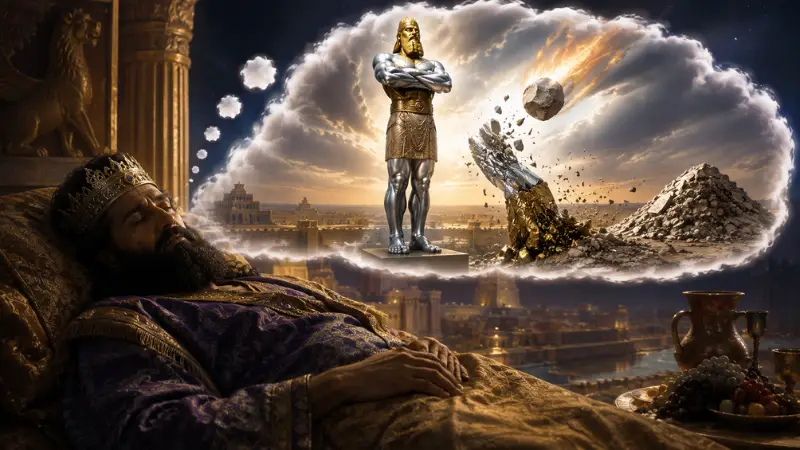
The dream contains a striking statue:
- A head of gold
- A chest and arms of silver
- A belly and thighs of bronze
- Legs of iron
- Feet partly made of iron and partly of clay
- A stone that strikes the image and destroys it
Daniel explains that Nebuchadnezzar represents the head of gold. Later kingdoms follow, and the final image is destroyed by a stone that becomes a great mountain.
The central point is that even an impressive empire has limits. Babylon may appear powerful, but it does not possess permanent authority.
That makes Nebuchadnezzar dream meaning especially important for readers interested in biblical symbolism. The image moves from human achievement toward divine permanence. Gold looks magnificent, iron looks strong, and the statue appears imposing, but none of those materials can withstand the stone.
Why Did Nebuchadnezzar Have the Dream?
Nebuchadnezzar dream meaning becomes clearer when the purpose of the dream is considered. Daniel says the revelation concerns what would happen after Nebuchadnezzar’s time and reaches toward future events. The dream therefore functions as a message about kingdoms rather than merely a private experience.
Nebuchadnezzar was troubled by the dream. His reaction shows that he understood it had significance, even though he did not know what that significance was.
His advisers included magicians, astrologers, sorcerers, and Chaldeans. They asked the king to tell them the dream so they could provide an interpretation. Nebuchadnezzar refused. He wanted them to reveal the dream itself as proof that their interpretation could be trusted.
The demand created a crisis.
Daniel responded differently from the king’s advisers. He asked for time and sought God rather than pretending to possess knowledge he did not have. The narrative presents prayer and divine revelation as the solution.
This part of Nebuchadnezzar dream meaning can also be understood as a lesson about humility. Daniel does not claim that he is smarter than everyone else. When he later speaks to the king, he gives the credit to God.
The story therefore contrasts two approaches to mystery:
- Human advisers attempt to solve the mystery through their own abilities.
- Daniel recognizes that the answer must come through God.
That contrast is one reason Daniel’s interpretation is central to the entire account.
What Was Nebuchadnezzar’s Dream About?
Nebuchadnezzar dream meaning in Daniel 2 is based on a giant statue representing a sequence of earthly kingdoms. Daniel describes the statue before explaining its symbolism. The head is gold, the chest and arms are silver, the belly and thighs are bronze, and the legs are iron. The feet combine iron and clay.
The statue is impressive but unstable at its base. A stone appears without human construction and strikes the feet of the statue. The entire image collapses.
The materials are significant because they show changing kingdoms and changing forms of strength. Gold represents Nebuchadnezzar and Babylon in Daniel’s interpretation. The later materials represent kingdoms that follow.
The exact identification of every kingdom has been discussed differently by interpreters, but a common Christian interpretation identifies the sequence as Babylon, Medo-Persia, Greece, and Rome. Enduring Word presents this traditional sequence in its Daniel 2 commentary.
The most important part of the vision is not simply identifying every empire. The dream ends with a kingdom established by God that will not be destroyed like the kingdoms represented by the statue.
For this reason, Nebuchadnezzar dream meaning is strongly connected with temporary versus lasting power.
A king can control armies, territory, wealth, and political institutions. Yet the dream says those achievements remain temporary when compared with God’s kingdom.
What Do the Four Parts of the Statue Mean?
The statue in Daniel 2 contains several materials, and each part receives an interpretation from Daniel. Understanding these parts helps explain Nebuchadnezzar dream meaning.
| Statue part | Material | Biblical association |
|---|---|---|
| Head | Gold | Nebuchadnezzar and Babylon |
| Chest and arms | Silver | A later kingdom |
| Belly and thighs | Bronze | A third kingdom |
| Legs | Iron | A powerful fourth kingdom |
| Feet and toes | Iron and clay | A divided and fragile phase |
| Stone | Stone | God’s enduring kingdom |
Daniel directly identifies Nebuchadnezzar as the head of gold. The next kingdom is described as inferior to his kingdom, followed by a third kingdom and then a fourth kingdom characterized by unusual strength. The final feet contain both strength and weakness.
The contrast between iron and clay is particularly meaningful. Iron is strong, while clay is fragile. Their combination creates an image of something that has power but lacks lasting unity.
This explains another dimension of Nebuchadnezzar dream meaning: political strength alone cannot guarantee permanence.
The statue may look powerful from a distance, but its foundation is vulnerable.
What Does the Stone in Nebuchadnezzar’s Dream Represent?
The stone in Nebuchadnezzar dream meaning represents the kingdom established by God. Daniel describes the stone as being cut without human hands. It strikes the statue at its feet, destroys the entire image, and then becomes a great mountain that fills the earth.
The stone is important because it changes the direction of the entire dream.
The statue represents human kingdoms. The stone represents something that does not originate from ordinary human political power.
Daniel explains that God will establish a kingdom that will not be destroyed. Unlike the kingdoms represented by gold, silver, bronze, iron, and clay, this kingdom endures.
For Christian readers, this is often understood as pointing toward God’s everlasting kingdom. The emphasis is on permanence rather than temporary political success.
The image also provides a strong contrast:
- Human kingdoms rise.
- Human kingdoms become powerful.
- Human kingdoms weaken.
- Human kingdoms eventually fall.
- God’s kingdom remains.
That contrast gives Nebuchadnezzar dream meaning its larger theological message.
What Are the Kingdoms in Nebuchadnezzar’s Dream?
The kingdoms in Nebuchadnezzar dream meaning are traditionally understood by many Christian interpreters as Babylon, Medo-Persia, Greece, and Rome. Daniel clearly identifies Babylon through Nebuchadnezzar, while the remaining kingdoms are described through the changing materials of the statue.
The first kingdom is represented by gold. Nebuchadnezzar is told that he is the head of gold because God has given him his kingdom, power, strength, and glory.
The second kingdom is represented by silver. Daniel says it will be inferior to the first.
The third kingdom is represented by bronze and is described as ruling broadly.
The fourth kingdom is represented by iron. Iron emphasizes strength and crushing power.
The feet and toes introduce another condition: strength mixed with fragility. Daniel describes a divided kingdom that cannot hold together like iron does not naturally bond with clay.
A common interpretation connects these kingdoms with major empires of the ancient world. However, readers should distinguish between what Daniel explicitly says and later interpretive systems that assign historical names to every part.
The safest central conclusion is that Nebuchadnezzar dream meaning concerns a succession of kingdoms and the ultimate superiority of God’s kingdom.
What Does Nebuchadnezzar’s Tree Dream Mean?
Nebuchadnezzar dream meaning also applies to Daniel 4, where the king dreams about an enormous tree. This dream is different from the statue vision in Daniel 2, but the central theme remains related: human greatness is subject to divine authority.
In Daniel 4, Nebuchadnezzar sees a tree that grows large and becomes visible across the earth. It provides food and shelter, and creatures benefit from it. Then a heavenly messenger orders that the tree be cut down. Its stump remains, however, with a band around it.
Daniel interprets the tree as Nebuchadnezzar himself.
The king’s greatness has expanded, but the dream warns that his pride will bring him down. Daniel tells him to turn away from wrongdoing and show mercy to the poor. The dream eventually becomes reality, and Nebuchadnezzar experiences humiliation before recognizing God’s authority.
The tree therefore adds another layer to Nebuchadnezzar dream meaning.
The statue emphasizes the rise and fall of kingdoms.
The tree emphasizes the rise and fall of a proud individual ruler.
Together, they create a consistent message about human power.
Nebuchadnezzar Dream Meaning and Pride
Pride is one of the strongest themes connected with Nebuchadnezzar dream meaning. Daniel 4 shows a king who has reached tremendous political power but must learn that his position does not make him independent of God.
The tree represents greatness, influence, and authority. Yet the tree is cut down.
The lesson is not that success itself is wrong. The warning concerns the belief that success belongs entirely to the individual.
Nebuchadnezzar’s story presents a movement from confidence in personal greatness toward recognition of divine authority. Reformed Theological Seminary describes Daniel 4 as a climax of the theme of God’s sovereignty over nations and individuals and connects the chapter with repentance.
For a person studying Nebuchadnezzar dream meaning today, this theme can provide a useful reflection point. A dream involving a king, throne, tower, enormous tree, or collapsing structure may symbolize questions about authority or personal control. That does not mean the dream has the same divine status as Daniel’s biblical vision.
Personal dreams should be interpreted within personal circumstances rather than automatically equated with biblical prophecy.
Nebuchadnezzar Dream Meaning and Humility
Humility is another major lesson. Daniel could have used the king’s crisis to make himself appear powerful, but the biblical narrative shows him giving God the credit for the revelation.
Nebuchadnezzar also learns humility through the experience described in Daniel 4.
This makes Nebuchadnezzar dream meaning relevant to anyone reflecting on authority, achievement, or control. A dream may bring attention to areas where a person feels powerful, powerless, praised, challenged, or afraid of losing control.
Possible symbolic themes include:
- Pride after success
- Fear of losing authority
- A major life transition
- Recognition of personal limits
- A need for humility
- Concern about future consequences
- A desire for greater spiritual understanding
These possibilities are psychological or symbolic interpretations, not guaranteed predictions.
The biblical account itself is more specific. Daniel interprets the king’s dream as a divine warning, and the narrative shows the warning being fulfilled.
Is Nebuchadnezzar’s Dream a Prophecy?
Nebuchadnezzar dream meaning in Daniel 2 has a prophetic dimension because Daniel says the revelation concerns future kingdoms and what will happen later. The biblical text presents the dream as a message revealed by God, not simply as an ordinary psychological dream.
That distinction matters.
Not every dream that feels powerful is prophetic.
A person may dream about a future event because of memory, fear, expectation, stress, religious belief, or ordinary dream processes. A vivid dream can feel meaningful without predicting an actual event.
Daniel’s situation is unique within the biblical story. The text explicitly presents God as revealing the mystery.
Therefore, someone asking about Nebuchadnezzar dream meaning should avoid assuming that every modern dream containing similar symbols carries a prophetic message.
A better approach is to ask:
- What symbols appeared in the dream?
- What emotions did the dream create?
- What was happening in waking life?
- Does the dream connect with an existing fear or concern?
- What does the biblical passage actually say?
- Am I separating biblical teaching from personal speculation?
This approach allows spiritual reflection without treating every dream as a prediction.
What Does the Dream of Nebuchadnezzar Teach About God?
Nebuchadnezzar dream meaning repeatedly points toward God’s sovereignty. In Daniel 2, God reveals the mystery that human advisers cannot discover. In Daniel 4, God humbles a powerful king and brings him to recognize divine authority.
The message can be summarized through several themes.
God reveals what humans cannot know. Daniel does not claim independent supernatural power. He attributes the revelation to God.
God controls kingdoms. Nebuchadnezzar has enormous political power, but his authority is presented as something permitted by God.
Human glory is temporary. The statue is eventually destroyed, and the great tree is cut down.
God’s kingdom is lasting. The stone becomes a mountain that fills the earth.
Pride has consequences. Daniel 4 connects Nebuchadnezzar’s downfall with his elevated view of himself.
These ideas make Nebuchadnezzar dream meaning much broader than a simple symbol dictionary. The dreams form part of Daniel’s larger message about God’s rule over history.
Nebuchadnezzar Dream Meaning for Personal Dream Interpretation
When someone searches for Nebuchadnezzar dream meaning because they have dreamed about similar imagery, the biblical account can provide themes rather than a fixed prediction.
For example, a statue may remind a reader of human achievement, status, public image, or something that appears strong but may be unstable.
Gold can suggest value, status, wealth, or greatness in symbolic dream language, although Daniel’s specific meaning is tied to Nebuchadnezzar and Babylon.
Iron can suggest strength or harshness, while clay can suggest weakness or instability. These ideas come directly from the contrast within Daniel’s image.
A stone may suggest permanence, decisive change, or divine action in a Christian reading because of its role in Daniel 2.
A large tree may suggest growth, influence, authority, or personal greatness. In Daniel 4, however, the tree has a specific meaning connected with Nebuchadnezzar.
The key is context.
A symbol should not be assigned one universal meaning. The same tree can mean growth in one dream and pride or authority in another.
That is why Nebuchadnezzar dream meaning should be read as a biblical case study rather than a universal dream dictionary.
How to Interpret a Dream Inspired by Nebuchadnezzar’s Story
Nebuchadnezzar dream meaning can be explored carefully by combining the biblical context with your own circumstances. The goal is not to force every dream into Daniel 2 or Daniel 4.
Use this simple process:
- Write down the dream. Record the main people, objects, places, colors, actions, and emotions.
- Identify the strongest symbol. Decide which image dominated the dream.
- Look at the emotional tone. Fear, pride, peace, confusion, loss, or excitement can change how a symbol feels.
- Compare the symbol with the biblical passage. Read Daniel 2 or Daniel 4 instead of relying only on a modern interpretation.
- Separate biblical meaning from personal meaning. Daniel’s dream had a specific revealed interpretation; your dream may not.
- Look for waking-life connections. Consider work, family, goals, pressure, leadership, change, or spiritual concerns.
- Avoid automatic predictions. A dream can encourage reflection without forecasting an event.
This method keeps Nebuchadnezzar dream meaning connected to the biblical text while leaving room for personal reflection.
Nebuchadnezzar Dream Meaning in Christian Interpretation
Christian interpretations often emphasize God’s kingdom, human pride, judgment, repentance, and the temporary nature of political power.
Daniel 2 is especially important because the statue ends with a kingdom that God establishes and that will not be destroyed. Daniel 4 adds the personal lesson that a ruler must recognize that authority ultimately belongs to God.
The two chapters can therefore be read together:
| Daniel passage | Main image | Main lesson |
|---|---|---|
| Daniel 2 | Giant statue | Earthly kingdoms are temporary |
| Daniel 2 | Stone | God’s kingdom endures |
| Daniel 4 | Great tree | Human greatness can be humbled |
| Daniel 4 | Cut tree | Pride can lead to downfall |
| Daniel 4 | Restored ruler | Humility and recognition of God |
Reformed Theological Seminary notes that Daniel 4 develops the recurring theme of God’s sovereignty and presents repentance as a major lesson.
This gives Nebuchadnezzar dream meaning a clear spiritual direction: power should be held with humility, and human authority should not be confused with ultimate authority.
Was Nebuchadnezzar’s Dream Fulfilled?
The biblical narrative presents the dreams as being fulfilled within the story. Daniel 2 describes future kingdoms and the eventual establishment of God’s enduring kingdom. Daniel 4 presents a more direct personal warning that comes upon Nebuchadnezzar after his pride.
Daniel 4 is especially clear because the king later experiences the humiliation described by the dream. Afterward, the narrative records his recognition of God’s authority.
This is important when considering Nebuchadnezzar dream meaning because it shows that the dreams were not presented as meaningless images. Within the biblical story, they had a purpose, a warning, and a response.
The two visions also show different types of fulfillment.
Daniel 2 deals mainly with kingdoms and history.
Daniel 4 deals directly with the king himself.
Both reinforce the same central idea: human authority has limits.
What Lessons Can We Learn From Nebuchadnezzar?
Nebuchadnezzar dream meaning offers several lessons that remain easy to understand.
Power is temporary. A ruler can become extremely powerful without becoming permanent.
Pride can distort judgment. Daniel 4 presents pride as a serious spiritual problem.
Humility matters. The king’s story moves toward recognition of God’s authority.
Not every mystery can be solved by human ability. Daniel’s success is presented as the result of divine revelation.
Warnings should be taken seriously. Daniel does not merely explain the dream; he calls the king to change his behavior.
Spiritual reflection requires context. Symbols should be interpreted according to the story in which they appear.
God’s kingdom is presented as enduring. The stone in Daniel 2 becomes the central contrast with temporary earthly kingdoms.
These lessons make the story valuable even for readers who are not trying to interpret a literal dream.
Did Nebuchadnezzar Ever Repent?
Nebuchadnezzar’s experience in Daniel 4 ends with a declaration of God’s greatness and sovereignty. The king’s words show a major change from the pride that preceded his humiliation. Reformed Theological Seminary describes the passage as presenting a process involving God’s dealing with pride, confession, and repentance.
However, readers should be careful about making claims beyond the biblical text.
The passage clearly records Nebuchadnezzar praising God and acknowledging God’s everlasting dominion. Whether this represents full personal conversion is interpreted differently by readers and traditions.
For Nebuchadnezzar dream meaning, the clearer lesson is the transformation in the king’s attitude.
He begins with extraordinary power.
He becomes humbled.
He recognizes God’s authority.
That movement gives Daniel 4 its moral force.
What Was Nebuchadnezzar’s Sin?
The central sin highlighted in Daniel 4 is pride. Nebuchadnezzar looks at Babylon’s greatness and attributes its glory to his own power and achievement. The dream warns that his elevated position will be brought down.
The issue is therefore more than ordinary confidence.
The story challenges the belief that human achievement makes a person independent of God.
This helps explain why the tree is such a powerful symbol. It grows high and becomes visible across the land, but the heavenly command orders it to be cut down.
The image communicates a simple warning: greatness without humility can become a reason for downfall.
In the context of Nebuchadnezzar dream meaning, this is one of the clearest personal lessons.
What Is the Main Message of Nebuchadnezzar’s Dream?
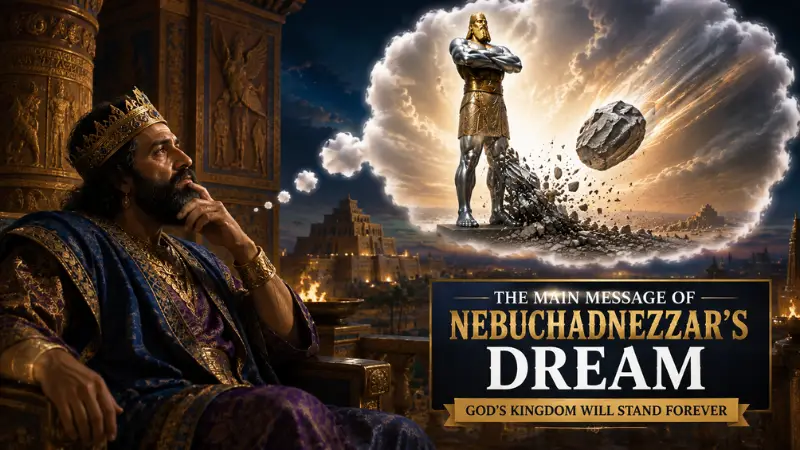
The main message of Nebuchadnezzar dream meaning is that God rules over human kingdoms and rulers. Daniel 2 emphasizes the temporary nature of earthly empires, while Daniel 4 emphasizes the danger of personal pride.
The dreams should therefore not be reduced to a list of symbols.
Their deeper message is about authority.
The statue asks the reader to look at kingdoms from a larger perspective. Even gold, iron, and political power eventually pass away.
The tree asks the reader to look at personal greatness from the same perspective. Even a mighty king can be humbled.
The stone and the restored king provide the contrast.
One points toward an enduring kingdom.
The other points toward a humbled ruler who recognizes divine authority.
For modern readers, Nebuchadnezzar dream meaning can therefore serve as a reminder to examine attitudes toward success, control, status, and spiritual dependence.
Frequently Asked Questions
What was Nebuchadnezzar’s dream in the Bible?
Nebuchadnezzar’s best-known biblical dream appears in Daniel 2 and involves a giant statue. Daniel later records another dream in Daniel 4 involving a huge tree that represents the king and his great authority.
What are the kingdoms in Nebuchadnezzar’s dream?
The common Christian interpretation identifies the kingdoms as Babylon, Medo-Persia, Greece, and Rome. Daniel explicitly identifies Nebuchadnezzar as the head of gold, while later kingdoms are represented by the other materials.
What was Nebuchadnezzar’s dream and how did Daniel interpret it?
Nebuchadnezzar dreamed of a huge statue made of gold, silver, bronze, iron, and iron mixed with clay. Daniel explained that the statue represented successive kingdoms and that a stone would destroy the image before becoming a great mountain, symbolizing God’s enduring kingdom.
Did Nebuchadnezzar’s dream come true?
Within the biblical narrative, the warnings and events associated with the dreams come to pass. Daniel 4 specifically describes Nebuchadnezzar experiencing the humiliation that Daniel had interpreted from the tree vision.
What does Nebuchadnezzar’s tree dream mean?
The tree dream in Daniel 4 represents Nebuchadnezzar and his great power. Its cutting down symbolizes the king’s coming humiliation because of his pride, while the later restoration connects with his recognition of God’s authority.
What does the stone in Nebuchadnezzar’s dream mean?
The stone represents a kingdom established by God that will not be destroyed. Daniel describes it as striking the statue and eventually becoming a great mountain that fills the earth.
How should I interpret a modern dream like Nebuchadnezzar’s?
A modern dream should not automatically be treated as a prophecy. Compare its symbols with the biblical passage, consider your emotions and waking-life circumstances, and distinguish personal symbolism from the specific revelation described in Daniel.
What lesson can Christians learn from Nebuchadnezzar’s dream?
A central lesson is that human power is temporary and God remains sovereign. The story also warns against pride and encourages humility, repentance, and recognition of divine authority.
Conclusion
Nebuchadnezzar dream meaning is ultimately about authority, humility, and the temporary nature of human power. Daniel 2 presents a giant statue that represents successive kingdoms, while Daniel 4 presents a great tree that represents Nebuchadnezzar’s personal greatness. Both visions show that human strength has limits.
The most important detail is not the gold, silver, bronze, iron, clay, or tree by itself. The larger message is that kingdoms and rulers do not have unlimited control. Daniel’s interpretation repeatedly directs attention toward God as the one who reveals mysteries and rules over kings.
For modern dream readers, the story can provide meaningful themes without turning every personal dream into a prediction. A dream about a statue may raise questions about stability or status. A dream about a tree may bring attention to growth, authority, or pride. A dream about something powerful being destroyed may reflect fear of change or a major transition.
The biblical story offers one final lesson: greatness is safest when joined with humility. The statue falls, the proud ruler is humbled, and God’s kingdom is presented as lasting. That is the central insight behind Nebuchadnezzar dream meaning.