The elephant is the largest land animal on earth. That size alone makes it hard to miss in a dream. When something that big walks into your sleeping mind, the message is rarely small.
I have spent years reading dream symbols across cultures, and the elephant keeps showing up in the same three places: power, memory, and duty. Ancient dream dictionaries said the same thing centuries ago. Modern dream astrology repeats it. The animal is a metaphor for what you are carrying, how much of it you control, and how far you can still walk.
Quick Answer: Elephant dream meaning centers on strength, wisdom, stability, and heavy responsibility. A calm elephant often points to inner strength, good fortune, and protection. A chasing, attacking, or caged elephant points to fear, blocked progress, or a burden you carry in waking life.
What Does It Mean to Dream About an Elephant?
A dream about an elephant usually reflects massive power inside you or pressing on you. The elephant stands for strength, wisdom, prosperity, protection, and long life. It can also stand for a heavy burden, a slow-moving obstacle, or an enemy you have not faced yet.
There are two species, and both feed the symbolism. The African elephant, Loxodonta africanus, is the larger of the two and roams open fields and bush. The Asian elephant, Elephas maximus, lives in tropical forest and has worked beside humans for centuries, hauling logs and carrying people. One says wild power. The other says power under control.
That split matters when you decode your own dream. A wild elephant in a dream often speaks about instincts, fear, and forces outside you. A work animal or a ridden elephant often speaks about skill, patience, and forward movement you are directing yourself.
| Feature | African elephant (Loxodonta africanus) | Asian elephant (Elephas maximus) |
|---|---|---|
| Usual dream setting | Safari, open fields, jungle, wild habitat | Villages, temples, work sites, festivals |
| Core symbolism | Untamed strength, freedom, raw instinct | Trained power, service, patience |
| Common emotion | Awe mixed with fear | Respect and calm |
| Typical message | Face what is bigger than you | Use the strength you already have |
| Cultural link | Africa, wild conservation, poaching | India, Nepal, Sri Lanka, Thailand, Bangladesh |
Dream symbolism is never one-size-fits-all. Over 2,000 dream books exist, and they do not always agree. Religion, history, and culture all bend the meaning. What stays constant is the elephant’s link to size, memory, and responsibility.
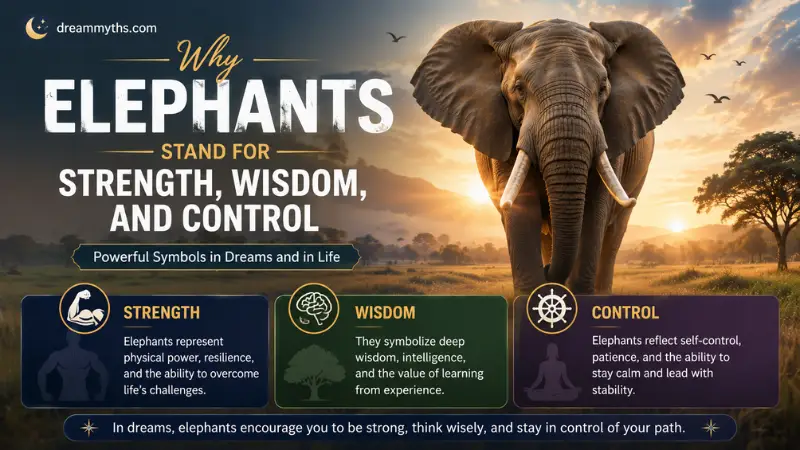
Why Elephants Stand for Strength, Wisdom, and Control
Immense Power and Inner Strength
The obvious reading comes from physical size. An elephant in a dream points to profound inner power and reserves of strength you may not have used yet. Seeing one calmly standing in front of you often means you have the capability to face significant challenges.
The opposite is also true. If the elephant looks weak, starved, or is being pushed around, the dream may be showing an absence of power. Something in your waking life is draining your stamina.
Wisdom, Memory, and Past Lessons
Elephants have a legendary memory. The saying that elephants don’t forget shapes much of the dream symbolism around them. When an elephant appears, past lessons are usually in play.
This can look like:
- Recall of significant memories you thought were closed
- A grudge you are still holding, or one being held against you
- Wisdom earned the slow way, through years rather than luck
- Self-awareness rising after a long stretch of denial
Elephants also mourn. Wild herds return to death sites and stand near the bones of lost family. A grieving elephant in a dream often points to unfinished mourning in the dreamer.
Control, Responsibility, and Heavy Burdens
The elephant is a walking symbol of heavy responsibility. A leadership role, a family that depends on you, a project no one else can carry — these all wear elephant clothing in dreams.
Ask one question: was the elephant under control? A guided elephant means you are managing the weight. An out-of-control elephant, or one in uncontrolled rage, means the weight is managing you. Destructive power in a dream is still your power. It has just slipped the rope.
Herd Loyalty, Family Bonds, and Protection
Elephants are social creatures with long lives and deep family bonds. The herd raises calves together and guards the weak. A herd in your dream speaks about loyalty, guardianship, commitment, and safety.
Good leadership in elephant terms is leadership by inclusion, not by force. If you dream of leading a herd, the dream is asking whether your leadership brings people in or drives them out. Communication, gentleness, and listening all belong to this reading, and they matter as much as the animal’s strength.
Common Elephant Dream Scenarios and What They Mean
The surrounding detail changes everything. Below are the scenarios people report most, with the reading that fits each one.
| Dream scenario | Common reading | Emotional cue | Suggested next step |
|---|---|---|---|
| Baby elephant | New beginnings, family growth, innocence | Joy, protectiveness | Nurture the new thing, don’t rush it |
| Elephant chasing you | Avoidance, blocked progress, fear | Panic, flight | Name what you are running from |
| Elephant attacking you | Conflict, spiritual attack, being overwhelmed | Dread, helplessness | Look for the real-life friction |
| White elephant | Good fortune, blessings, or a costly burden | Wonder | Check the cost of what you were given |
| Riding an elephant | Control, career success, emotions under control | Confidence | Take the position or the trip |
| Elephant in water | Emotional healing, grounding, prosperity | Peace | Rest and let feelings settle |
| Caged or zoo elephant | Restriction, self-neglect, confinement | Sadness | Free one limitation this month |
| Dead elephant | Ending, letting go, rebirth | Grief or relief | Close the chapter cleanly |
| Herd or parade | Cooperation, celebration, group success | Warmth | Lean on friends and family |
| Flying elephant | Freedom, creativity, breaking limitations | Delight | Follow the passion you shelved |
Baby Elephant in a Dream
A grey baby elephant weighs around 200 lbs at birth and still needs the herd for years. In dreams it stands for new life, innocence, potential, and fresh phases. Many dreamers see one during family growth — a pregnancy, an adoption, a new home.
The baby elephant also carries curiosity, playfulness, creativity, and excitement. It is a powerful animal in miniature. That is the point. Something new in your life is small now and strong later. Your job is protection, patience, and personal responsibility while it grows.
If the calf is in a difficult situation, separated or stuck, the dream may be pointing at inner growth that has stalled. Determination and instincts are being tested.
An Elephant Chasing You
A chasing elephant is the most reported version of this dream, and the least comfortable. It points to avoidance. Something in waking life is large, real, and behind you.
Common triggers include:
- A real-life problem you keep postponing
- Financial attack or pressure from creditors
- Unresolved issues with family or friends
- Past mistakes that resurface
- External pressures at work that block progress
In deliverance traditions, a chasing elephant is read as satanic oppression or a battle you are meant to win through prayer and intercession. Mark 11:23 is often applied here — the teaching that a mountain can be moved by spoken faith. Some readers connect flight from an elephant to unrepented sin, while others frame it simply as fear.
Setting matters. Being chased through a jungle or on safari suggests a threat in an unfamiliar area of life. Being chased near a broken-down vehicle suggests your usual means of escape has failed. Running toward goals while the elephant runs behind you suggests you are going against the grain and paying for it in stress.
The dream is not asking you to run faster. It is asking for confrontation, courage, and a clear life direction — plus divine protection if that is your framework.
An Elephant Attacking You
A lunging elephant, trampling feet, or a strike from a tusk or horn shifts the dream from fear to damage. This version points to conflict that has already started.
It often reflects:
- Friction in relationships that has turned openly hostile
- Being stressed, overwhelmed, or worried past your limit
- Self-destructive behaviours turning your own internal force against you
- Setbacks and delays at work that feel deliberate
- An inherited trait or family pattern running out of control
Some readers treat an attacking elephant as a spiritual attack and pair it with prayer for peace and resilience. Others treat it as a warning about neglected skills and talents. If your gifts are ignored long enough, the same immense power that could build something starts breaking things in your surroundings.
Being killed by an elephant in a dream sounds terrible but often reads as a forced fresh start. The old version of you does not survive the change.
White Elephant in a Dream
The white elephant has a Buddhist origin. Buddha’s mother, Queen Maya, is said to have dreamed of a pure white elephant holding a lotus flower, circling her three times before entering her womb. The birth that followed was Siddhartha Gautama.
Because of that story, a white elephant in a dream is read as holy, pure, powerful, and a sign of blessings, success, and trouble-free times ahead. Multiple white elephants amplify the good fortune.
Western usage adds a twist. A “white elephant” also means something expensive and hard to get rid of — a gift that becomes a burden. And in plain speech, a white lie is a small, harmless lie. If your dream carried a heavy or dishonest feeling, that second layer may be the one at work. Hard work is usually still required either way.
Riding an Elephant
Riding an elephant is a positive omen in most traditions. It signals control, career success, financial growth, and emotions under control. You are on top of the largest land mammal and steering it. That is the whole message.
Dreamers often report this before a new position or an important trip. Because elephants don’t forget, a ride can also mark an unforgettable event in your near future. If you feel a grudge during the ride, check whether you are carrying an old resentment into a new chapter.
Elephant in Water or Drinking Water
An elephant in water or mud points to emotional healing, peace, and grounding. Water holds your emotional side, and the elephant is your strength meeting your feelings. The energies settle.
An elephant drinking water is widely read as business prosperity and financial prosperity. Good news, a promotion, or a fresh opportunity in your career or personal life may be close. The dream rewards seizing opportunities rather than waiting for positive change to arrive on its own.
Caged, Captive, or Zoo Elephant
Captivity flips every good elephant quality into its shadow. A caged elephant means your best caged qualities — strength, wisdom, leadership — are closed in and unavailable.
Look for restriction in these areas:
- Work that gives you no room to move
- Personal life where you are always available to others and never to yourself
- Internal mental struggles you have not named
- Past memories keeping you in confinement
A starved elephant in a zoo adds self-neglect to the reading. You are feeding everyone but yourself. The dream asks for release, respect, and one honest look at the limitations you have accepted. If you feel unable to free yourself in the dream, that feeling is the message, not the fact.
Dead, Dying, or Killed Elephant
A dead elephant in a dream rarely means literal death. Big and unique things end, and this is the symbol for that. A chapter, a relationship, or a project is closing.
The contradiction here is real: many dream traditions read the death of an elephant as good times ahead, because death makes room for rebirth. A dying elephant leans more toward loss and tough times. Context and your own feeling decide which reading fits. Either way, destiny is asking for letting go before new beginnings can start.
A Herd, Parade, or Many Elephants
A herd, a large group, or a full elephant parade is a good luck omen. It points to harmony, cooperation, celebration, and group success. Friends and family are with you, not against you.
Dreamers who had a difficult childhood often report herd dreams during periods of healing. The herd offers the support and peace that was missing. Accomplishments feel shared rather than lonely.
In some deliverance testimonies, many elephants standing on a road are read the other way — as a closed door or a confusing blockade set by an enemy, with breakthrough coming after prayer. Read the mood of the dream. Warm herd, good omen. Cold blockade, warning.
Bitten by an Elephant
Being bitten by an elephant is rare and jarring, since teeth and tusks are not the animal’s usual weapon. The shock is part of the meaning. This dream often points to a friendship ending or losing regard from someone whose opinion mattered.
The future reading is not bleak. Once the shock passes, the dream is about moving forward without that person.
Elephant in Africa or on Safari
Seeing an elephant in Africa, in its wild habitat, points to overcoming fears and overcoming obstacles through raw strength. Future happiness usually sits at the far end of this dream.
A safari version adds a busy phase. You are watching power from a moving vehicle, on a schedule. Time management, career pace, kindness, and respect all sit inside this good omen. Slow down enough to see what you came for.
Being the Elephant Yourself
Dreaming that you are an elephant is a dream about being in charge. Clear goals and persistence are your strengths right now. The risk is pleasing others until your own size becomes a problem — big, obvious, and in everyone’s way.
An Elephant Standing Still and Trumpeting
A still elephant that trumpets is a short, loud dream with a short, loud meaning: great news is coming. The stillness says it is certain. The sound says you will not miss it.
Talking Elephants
Talking elephants point to communication. The dream is about expressing thoughts and feelings you have kept quiet. Openness and being vocal will help your relationships more than another month of silence.
Flying Elephant
A flying elephant is rare and magical, and Dumbo has kept the image alive in popular culture. It stands for freedom, adventure, personal growth, and breaking free of limitations. Transcending boundaries is the theme. Creativity and old passions are asking for room.
Black Elephant
A black elephant is a small symbol with a generous meaning: prosperity and unexpected good things.
Slaughter or Poaching of Elephants
Dreams of slaughter, poachers, or the ivory trade often follow media influence — a documentary, a news story about the roughly 500k elephants remaining in the wild. Under that surface, the dream is about power and control being stolen from you. Extinction is the emotional word here. Something you thought was permanent feels endangered.
A Snake Facing the Elephant
A snake set against an elephant is a classic enemy image. In dream language, the snake is the small, quiet threat to your large, visible strength. Some readers add a fear of healing to this reading, since the snake also carries medicine symbolism. You want the cure, and you are afraid of it.
Elephant Body Parts in Dreams: Trunk, Tusks, Ears, and Feet
The Elephant Trunk
The trunk is the elephant’s most useful tool. In life it handles grasping, breathing, feeding, dusting, smelling, drinking, lifting, defence, sensing, and communication — survival in one nose.
In Feng Shui, a trunk raised up is a good luck symbol and a positive omen. A trunk pointing down reads as caution, patience, or stored energy rather than bad luck. A non-threatening trunk reaching toward you often means advice is arriving, or that someone is offering direction.
Other trunk readings include:
- Trunk spying or searching: avoidance, or someone watching your business
- Trunk washing: cleansing before a fresh start
- Trunk eating: appetite, fertility, and abundance
- Trunk hanging limp: a disliked job or a talent you have lost touch with
Elephant Tusks
Tusks carry strength, power, and rarity. Ivory is valuable and dangerous to own, and that tension is the symbol. Freud read tusk-shaped objects as a phallic symbol tied to sexual desire, and that reading still appears in dream books.
A tusk pointing at you shows a clear path and a real risk of being hurt on it. Desire and danger are traveling together.
Elephant Ears
Elephant ears can reach roughly one-sixth of body size and act as a cooling mechanism. In dream symbolism they mean listening. Buddha is often shown with big ears for the same reason — listening more than speaking is treated as a mark of wisdom.
Elephant Feet
Elephant feet in a dream point to the idiom about filling big shoes. Heavy responsibility has been handed to you, or is about to be.
The elephant in the room. If your dream featured an elephant in a room, indoors and impossible to ignore, you are dreaming an idiom. Something significant and obvious is going unaddressed. You may also feel like the odd one out — standing out when you would rather blend in.
Spiritual and Religious Meanings of Elephants in Dreams
The elephant’s spiritual significance spans several traditions, and each one reads it differently.
Biblical Meaning of an Elephant
Scripture does not name the elephant directly, so biblical readings work through symbolism. In many deliverance teachings, a large hostile animal represents a strongman, an ancestral spirit, or household wickedness — a demonic figure behind persistent problems.
Verses commonly applied to these dreams include:
- Isaiah 54:15 — attackers who gather against you will fall
- Mark 11:23 — spoken faith moving a mountain
- Deuteronomy 28:45 — curses that pursue and overtake
- Job 30:15–31 — terrors, night pain, and mourning
- Exodus 19:14 — washing and setting yourself apart before meeting God
Positive biblical readings of an elephant include big opportunities, wealth, prosperity, strength, protection, long life, and good fortune. Negative readings include fear, delay, obstacles, failure, and a major battle ahead. The snake appears again here as the enemy figure requiring deliverance.
Some believers respond to a hostile elephant dream with a set practice: three days of fasting, often from 6am to 2pm, paired with five prayer points covering battles, escape from a pit, pursuers, opposing powers, and the reversal of failure into success. This is a tradition within certain churches rather than a universal Christian teaching.
Ganesha and Hinduism
In Hinduism, Ganesh is the elephant-headed deity known as the remover of obstacles, the patron of arts and sciences, and the deva of intellect and wisdom. Dreaming of Ganesha is widely read as a blessing over new ventures.
Hindu cosmology also describes four elephants that hold up the world. That image gives the animal its association with stability, the earth, and the weight of existence itself.
Buddhism and the White Elephant Dream
Buddhism inherits the white elephant through the dream of Buddha’s mother. Beyond that story, the elephant in Buddhist teaching represents the mind. An untrained elephant is the wandering mind — vanity, pride, and selfishness pulling it in every direction. A trained elephant is a calm, alert, mindful practitioner walking toward enlightenment.
Meditation traditions use this image directly. Gentle, noble, and harmless are the qualities the trained elephant is meant to show.
Chakras, Muladhara, and Grounding
In chakra systems, the elephant is linked to Muladhara, the first chakra at the base of the spine. Muladhara governs survival, family, material wellbeing, safety, and loyalty. An elephant dream during a period of instability often points here — your foundation, not your ambitions.
Thick skin, big ears, and solitude round out the spiritual nature of the symbol: protect yourself, listen well, and take time alone for spiritual growth.
Elephants in Everyday Culture
Elephants remain work animals and cultural icons across India, Nepal, Sri Lanka, Thailand, Indonesia, Bangladesh, and Fiji. In these places the animal is tied to daily labor, temple ritual, and festival life, which is why so much elephant dream symbolism carries themes of service, patience, and honored strength rather than wild danger. Some traditions read a visiting elephant as an ancestral spirit or a guardian of the family line. Others warn that the same figure can carry evil spirits when the dream feels dark. Culture decides the tone.
Fertility, Family Change, and New Life Themes (new section)
Elephant dreams cluster around family transitions. Dreamers report them when children are born, when a parent needs care, or when the household changes shape.
The symbols line up neatly. The womb appears in Queen Maya’s white elephant dream. Fertility appears in the trunk. Family growth appears in the baby elephant. Heavy responsibility appears in the feet.
These are stabilising dreams. They usually arrive as reassurance, not warning. The dream is telling you that wisdom and strength are available for the role you just took on.
How to Interpret Your Own Elephant Dream, Step by Step
Decoding works best when you read the whole dream rather than the animal alone.
- Write the surrounding detail first. Setting, weather, other people, the elephant’s color and size.
- Name your feeling in the dream, not after it. Fear, awe, joy, and helplessness point to different readings.
- Check for control. Were you riding, watching, running, or trapped?
- Match the elephant to a waking-life situation. A person, a duty, a debt, a fear.
- Ask what the elephant wanted. Passage, attention, food, escape, or your attention on a closed door.
- Choose one action. A dream that changes nothing was only entertainment.
The Blind Monks Parable
An old parable describes blind monks touching one elephant. One holds the leg and calls it a tree. One holds the trunk and calls it a snake. One touches the side and calls it a wall. Each man is right about his part and wrong about the animal.
Dream interpretation fails the same way. A single symbol is a leg. Read the whole dream and you get the elephant.
Feeling Checklist
Use this quick block to place your dream:
- Zoo → adventure has narrowed into routine
- Being an elephant → understanding your own size and role
- Being chased → you need clarity, not speed
- Liking the elephant → indulgence, something you enjoy that is growing
- Other elephants present → you feel invisible in a crowd
- Lack of control → fear driving your choices
- Losing a promotion in the dream → control slipping at work
- Feeling invisible → loss of recognition
- Taking control of the elephant → uncertainty ending
The “Out of Control” Reading
When the dominant feeling is out of control, the dream usually points at career satisfaction and responsibility rather than danger. Helplessness, stress, and hiding are its markers. Some traditions read this as spirit guides pushing for change. The practical reading is the same: happiness is on the other side of a decision you keep avoiding.
Good Omen or Warning? A Side-by-Side Comparison (new section)
| Signal in the dream | Reads as a good omen | Reads as a warning |
|---|---|---|
| Elephant’s mood | Calm, still, trumpeting | Raging, lunging, stampeding |
| Your position | Riding, walking beside, watching safely | Running, hiding, cornered |
| Trunk | Raised up | Limp or striking |
| Color | White, black, healthy grey | Dull, wounded, starved |
| Setting | Water, herd, open fields, festival | Cage, zoo, blocked road, poaching scene |
| Number | Herd, parade, several white elephants | One elephant blocking your only path |
| Aftertaste on waking | Peace, excitement | Dread, exhaustion |
Most elephant dreams contain both columns. Count which side has more entries and you have your answer.
Elephant Facts That Shape the Symbolism
Dream meaning grows out of real animal behavior. These facts explain why the symbolism landed where it did:
- Elephants show problem solving and intelligence that ranks among the highest in the animal world.
- They can sense a thunderstorm from as far as 280 km away.
- The trunk handles grasping, breathing, feeding, dusting, smelling, drinking, lifting, defence, sensing, and communication.
- Their ears can reach about one-sixth of body size.
- Their diet is grass, leaves, woody parts of trees, shrubs, flowers, and fruit.
- They mourn lost family and return to the remains of their dead.
- They show self-awareness and strong sociability across the herd.
- They are among the most dangerous animals when provoked, and rage is fast once it starts.
- A repeated rocking motion is common in captive elephants under stressful situations, and rare in wild elephants.
That last fact is the one to remember. A rocking, restless elephant in your dream is a captivity symbol, not an aggression symbol.
What to Do After an Elephant Dream (new section)
- Record the dream within ten minutes of waking, while the surrounding detail is intact.
- Circle the single strongest emotion.
- Name the waking-life situation that matches it.
- Take one small step toward the thing you have been avoiding.
- If your framework includes prayer or meditation, use it for peace and focus rather than fear.
- Watch for a repeat. A dream that returns is a message that was not received.
Frequently Asked Questions
Is it good to see elephants in dreams?
Yes, in most cases. Seeing an elephant is generally a positive dream tied to strength, wisdom, stability, good fortune, and inner strength. The scenario decides the tone. Chasing, attacking, caged, dying, and stampeding elephants carry negative readings, and some traditions connect them to spiritual warfare and heavy responsibility.
What is the spiritual meaning of an elephant?
The elephant’s spiritual meaning centers on spiritual growth and obstacle removal. Ganesha removes obstacles in Hinduism. Buddhism links the trained elephant to enlightenment and the untrained one to a wandering mind. A biblical frame adds protection against evil spirits, while cross-tradition readings tie the elephant to the higher self, mother earth, and the meeting point of physical and spiritual strength.
What is the biblical meaning of an elephant in a dream?
Biblical readings split in two directions. On the negative side, the elephant can represent a strongman, household wickedness, or a snake-like enemy requiring deliverance and a major battle, with themes of fear, delay, obstacles, and failure. On the positive side, it signals big opportunities, wealth, prosperity, strength, protection against evil spirits, long life, and good fortune.
Is it good luck to see an elephant?
Usually, yes, though it is culture-dependent. Feng Shui treats a trunk raised up as a good luck omen. More than one elephant, white elephants, and a black elephant all read as peace, prosperity, and trouble-free times. Western usage complicates it: a white elephant can also mean an expensive burden rather than a positive omen or success.
What does it mean when an elephant chases you in a dream?
A chasing elephant points to avoidance. A real-life problem, a financial attack, or unresolved issues with family are following you, and flight in the dream mirrors flight in waking life. Some traditions read it as satanic oppression calling for prayer and intercession. The practical reading is confrontation: name the problem and face it.
Do elephant dreams mean money is coming?
Sometimes. An elephant drinking water is widely tied to financial prosperity and business prosperity, and riding an elephant is linked to career success and financial growth. A white elephant or black elephant can signal wealth arriving. A dead, caged, or attacking elephant does not carry that reading, and a Western-style white elephant may point to an expensive burden instead.
Final Thoughts on Elephants in Your Dream Life
Dreaming of the largest land mammal is your mind choosing the biggest symbol it owns. Strength, memory, family, and duty all ride on that back.
Read the whole animal, not one leg. Note the setting, the trunk, the herd, and your own feeling as you watched. Then choose the one thing in waking life that is exactly that size — and stop walking around it.