
The phrase big back meaning can be confusing because the expression does not always refer to a person’s literal back. In current American internet slang, “big back” is commonly used as a joking description of someone who eats a lot, loves food, or is associated with a large body. It can also refer to a broad or muscular back in fitness conversations.
Context is essential. A person might describe themselves as a “big back” after eating an unusually large meal, while a gym enthusiast might say they are working toward a “big back” to describe increased muscle development. A comment aimed at another person’s body can have a much harsher meaning.
The phrase has appeared in social-media jokes, memes, group chats, food posts, and fitness content. Because its tone can range from playful to insulting, understanding the situation around the expression is more useful than translating the two words literally.
Quick Answer
The big back meaning in slang usually refers to someone with a large body or someone jokingly portrayed as eating a lot. Online, it is often connected with food, overeating, snacks, and exaggerated appetite. In gym contexts, “big back” can instead describe a broad, muscular back. The phrase is informal and can become body-shaming when directed at another person.
What Does Big Back Mean in Slang?
The big back meaning in modern slang usually connects the expression with body size, appetite, or exaggerated food-related behavior. Someone may call themselves a “big back” after eating a large meal, or friends may use the expression to tease someone who keeps ordering or eating more food.
The phrase is not a precise description of a person’s body. It is casual slang, and its meaning shifts according to context.
For example:
“You ate the whole pizza? Big back.”
In that sentence, the speaker is probably joking about the person’s appetite. The phrase does not necessarily mean that the speaker has made a serious judgment about the person’s weight.
Another common variation is “big back behavior.” This expression focuses on an action rather than directly labeling a person. Someone who goes back for several servings, orders multiple desserts, or buys an unusually large amount of snacks might be described as displaying “big back behavior.”
Merriam-Webster lists “big back” as slang and explains that it can function as a noun or modify another noun. The dictionary also identifies “big back behavior” as an associated expression.
The big back meaning therefore works best when understood as flexible internet slang rather than as a fixed anatomical definition.
What Does Big Back Mean in Text Messages?
The big back meaning in text messages is usually determined by the conversation surrounding it. When food is being discussed, “big back” commonly becomes a joke about appetite, overeating, or wanting more food.
For example:
Person A: “I just finished dinner.”
Person B: “And you’re ordering dessert? Big back 😂”
The second person is teasing Person A about eating more.
Self-directed use is also common:
“I said I was only getting one cookie. I ate the whole box. Big back behavior.”
Here, the writer is joking about their own eating habits rather than criticizing another person.
Text messages can make slang harder to interpret because readers cannot hear the speaker’s voice or see facial expressions. A phrase intended as playful teasing may appear more aggressive in writing, particularly when the relationship between the speakers is unclear.
That is why the big back meaning should always be interpreted together with the surrounding words, emojis, relationship, and topic.
If a conversation is about dinner, snacks, restaurants, or desserts, the food-related meaning is likely. If the conversation is about lifting or bodybuilding, the physical meaning may be more appropriate.
Does Big Back Mean Someone Eats a Lot?
Yes. One important big back meaning is someone who appears to have a very large appetite or who jokes about eating a lot.
This usage is especially common when someone:
- Goes back for another serving
- Finishes someone else’s leftovers
- Orders several dishes
- Wants dessert after a large meal
- Buys a large quantity of snacks
- Talks excitedly about food
- Eats quickly or frequently
For example:
“You said you were full, then ordered wings. Big back behavior.”
The joke focuses on eating rather than on a literal body measurement.
Another example is:
“I went to the store for one snack and came home with six bags. Big back activities.”
The expression is humorous because it turns an ordinary food decision into an exaggerated personality trait.
The food-related big back meaning does not necessarily imply that the person is overweight. Someone can use the phrase simply to joke about having an appetite.
That distinction matters because slang often exaggerates. A person saying “I’m such a big back” after eating two slices of pizza may not be making a serious statement about their body at all.
Can Big Back Refer to Body Size?
Yes. The big back meaning can refer directly to body size or physical appearance.
Some uses describe someone as having a large, broad, or full upper body. Other uses focus on the rear of the body. The exact feature being referenced depends on the speaker and the context.
Merriam-Webster notes that “back” has older uses in African American and Caribbean English referring to the rear end, including a large or voluptuous rear. It also explains that newer uses expanded the phrase to describe larger bodies more generally.
This history helps explain why different people can hear “big back” differently.
For example:
“She has a big back.”
Without context, that sentence is ambiguous.
It could refer to body shape, a broad upper body, or a joke about size.
By contrast:
“He built a big back from lifting.”
clearly points toward muscular development.
The big back meaning is therefore not limited to one body-related interpretation.
Does Big Back Mean Fat?
Not necessarily. The big back meaning can overlap with jokes about being overweight, but “big back” is not a precise synonym for “fat.”
Some slang references describe a “big back” as an overweight person or someone perceived as having a large body. Other uses focus primarily on eating habits or indulgence. Still others describe a muscular back.
That means translating every occurrence as “fat” would be misleading.
Consider:
“I ate the whole cake. Big back.”
The speaker is probably joking about appetite.
Now consider:
“I’ve been training my back for two years. Finally got a big back.”
That is clearly about muscle.
The expression can also be directed at another person’s body, in which case it may function as an insult.
Understanding the big back meaning therefore requires identifying whether the speaker is talking about food, physical appearance, or fitness.
What Does Big Back Behavior Mean?
“Big back behavior” refers to behavior that the speaker jokingly associates with having a large appetite, eating heavily, or indulging in food.
The phrase is particularly common in food-related jokes.
Examples include:
“Going back for a fourth slice is big back behavior.”
“Ordering two desserts after saying you’re full is big back behavior.”
“Buying family-size chips for one movie night is big back behavior.”
The phrase focuses on what someone does rather than directly describing their body.
Merriam-Webster specifically identifies “big back behavior” as a common expression associated with the slang term.
Because the phrase is often used for self-directed humor, it can function as a form of playful self-mockery:
“My big back behavior got me ordering fries at midnight.”
That use is generally easier to interpret because the speaker is applying the joke to themselves.
Still, calling another person a “big back” can have a different social effect.
Big Back Meaning: Is It an Insult?
The big back meaning can be insulting when it is directed at another person’s body, weight, or eating habits.
Among close friends, the expression may be harmless teasing. On social media, people also use it about themselves as part of food-related humor.
However, the same phrase can become hurtful when used against someone who has not invited that kind of joke.
For example:
“You’re eating again? Big back.”
That sentence may sound judgmental rather than playful.
Compare it with:
“I bought a family-size pizza for myself. Big back behavior.”
The second sentence is self-directed.
The difference is not the vocabulary. The difference is the target.
Parents has discussed “big back” as a body-related slang expression and noted concerns about its use for body shaming and fat-shaming, especially among younger social-media users.
Therefore, the big back meaning should not automatically be treated as harmless simply because it appears in a meme or joke.
Can Big Back Be a Compliment?
Yes. In fitness contexts, the big back meaning can be positive.
Someone who has developed broad back muscles through strength training may describe their physique as having a “big back.” In this setting, the expression can communicate pride or admiration.
For example:
“All those pull-ups finally gave me the big back I wanted.”
Or:
“Those back gains are crazy. Big back!”
Here, the phrase is complimentary.
The surrounding language provides the clue. Words such as “gains,” “lifting,” “lats,” “workout,” “muscle,” and “training” strongly suggest a fitness interpretation.
Some people may also use body-related slang positively to describe themselves or others. But a body comment that feels flattering to one person can feel invasive to another.
That is why the big back meaning is best treated as context-dependent rather than automatically positive or negative.
Big Back Meaning on Social Media
The big back meaning became much more visible through social-media humor during the mid-2020s.
In 2024, TikTok users circulated a “big back” trend involving exaggerated portrayals of larger bodies and jokes about eating. Know Your Meme documented videos in which creators used stuffed clothing to imitate a larger back as part of comedy content related to excessive eating.
The trend helped spread the expression beyond people who were already familiar with its older body-related uses.
Social media is particularly suited to the phrase because it is short, visual, and easy to attach to a food joke.
For example:
“When someone says free food: big back activated.”
The phrase acts almost like a punchline.
Another example:
“Me pretending I don’t want dessert.”
The caption might then add:
“Big back behavior.”
The humor comes from exaggeration rather than from a literal anatomical claim.
At the same time, the trend created criticism because some people viewed the humor as mocking larger bodies. This is one reason the phrase remains socially sensitive.
What Does Big Back Mean on TikTok?
On TikTok, the big back meaning commonly connects the phrase with eating, body size, food jokes, and exaggerated appetite.
The 2024 trend included videos where creators visually exaggerated a large back by stuffing clothing. Some videos connected the joke directly to eating large amounts of food.
A typical joke might show someone seeing food and suddenly becoming “big back.”
The meaning depends partly on the visual. Someone unfamiliar with the trend might interpret the phrase literally, while someone who has seen similar videos may immediately understand it as a food joke.
TikTok also demonstrates how quickly slang can change. A phrase can move between communities, develop new uses, and become recognizable to people who do not know its earlier history.
Parents has specifically cautioned that viral expressions with roots in Black language should not automatically be described as inventions of Gen Z or Gen Alpha.
What Does Big Back Mean in Gym Culture?
In gym culture, the big back meaning can refer to a broad, thick, or muscular back.
This interpretation is quite different from the food-related meme.
For example:
“My goal is to build a big back.”
That sentence normally means the person wants greater back-muscle development.
Other examples include:
“Back day is finally paying off.”
“Chasing those big back gains.”
“His lats are huge. That’s a big back.”
In these contexts, the phrase is usually positive.
Fitness content is therefore one of the clearest examples of why the expression should not always be translated as an insult about weight.
If the surrounding post contains gym equipment, workout routines, progress photos, muscle measurements, or bodybuilding terminology, a fitness interpretation is more likely.
What Does Big Back Meaning Refer To?
Yes. Older uses of “back” can refer to the rear or backside of the body, and some uses of big back meaning retain that association.
Merriam-Webster notes that “back” has long been used in African American and Caribbean English to refer to the rear end, including a large or voluptuous rear. It also connects this broader history with the later popularity of “big back” as a description of larger bodies.
This background matters because the phrase did not suddenly appear from nowhere as a TikTok joke.
Its modern meanings developed from earlier body-related language and then expanded through internet culture.
A person may therefore use “big back” to comment on body shape, while another person may use it to joke about eating.
The exact intention must be determined from context.
Where Did the Big Back Meaning Come From?
The exact origin of the modern phrase is not completely settled. The big back meaning developed through older uses of “back” as a body reference and later gained new popularity through social media.
Merriam-Webster traces older uses of “back” to African American and Caribbean English and mentions the cultural association with Sir Mix-a-Lot’s 1992 song “Baby Got Back.” The dictionary also says that the broader use of “big back” for an entire large body rose in popularity in the mid-2020s.
Some online sources describe earlier British slang uses, but those accounts should not be treated as a definitive single-origin story.
What is clearer is the sequence of development: body-related uses existed before the recent viral trend, and social media later helped expand the phrase into food jokes and broader internet slang.
That makes the big back meaning an example of how older slang can gain a new life in online culture.
Why Did “Big Back” Become Popular Online?
The big back meaning works well in internet humor because the phrase is short and visually easy to understand.
Food is also a familiar subject for memes. People joke about snacks, desserts, fast food, leftovers, and oversized meals because these situations are easy to recognize.
A caption such as:
“I said I wasn’t hungry.”
followed by:
“Big back activated.”
creates a simple joke without requiring much explanation.
The phrase can also be adapted into related expressions such as “big back behavior” and “big back activities.”
This flexibility helped it spread across captions, comments, videos, and group chats.
However, viral popularity does not make a slang term universally acceptable. Some users embraced the expression as self-deprecating humor, while others criticized it as body shaming.
The big back meaning therefore includes not only a dictionary-style definition but also a social question: who is being described, and why?
Is the Big Back Meaning Connected to AAVE?
The big back meaning has associations with African American and Caribbean English, particularly because of older uses of “back” as a reference to the rear or backside.
Merriam-Webster specifically discusses this linguistic background. Parents likewise warns against reducing expressions with Black linguistic roots to “Gen Z slang” simply because younger users popularize them online.
That distinction is important.
Slang can travel from one linguistic community to another. Music, entertainment, social media, and everyday conversation can all contribute to that process.
When a phrase becomes popular with a wider audience, the newer usage may not preserve every part of its earlier meaning.
It is therefore better to describe modern “big back” as internet slang with documented connections to African American and Caribbean language varieties rather than claiming that teenagers recently invented the entire expression.
Is the Big Back Meaning Appropriate at Work?
Usually not. The big back meaning is informal, and body-related slang is particularly risky in professional settings.
Avoid using “big back” in workplace emails, academic papers, formal reports, customer-service messages, or professional feedback.
Even when the speaker intends humor, written communication often lacks the tone and facial expression that make teasing understandable.
Instead of saying:
“That’s big back behavior.”
about a coworker’s lunch, use a neutral description if the situation actually matters:
“You brought enough food for the whole team.”
That statement describes the observable situation without commenting on body size or appetite.
Professional language should generally be clear and neutral. Slang is appropriate when discussing slang, quoting casual speech, or communicating informally with people who understand the tone.
Is Big Back Body Shaming?
It can be. The big back meaning has been criticized because some uses mock larger bodies or treat eating as something worthy of ridicule.
Parents described the term as potentially body-shaming and noted that the associated trend drew criticism for making larger bodies part of a joke.
The expression is not automatically hostile. Self-directed use can be playful, and fitness users may use it positively.
The important difference is whether the phrase is being used to describe oneself, celebrate fitness progress, joke about one’s own appetite, or ridicule another person’s appearance.
A useful rule is simple: if the phrase is aimed at another person’s body and there is any doubt about whether they welcome the joke, choose different wording.
The big back meaning is especially sensitive when used toward someone who may already feel uncomfortable about weight or appearance.
Common Mistakes About Big Back Meaning
One common mistake is assuming that “big back” always means overweight. That interpretation is too narrow because the phrase can also describe appetite or muscular development.
Another mistake is assuming that the expression is always harmless. A meme can still rely on body-shaming humor.
A third mistake is treating “big back” as a precise anatomical term. It is slang, not a standardized measurement.
A fourth mistake is using it with strangers. A phrase that feels funny among friends may sound insulting when directed at someone with whom you have no relationship.
A fifth mistake is assuming that the latest viral trend created the entire expression. The recent TikTok trend increased visibility, but older body-related uses existed before it.
Finally, do not assume that one platform determines the meaning everywhere. The same expression can function differently on TikTok, Instagram, in a group chat, or in face-to-face conversation.
How Do You Use Big Back Naturally?
Natural use depends on the intended sense. For a food joke, make the appetite connection clear.
For example:
“I ate four slices after saying I was full. Big back behavior.”
Another option:
“I bought one snack and left with an entire bag of groceries. Big back activities.”
Self-directed use is usually easier to understand:
“My big back made me order fries at midnight.”
For fitness, the wording changes:
“Two years of lifting finally gave me the big back I wanted.”
Or:
“Those rows are building a serious big back.”
The big back meaning becomes much clearer when surrounding words establish whether the topic is food, body size, or muscle.
What Should You Say Instead of Big Back?
If you want to comment on appetite without mentioning someone’s body, use a neutral phrase.
You could say:
- “You really have an appetite.”
- “You love snacks.”
- “You went back for seconds.”
- “You must have been hungry.”
- “You really enjoyed that meal.”
If you are discussing fitness, consider:
- “Broad back”
- “Strong back”
- “Well-developed back”
- “Great back development”
These alternatives communicate more precisely and avoid some of the ambiguity attached to slang.
For self-directed humor, saying “I ate way too much” is also clear and direct.
The big back meaning may be useful when you are trying to understand a meme or casual conversation, but you do not need to use the phrase simply because it is popular online.
How Can You Tell Which Meaning Is Intended?
Start with the topic. Food words such as pizza, fries, dessert, snacks, leftovers, buffet, and hungry strongly suggest the appetite-related sense.
Gym words such as lifting, lats, muscles, shoulders, workout, gains, and back day point toward the fitness meaning.
Next, consider who is speaking. Self-directed use often signals humor. A comment aimed at another person’s body may be more judgmental.
Then look at the grammatical form. “Big back behavior” usually focuses on actions, especially eating. “Big back gains” is much more likely to refer to fitness.
Finally, consider the visual setting. A gym photo and a food meme may use the same words while communicating completely different ideas.
That is why the big back meaning cannot always be determined from the phrase alone.
Big Back vs. Big Back Behavior
The big back meaning and “big back behavior” are closely related, but they do different grammatical jobs.
“Big back” can describe a person or physical characteristic:
“He’s got a big back.”
“Big back behavior” describes an action:
“Going back for a third dessert is big back behavior.”
The second expression often sounds more playful because it focuses on what someone did.
However, it can still be insulting if the speaker is using the phrase to shame someone for eating.
The distinction is useful when interpreting comments and captions because it tells you whether the writer is labeling a person or describing an action.
Big Back vs. Big-Backed
“Big-backed” is an adjective-like form that describes someone or something as having a large or broad back.
For example:
“Years of strength training gave him a big-backed physique.”
In online slang, however, “big-backed” may also appear in food-related jokes and memes.
The grammatical form does not completely determine the meaning. Context still matters.
If the surrounding post is about bodybuilding, the phrase is probably physical or complimentary. If the post is about eating, it may be humorous or body-related.
The big back meaning therefore remains context-sensitive even when related forms are used.
Can Big Back Be Used Positively?
Yes. The big back meaning can be positive when someone is celebrating their own physique, joking about their appetite, or praising fitness progress.
Examples include:
“Finally seeing the big back gains.”
“All those pull-ups paid off. Big back!”
“Big back, bigger dinner.”
The first two are fitness-oriented. The last is a food joke.
Positive intent still does not guarantee that another person will appreciate a body-related comment. People have different boundaries around appearance and weight.
When the target is someone else, neutral wording is usually safer unless the relationship clearly supports that type of teasing.
What Does Big Back Say About Tone?
The big back meaning can range from playful to insulting, but the expression is almost always informal.
A self-directed example sounds humorous:
“My big back made me order dessert.”
A close-friend example may sound teasing:
“You ate my fries too? Big back.”
A public comment about a stranger may sound insulting:
“Look at that big back.”
A fitness caption may sound complimentary:
“Building a big back.”
The phrase itself does not determine the emotional tone. Relationship, context, audience, and delivery all contribute.
This is why someone who understands the slang can still misread a particular use.
Should Children Use Big Back?
Parents and teachers may want to explain the phrase rather than treating every use as equally serious. The big back meaning can appear in harmless self-directed jokes, but it can also be used to mock someone’s body.
If a child uses the expression toward another child, the important issue is whether the target feels ridiculed or singled out.
Adults can explain that popular slang is not automatically harmless. They can also explain that many viral expressions have histories that extend beyond current youth culture.
Parents has specifically discussed the phrase in the context of youth slang and body-shaming concerns.
Does Capitalization Change the Meaning?
Usually not. “Big back,” “BIG BACK,” and “big-back” can point to the same expression when the surrounding context is unchanged.
Capitalization can add emphasis:
“BIG BACK behavior 😭”
looks more dramatic than:
“big back behavior.”
But the underlying meaning remains similar.
Emojis can also influence tone without creating a separate definition. A laughing emoji may signal that the writer intends humor, although it does not guarantee that the recipient will find the comment funny.
Can Big Back Describe a Muscular Person?
Yes. The big back meaning can describe a muscular person when the topic is exercise or physique development.
For example:
“His back has gotten huge from years of lifting.”
A friend might respond:
“Big back!”
In that context, the phrase is praise.
This fitness sense is important because a simple definition focused only on body size would leave readers confused when they encounter the expression under workout content.
The surrounding vocabulary is the best clue.
What Does Big Back Mean in a Meme?
In a meme, the big back meaning often works as an exaggerated punchline about food, body size, or appetite.
A creator might show a large meal with a caption such as:
“Me saying I’m not hungry.”
Then:
“Big back mode activated.”
The humor depends on exaggeration.
Memes also allow the expression to move between meanings. A fitness meme might use “big back” as praise, while a food meme might use it as self-mockery.
Someone unfamiliar with the trend may therefore need the image, caption, and comments to understand the intended meaning.
How Does Context Change the Meaning of “Big Back”?
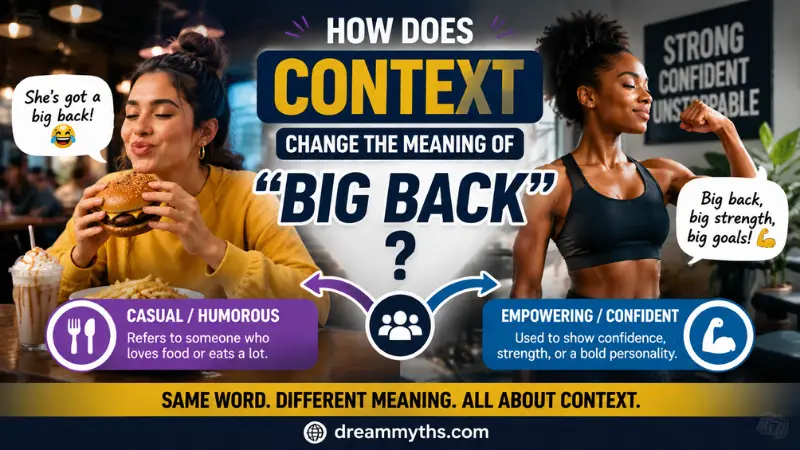
The big back meaning changes according to speaker, audience, topic, and situation.
A close friend may use it as harmless teasing. A stranger may use exactly the same phrase as an insult. A fitness creator may use it positively, while a food meme may use it as self-deprecating humor.
Body-related slang is especially dependent on social context because appearance can be a sensitive subject.
The safest approach is to understand the expression before using it. If the phrase targets another person’s body and you are unsure how it will be received, choose neutral language.
Frequently Asked Questions
Is big back rude?
It can be. The phrase is risky when directed at another person’s body or eating habits, particularly when the relationship is not close.
Does big back mean fat?
Not always. It can imply a larger body, but it can also joke about eating a lot or describe a broad, muscular back.
What is the big back meaning on TikTok?
The phrase became widely visible through TikTok trends involving body-size jokes and eating behavior. The 2024 trend included exaggerated visual portrayals of a larger back and generated discussion about body-shaming.
Is big back slang?
Yes. “Big back” is informal slang used in casual speech and online conversations. It can relate to body size, eating habits, food jokes, or fitness.
Is big back an acronym?
No. “Big back” is a slang phrase made from ordinary words. It does not expand into a longer abbreviation.
Can big back be a compliment?
Yes. In fitness contexts, it can praise a broad or muscular back. Some people also use the phrase positively about themselves.
What does big back behavior mean?
It refers to behavior jokingly associated with overeating or indulgence, such as getting several servings or ordering a large amount of food.
Conclusion
The big back meaning is best understood as flexible informal slang rather than a single fixed definition. In many current online conversations, it refers to eating a lot, loving food, or joking about a large body. In fitness settings, it can instead describe a broad or muscular back.
The phrase has cultural and linguistic history that predates its recent social-media popularity. Its spread through TikTok and other online spaces added new food-related jokes and meme formats, while also creating criticism around body shaming.
The most important rule is to read the context. Food references usually signal an appetite joke, gym references often signal muscle development, and direct comments about someone’s appearance can be more sensitive.
If you encounter “big back” in a text, caption, comment, or conversation, do not assume that every use means exactly the same thing. Look at the surrounding words, the relationship between the speakers, and whether the phrase is being used about food, fitness, or someone’s body.


