
If you have seen AWOL meaning in a text message, workplace conversation, movie, or online discussion, you may wonder what this abbreviation really means. AWOL is a short form of “absent without leave.” It originally came from military language, where it describes someone who is away from an assigned duty or location without official permission.
However, modern American English has expanded the meaning. Today, people often use AWOL casually to describe someone who suddenly disappears, stops replying, becomes unavailable, or takes a break from online activity.
For example, if someone does not answer messages for several days, a friend might say, “He went AWOL.” In this situation, the speaker usually does not mean a military absence. Instead, they mean the person has disappeared from communication.
Understanding the AWOL meaning requires looking at both its official history and its everyday use. The context determines whether AWOL sounds serious, professional, or humorous.
Quick Answer
The AWOL meaning is “absent without leave.” It originally referred to a military person who was away from duty without permission. In modern English, especially in texting and casual conversations, AWOL means someone has disappeared, stopped responding, or become unavailable unexpectedly.
For example:
“I’m sorry I went AWOL this week. Work became really busy.”
Here, AWOL means the person was unavailable, not that they broke a military rule.
What Does AWOL Meaning Mean in English?
In English, AWOL stands for “absent without leave.” The phrase describes a person who is missing from a required place or responsibility without approved permission.
The word leave in this expression means official authorization to be away. It does not mean leaving a place physically.
For example:
The soldier was reported AWOL after failing to return to duty.
In this sentence, AWOL has its original military meaning. The person was expected to return but did not have permission to remain away.
Over time, the expression moved beyond military situations. English speakers began using AWOL as a metaphor for unexpected absence.
For example:
“My brother went AWOL after starting his new job.”
This sentence usually means that the brother became difficult to contact or stopped appearing regularly.
The modern meaning is broader, but the central idea remains the same: someone or something is unexpectedly absent.
What Does AWOL Meaning Stand For?
AWOL is an abbreviation created from the first letters of the phrase:
A — Absent
W — Without
O — Of
L — Leave
Together, these letters create AWOL, meaning Absent Without Leave.
The term became strongly connected with military organizations because service members have specific duties, schedules, and locations. Unlike ordinary jobs, military responsibilities often require strict attendance and reporting rules.
If a person leaves their assigned location without authorization, the absence can become an official matter.
However, when people use AWOL in everyday speech, they usually use it in a much lighter way.
For example:
“My friend has been AWOL from our group chat.”
This does not mean the friend committed an official offense. It simply means the person has not been active or responsive.
What Is the AWOL Meaning in Texting?
In texting, the AWOL meaning is usually informal and conversational. It means someone has disappeared from messages, stopped replying, or has not been available.
People often use AWOL when they notice that someone suddenly becomes quiet.
Examples:
“Where have you been? You went AWOL.”
Meaning: You disappeared or stopped communicating.
Another example:
“Sorry for going AWOL yesterday. My phone died.”
Meaning: I was unavailable and could not respond.
In digital communication, AWOL has become popular because it describes a common modern experience: someone suddenly stops appearing online.
A person may go AWOL from:
- Text messages
- Group chats
- Social media
- Online communities
- Gaming platforms
- Work communication channels
The phrase is often playful rather than aggressive.
For example:
“Our favorite YouTuber went AWOL for two months.”
This usually means the creator stopped posting content.
Is AWOL Meaning a Slang Word?
AWOL is not technically just slang. It is an established abbreviation with a formal origin. However, many modern uses of AWOL are informal.
The difference depends on context.
Formal use:
The service member was listed as AWOL.
This sounds official and relates to military responsibility.
Informal use:
“My coffee machine went AWOL this morning.”
This sounds humorous and means the machine stopped working or disappeared unexpectedly.
Because AWOL has entered everyday language, many people use it casually without thinking about its military background.
The expression has become a flexible way to describe absence.
What Does “Go AWOL” Mean?
The phrase “go AWOL” means to become absent, unavailable, or difficult to reach.
The expression is commonly used outside military situations.
Examples:
“She went AWOL after the meeting.”
Meaning: She disappeared or stopped responding.
“I went AWOL from social media for a month.”
Meaning: I stopped using social media for a while.
The phrase works because it creates a simple image: someone has suddenly vanished from where people expect them to be.
In casual American English, “go AWOL” is often humorous.
For example:
“My motivation went AWOL during finals week.”
Here, motivation is treated like something that disappeared.
How Is AWOL Used at Work?
In workplace conversations, the AWOL meaning is usually informal. Employees and coworkers often use the term to describe someone who suddenly becomes unavailable, leaves unexpectedly, or stops responding.
For example:
“Tom has been AWOL since the morning meeting.”
This could mean Tom left his desk, is not answering messages, or cannot currently be reached.
However, AWOL should be used carefully in professional environments. Although many people understand the expression, it can sound casual or slightly critical because its original meaning involves unauthorized absence.
A manager writing an official report would usually avoid saying:
“The employee went AWOL.”
Instead, more professional wording would be:
“The employee was absent without authorization.”
or:
“The employee was unavailable during scheduled work hours.”
The casual AWOL meaning works better in everyday workplace conversations:
“Where is Sarah? She went AWOL after lunch.”
This sounds like a friendly comment rather than a formal accusation.
Is AWOL Formal or Informal?
The AWOL meaning changes depending on the situation.
In official settings, AWOL has a serious meaning connected to military responsibilities. In casual conversations, it is often used as a humorous expression.
| Context | AWOL Meaning | Tone |
|---|---|---|
| Military | Absent without official permission | Formal |
| Workplace conversation | Suddenly unavailable | Informal |
| Text messages | Not replying or disappearing | Casual |
| Social media | Not active online | Casual |
| Everyday speech | Missing or hard to contact | Informal |
For example:
Formal:
The soldier was reported AWOL.
This refers to an official military situation.
Casual:
“My friend went AWOL during vacation.”
This simply means the friend disappeared or became less available.
The same word can therefore sound completely different depending on where and how it is used.
How Do You Pronounce AWOL?
AWOL is pronounced by saying each letter separately:
A-W-O-L
The pronunciation sounds like:
“ay-double-you-oh-el”
It is not usually pronounced as one complete word.
Example:
“He went AWOL last week.”
The speaker says the individual letters rather than pronouncing AWOL like a normal word.
Because AWOL is an abbreviation, spelling it out is the standard pronunciation in American English.
What Part of Speech Is AWOL?
AWOL is mainly an abbreviation, but modern English allows it to function in different grammatical ways.
Most commonly, it works like an adjective.
Example:
“The employee is AWOL.”
Here, AWOL describes the person’s condition.
It also appears in the phrase:
“Go AWOL”
Example:
“My brother went AWOL for three days.”
In this structure, AWOL describes becoming absent or unavailable.
Informally, people sometimes treat AWOL almost like a noun when talking about a disappearance.
Example:
“His sudden AWOL surprised everyone.”
This usage is less common, but English speakers often adapt words creatively.
What Does AWOL Mean in the Military?
The military AWOL meaning is more specific than its everyday use.
In military language, AWOL means that a service member is absent from an assigned duty, location, or responsibility without approved permission.
Military personnel may receive authorized leave, which means they have official permission to be away.
For example:
The soldier was on approved leave.
This person is not AWOL.
However:
The soldier failed to return after leave ended and was reported AWOL.
This describes an unauthorized absence.
The consequences of being AWOL can depend on the circumstances, length of absence, and applicable military rules.
The important difference is that military AWOL is not simply “being missing.” It specifically involves being absent without authorization.
Can AWOL Mean Someone Is Ignoring You?
Yes. In casual English, AWOL can describe someone who appears to ignore messages or communication.
For example:
“I called him all day, and he went AWOL.”
The speaker usually means the person did not answer or became unavailable.
However, AWOL does not always mean someone is intentionally ignoring another person.
Someone may go AWOL because they are:
- Busy
- Away from their phone
- Taking a break
- Dealing with personal matters
- Not checking messages
The expression is broader than simply refusing to communicate.
Is AWOL the Same as Ghosting?
No. Although AWOL and ghosting can sometimes describe similar situations, they are not exactly the same.
AWOL
AWOL means someone has become absent, unavailable, or difficult to contact.
The absence may be accidental or temporary.
Example:
“My coworker went AWOL today.”
This could simply mean the coworker is unavailable.
Ghosting
Ghosting usually means someone intentionally stops communicating without explanation.
It is most commonly used in dating, friendships, and online relationships.
Example:
“She ghosted me after our first date.”
This suggests the person deliberately ended communication.
AWOL vs Ghosting Comparison
| Word | Main Meaning | Usually Intentional? |
|---|---|---|
| AWOL | Absent or unavailable | Not necessarily |
| Ghosting | Suddenly ending communication | Usually yes |
So, someone can go AWOL without ghosting anyone.
AWOL vs MIA: What Is the Difference?
AWOL and MIA are sometimes confused because both relate to absence.
However, they have different meanings.
AWOL
AWOL means:
Absent Without Leave
It usually suggests that someone is absent without permission.
Example:
“The employee went AWOL from work.”
Meaning: The employee disappeared or was unavailable unexpectedly.
MIA
MIA means:
Missing In Action
It originally comes from military language and refers to service members who disappear during military operations.
In everyday speech, MIA can mean someone has disappeared.
Example:
“My friend has been MIA lately.”
Meaning: My friend has not been around.
AWOL vs MIA Table
| Term | Full Form | Common Meaning |
|---|---|---|
| AWOL | Absent Without Leave | Missing or unavailable without notice |
| MIA | Missing In Action | Missing or not seen |
In casual conversations, both can describe someone’s absence, but AWOL focuses more on being away when expected to be present.
How Do Americans Use AWOL in Everyday Conversation?
In the United States, AWOL is often used in a playful or casual way.
People use it to describe temporary disappearance from normal activities.
Examples:
“I’ve been AWOL from the gym lately.”
Meaning: I have not been going to the gym.
“My phone went AWOL.”
Meaning: My phone disappeared or I cannot find it.
“The sun has gone AWOL this week.”
Meaning: The weather has been cloudy.
These examples show how flexible the expression has become.
Modern speakers often use AWOL for people, objects, habits, and even abstract ideas.
Can AWOL Be Used for Things Other Than People?
Yes. In informal English, AWOL can describe anything that seems to disappear unexpectedly.
Examples:
“My motivation went AWOL before the exam.”
Meaning: My motivation disappeared.
“The internet went AWOL during the meeting.”
Meaning: The internet stopped working.
“My keys went AWOL again.”
Meaning: I cannot find my keys.
These examples are humorous because they give human behavior to objects or ideas.
The original AWOL meaning applies to people, but modern English often extends expressions in creative ways.
What Are Common Mistakes With AWOL?
Although AWOL meaning is simple, people sometimes misunderstand how the term should be used. Because AWOL has both an official military meaning and a casual everyday meaning, context is important.
Mistake 1: Thinking AWOL Always Means Military Absence
Many people assume AWOL only applies to soldiers. While the term originally came from military language, modern English uses it in many informal situations.
For example:
“My friend went AWOL after starting college.”
This does not mean the person left military service. It means the friend became less available or stopped communicating.
The everyday use of AWOL has become common in conversations, texts, and online discussions.
Mistake 2: Assuming AWOL Means Someone Is Missing Forever
AWOL does not mean that a person has disappeared permanently.
Someone described as AWOL may simply be:
- Away from their phone
- Taking a break from social media
- Busy with work
- Temporarily unavailable
- Not responding to messages
For example:
“I went AWOL for the weekend.”
This usually means the person disconnected for a short time.
Mistake 3: Using AWOL as the Exact Same Meaning as Ghosting
AWOL and ghosting can overlap, but they are different.
When someone goes AWOL, they may simply become unavailable. There is no clear suggestion that they intentionally ended communication.
Ghosting usually implies that someone deliberately stopped responding.
For example:
“My cousin went AWOL during the trip.”
This could simply mean the cousin was busy or unreachable.
However:
“He ghosted me after the conversation.”
This suggests intentional avoidance.
Mistake 4: Using AWOL in Every Professional Situation
Although many people understand AWOL, it can sound informal in serious situations.
For official communication, clearer phrases may include:
- Absent without authorization
- Unavailable
- Not present
- Failed to report
- Missing from duty
For example, a workplace report would usually avoid:
“The employee went AWOL.”
A more professional version would be:
“The employee was absent without authorization.”
The correct wording depends on the purpose and audience.
What Are Synonyms for AWOL?
The best synonym for AWOL depends on the situation. Since the term can mean different things, there is no single replacement that works everywhere.
For casual conversations, alternatives include:
- Missing
- Unavailable
- Out of contact
- Unresponsive
- Off the radar
- Disappeared
- Nowhere to be found
Example:
“She has been AWOL all week.”
Possible replacements:
“She has been unavailable all week.”
or:
“She has been out of contact all week.”
For formal situations, especially when discussing official absence, better alternatives include:
- Absent without authorization
- Unauthorized absence
- Failed to report
- Not present as required
The important point is that AWOL carries a stronger idea of unexpected absence than the simple word “absent.”
Is AWOL a Negative Word?
The AWOL meaning can have either a negative or playful tone depending on the context.
In serious situations, AWOL may suggest irresponsibility or failure to meet expectations.
Example:
“The employee went AWOL during an important project.”
This sounds critical because the person was expected to be available.
However, in casual conversations, AWOL is often humorous.
Example:
“Sorry, everyone. I went AWOL for a few days.”
Here, the speaker is simply explaining that they were less active.
The relationship between speakers also affects the meaning. Friends may use AWOL jokingly, while a manager or official document may use the term more seriously.
What Does AWOL Mean on Social Media?
On social media platforms, the AWOL meaning usually refers to someone who has stopped posting, commenting, or interacting online.
People often use the term when an account becomes inactive without explanation.
Examples:
“My favorite creator has gone AWOL.”
Meaning: The creator has stopped uploading content.
“I have been AWOL from Instagram lately.”
Meaning: I have not been active on Instagram recently.
This social media use is especially common because online activity is easy to notice. When someone suddenly stops posting, friends and followers may describe them as AWOL.
The phrase is usually casual and does not suggest anything serious.
How Do You Use AWOL in a Sentence?
Here are examples showing different uses of AWOL:
Military Example
The soldier was reported AWOL after failing to return to duty.
Meaning: The person was absent without official permission.
Workplace Example
Mark went AWOL after the morning meeting.
Meaning: Mark became unavailable or disappeared from communication.
Texting Example
Sorry I went AWOL yesterday. I was dealing with a busy schedule.
Meaning: Sorry I was unavailable.
Social Media Example
I have been AWOL from social media for two weeks.
Meaning: I have not been active online.
Everyday Example
My keys went AWOL again.
Meaning: My keys disappeared or cannot be found.
These examples show that the AWOL meaning changes slightly depending on context, but the main idea remains absence or disappearance.
When Should You Use AWOL?
The AWOL meaning works best when you want to describe an unexpected absence in a casual or conversational way. It is especially common when talking about communication, online activity, or someone who suddenly becomes unavailable.
You can use AWOL naturally in situations like these:
Talking About Messages
“He went AWOL after our conversation.”
Meaning: He stopped replying or became unavailable.
Talking About Social Media
“I have been AWOL from TikTok for a month.”
Meaning: I have not been active on TikTok recently.
Talking About Personal Life
“My brother went AWOL during the family event.”
Meaning: My brother disappeared or was difficult to find.
Talking About Habits
“My motivation went AWOL this week.”
Meaning: My motivation disappeared.
In these examples, AWOL creates an informal and sometimes humorous tone.
The expression is popular because it quickly explains a situation where someone or something is missing from where it is normally expected.
When Should You Avoid AWOL?
Although AWOL is widely understood, it is not suitable for every situation.
You should avoid using the casual meaning of AWOL in:
- Formal business documents
- Academic writing
- Legal communication
- Official reports
- Sensitive workplace situations
For example, writing:
“The employee went AWOL.”
in a formal report may sound informal or judgmental.
A clearer alternative would be:
“The employee was absent without authorization.”
or:
“The employee failed to report for scheduled work.”
The official military use of AWOL is different. In a military context, the term may be appropriate because it has a specific established meaning.
The key rule is simple: use AWOL casually in conversations, but choose more precise language in professional writing.
Why Has AWOL Become Common in Everyday English?
The reason AWOL became popular outside military settings is because it describes a situation many people experience: someone suddenly disappears.
Modern communication has made this idea even more common.
People disappear from:
- Text messages
- Social media platforms
- Online groups
- Work chats
- Gaming communities
- Email conversations
Because of this, speakers needed a quick way to describe temporary absence.
AWOL became useful because it creates an easy mental picture: someone has left a place where they were expected to be.
For example:
“The group chat went AWOL after midnight.”
This does not mean the chat itself disappeared. It means nobody was active or responding.
AWOL Meaning in Movies, News, and Popular Culture
The word AWOL appears frequently in movies, television shows, books, and news reports because its meaning creates tension.
In military stories, AWOL often represents a serious situation involving duty, responsibility, and consequences.
In entertainment and everyday media, the word is often used more casually.
For example:
A movie character might leave without explanation, and another character may say:
“He went AWOL.”
The audience understands that the person disappeared unexpectedly.
In online culture, creators and influencers are also described as going AWOL when they stop posting for a long period.
Example:
“The streamer went AWOL after the last update.”
This simply means the person stopped appearing online.
What Is the Difference Between AWOL and Absent?
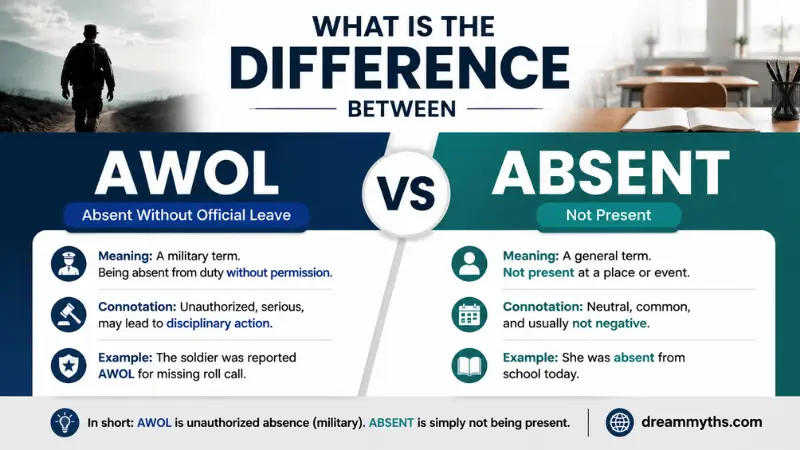
AWOL Meaning.
AWOL and absent are related, but they are not exactly the same.
Absent is a general word meaning someone is not present.
A person can be absent because of:
- Vacation
- Illness
- Approved leave
- Personal reasons
- Work arrangements
Example:
“Sarah is absent today because she is sick.”
This does not suggest wrongdoing.
AWOL is more specific. Traditionally, it suggests someone is absent without permission or explanation.
Example:
“The soldier was AWOL.”
This means the absence was unauthorized.
However, in casual English, AWOL Meaning is often used more loosely to mean missing or unavailable.
| Word | Meaning | Example |
|---|---|---|
| Absent | Not present | “He is absent today.” |
| AWOL | Missing or unavailable unexpectedly | “He went AWOL after lunch.” |
Context determines the intended meaning.
Frequently Asked Questions About AWOL Meaning
What is the simple AWOL meaning?
The simple AWOL meaning is “absent without leave.” It originally described someone, especially a military service member, who was away from duty without official permission.
In modern English, AWOL can also mean someone has disappeared, stopped responding, or become unavailable.
What does AWOL meaning in texting?
In texting, AWOL usually means someone has stopped replying or disappeared from communication.
For example:
“Sorry I went AWOL yesterday.”
This means the person was unavailable or did not respond.
Is AWOL considered slang?
AWOL is not only slang. It is an established abbreviation with a formal military origin.
However, phrases like “go AWOL” are often used informally in everyday conversations.
What does “go AWOL” mean?
“Go AWOL” means to suddenly become absent, unavailable, or difficult to contact.
In casual situations, it often means someone disappeared for a while.
Is AWOL the same as ghosting?
No. AWOL and ghosting can overlap, but they are different.
AWOL meaning someone is absent or unavailable. Ghosting usually suggests that someone intentionally stopped communicating.
A person can go AWOL without deliberately ignoring anyone.
Can AWOL be used for objects?
Yes. In informal English, people sometimes use AWOL for things that seem to disappear.
Examples:
“My charger went AWOL.”
“My focus went AWOL during the exam.”
These are humorous uses.
Is AWOL a negative word?
AWOL can sound negative in serious situations because it suggests someone is absent when they are expected to be present.
However, in casual conversations, it is often playful.
Example:
“Sorry, I went AWOL this weekend.”
This sounds friendly rather than critical.
Conclusion
The AWOL meaning comes from the phrase “absent without leave.” Originally, it was a military term used for someone who was away from duty without official permission.
Today, AWOL has a much wider role in American English. People use it in texts, workplace conversations, social media discussions, and everyday speech to describe someone who disappears, stops responding, or becomes unavailable.
The phrase “go AWOL” is especially common because it provides a simple and memorable way to describe an unexpected absence. The AWOL Meaning is closely connected to the idea of being away without permission, especially in military situations. Because the AWOL Meaning comes from the term “Absent Without Official Leave,” it originally referred to service members who left their duties without approval.
However, the AWOL Meaning can change depending on the context. In military settings, AWOL has a serious official meaning and may involve disciplinary consequences. In casual conversations, the AWOL Meaning is often used in a humorous way to describe someone who has gone quiet, stopped responding, or disappeared for a while.
Understanding the AWOL Meaning helps you use the term correctly and avoid confusion. Whether you see it in a message, workplace chat, movie, or online post, the AWOL Meaning usually points to someone or something being unexpectedly absent. Overall, the AWOL Meaning remains centered on the idea of being missing or unavailable, while the tone depends on the situation.


