
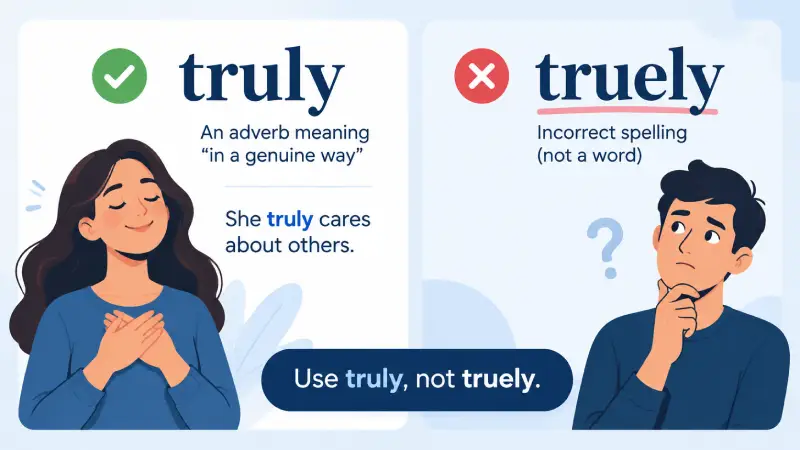
Truly and truely look almost identical, so it is easy to wonder which spelling is correct. The standard English spelling is truly. Truely is a misspelling and should not be used in standard American English.
The word truly is an adverb meaning “in a true or sincere way,” “really,” “actually,” or “exactly,” depending on the sentence. Cambridge Dictionary lists truly as an adverb and gives several uses, including emphasizing truth, expressing sincerity, and indicating something is exact.
The spelling can be confusing because the adjective is true, which makes truely look like a logical spelling when adding -ly. However, the correct form changes the spelling from true to truly.
Quick Answer: Truly or Truely?
Truly is the correct spelling. Truely is incorrect in standard English.
Use truly when you mean “really,” “genuinely,” “sincerely,” or “in a true way.”
- Correct: I truly appreciate your help.
- Correct: She is truly talented.
- Incorrect: I truely appreciate your help.
- Incorrect: She is truely talented.
A useful rule is to remember that true + ly becomes truly, not truely.
Truly vs. Truely: The Basic Difference
The main difference between truly and truely is spelling and correctness.
| Word | Correct? | Meaning | Example |
|---|---|---|---|
| truly | Yes | Really, genuinely, sincerely, or exactly | I truly enjoyed the concert. |
| truely | No | Standard English does not use this spelling | I truely enjoyed the concert. |
Truly is the standard form found in English dictionaries. Cambridge Dictionary gives the US pronunciation as /ˈtruː.li/ and identifies truly as an adverb.
Truely is not an alternative American spelling. If you are writing an email, school assignment, article, résumé, business document, or other standard English text, use truly.
Why Is Truly Spelled Without the E?
The spelling of truly can be confusing because the base adjective is true.
You might expect:
true + ly = truely
But standard English uses:
true → truly
The final e in true is dropped before -ly is added.
This pattern is not something you should try to recreate by simply attaching -ly to every adjective. English spelling often changes when suffixes are added, so the correct spelling of an individual word still needs to be learned.
For true, the standard adverb is truly.
A Simple Memory Trick
Remember:
TRUE → TRULY
Think of truly as true without the final e, followed by -ly.
So:
- true → truly
- not true → not truly
- true statement → truly stated
This makes truely easier to recognize as an error.
What Does Truly Mean?
Truly is an adverb used to emphasize that something is true, real, sincere, or exact. It can also be used to mean “really” or “certainly,” depending on the context.
For example:
I truly believe you.
Here, truly emphasizes the speaker’s sincerity.
Another example:
That was a truly amazing performance.
Here, truly strengthens the description and means something like “really” or “genuinely.”
Truly can also describe something that is accurate or exact:
The painting is not truly representative of the original.
In this use, truly relates to whether something is accurate or genuine.
7 Key Differences Between Truly and Truely
1. Truly Is Correct
The most important difference is straightforward: truly is the correct standard spelling.
Use:
I truly understand your concern.
Do not write:
I truely understand your concern.
2. Truely Is a Spelling Error
Truely is not a standard alternative spelling of truly. If you see it in ordinary English writing, it is generally an error caused by the spelling of true.
The correction is:
truely → truly
3. Truly Is an Adverb
Truly functions as an adverb.
It can modify an adjective:
She is truly remarkable.
It can modify a verb:
I truly appreciate your kindness.
It can also modify a broader statement:
The results are truly surprising.
Cambridge Dictionary classifies truly as an adverb and identifies several meanings, including emphasis of truth and sincerity.
4. Truly Can Mean “Really”
One common use of truly is to emphasize a description.
This is truly beautiful.
The sentence means that the speaker considers it genuinely or really beautiful.
Other examples:
- The view was truly spectacular.
- She is truly gifted.
- That was a truly memorable experience.
- The book is truly fascinating.
In these sentences, truly adds emphasis.
5. Truly Can Express Sincerity
Truly can also show that a statement, belief, apology, or feeling is sincere.
I am truly sorry.
This means the speaker is expressing genuine or sincere regret.
Other examples include:
- I truly appreciate everything you did.
- He truly believes in his team.
- We are truly grateful for your support.
- She truly cares about her students.
Cambridge specifically includes a sincerity-related use of truly, including examples such as “I’m truly sorry.”
6. Truly Can Mean “Exactly” or “In Reality”
In some contexts, truly indicates that something is accurate, genuine, or true in an exact sense.
For example:
Is this truly what you wanted?
Here, truly asks whether the statement accurately reflects the person’s actual wishes.
Another example:
The two products are not truly identical.
This means they may appear identical, but they are not identical in every relevant sense.
Cambridge Dictionary includes an “exactly” sense for truly, showing that its use is broader than simply “really.”
7. Truly Works in Formal and Everyday Writing
Truly is not limited to slang or casual English. It is a standard English adverb that works in conversations, essays, professional writing, and other contexts.
For example:
Casual:
I truly can’t believe it.
Professional:
We truly appreciate your continued support.
Formal:
The decision truly reflects the organization’s stated principles.
The word itself is standard. The surrounding sentence determines how formal the overall expression sounds.
Truly vs. Truely Examples
Seeing the correct spelling in different sentences makes the distinction easier to remember.
Correct Examples With Truly
- I truly appreciate your help.
- She truly deserves the award.
- He is truly committed to the project.
- We were truly surprised by the announcement.
- I truly believe this is the right decision.
- That was a truly remarkable achievement.
- Are you truly ready to leave?
- The experience was truly unforgettable.
Incorrect Examples With Truely
The following sentences use the misspelling:
- I truely appreciate your help.
- She truely deserves the award.
- He is truely committed to the project.
- We were truely surprised.
- I truely believe you.
The corrected versions are:
- I truly appreciate your help.
- She truly deserves the award.
- He is truly committed to the project.
- We were truly surprised.
- I truly believe you.
How to Use Truly Correctly
Use truly when you want to emphasize truth, sincerity, reality, or the strength of a description.
To Express Sincerity
I truly appreciate your support.
To Emphasize a Description
It was a truly incredible experience.
To Emphasize a Belief
She truly believes that the plan will work.
To Question Whether Something Is Genuine
Do you truly understand what happened?
To Emphasize Reality
This is truly an unusual situation.
The exact meaning changes slightly with context, but the spelling remains truly.
Common Mistakes With Truly and Truely
Mistake 1: Adding -ly Directly to True
A common spelling mistake is treating the word as:
true + ly = truely
That produces truely, which is incorrect.
The standard form is:
true → truly
Mistake 2: Thinking Truely Is a British or American Variant
Truely is not simply a British-versus-American spelling difference. American English uses truly, and standard English references likewise give truly as the established form. Cambridge’s American Dictionary lists truly as the standard word.
Mistake 3: Confusing Truly With True
True and truly have different grammatical roles.
- True is usually an adjective: The statement is true.
- Truly is an adverb: She truly understands the issue.
Do not replace one with the other simply because their meanings are related.
Mistake 4: Assuming Every Use Means “Very”
Truly can sometimes strengthen an adjective, but it does not always simply mean very.
Compare:
She is truly talented.
This emphasizes that her talent is genuine or remarkable.
But:
I truly believe him.
Here, truly relates to sincerity or genuine belief rather than simply meaning “very.”
Truly vs. Really: Are They the Same?
Truly and really can overlap, but they are not identical in every sentence.
For example:
I truly appreciate your help.
and
I really appreciate your help.
Both can express genuine appreciation, although truly can sound slightly more deliberate or emphatic.
Similarly:
It was truly remarkable.
and:
It was really remarkable.
Both are natural, but the choice can affect tone and emphasis.
Cambridge Dictionary lists really as an adverb used to express certainty, actuality, or emphasis, while truly has overlapping meanings involving truth, sincerity, and exactness.
Is Truly Formal or Casual?
Truly is a standard word that can be used in both everyday and formal English. Its tone depends on how it is used.
For example:
I truly can’t believe this happened.
sounds conversational.
Meanwhile:
We are truly grateful for your contribution.
can sound polished and formal.
Truly also appears in the closing “Yours truly,” which Cambridge identifies as a formal letter ending, mainly in US English.
Pronunciation of Truly
Truly is pronounced approximately:
TROO-lee
The US pronunciation listed by Cambridge is /ˈtruː.li/.
The first syllable sounds like true, followed by a short lee sound.
The spelling truely does not have a separate standard pronunciation because it is a misspelling of truly.
Truly vs. Truely: Which One Should You Use?
Use truly whenever you need this adverb.
A quick rule:
If you mean “really,” “genuinely,” “sincerely,” or “in reality,” use TRULY.
Do not use truely in standard English writing.
| If you want to write… | Use |
|---|---|
| I ___ appreciate it. | truly |
| She is ___ talented. | truly |
| I ___ believe you. | truly |
| It was ___ amazing. | truly |
| He ___ understands. | truly |
Frequently Asked Questions
Is “truly” or “truely” correct?
Truly is correct. Truely is a misspelling and should not be used in standard English.
Why is “truly” spelled without an E?
The standard spelling changes true to truly when the adverbial ending -ly is added. The correct form is therefore truly, not truely.
Is “truely” ever correct?
Truely is not the standard spelling of the adverb. In normal English writing, use truly.
What does truly mean?
Truly can mean “really,” “genuinely,” “sincerely,” “actually,” or “exactly,” depending on context. It is an adverb.
Is truly a formal word?
Truly can be used in both formal and informal English. It is a standard adverb, and its tone depends on the sentence and context.
Is truly the same as really?
Truly and really have overlapping meanings, especially when emphasizing a statement or description. However, truly can put more emphasis on sincerity, genuineness, or truth.
What is the easiest way to remember truly?
Remember:
TRUE → TRULY
The correct spelling is truly, with no e before ly.
Conclusion
Truly is the correct spelling, while truely is incorrect. Although truely may look logical because the base word is true, standard English uses truly.
Use truly as an adverb when you mean really, genuinely, sincerely, actually, or exactly, depending on the context. It works naturally in both everyday and formal writing.
The easiest rule to remember is simple: true becomes truly, not truely.
<<<ARTICLE_READY>>>


