
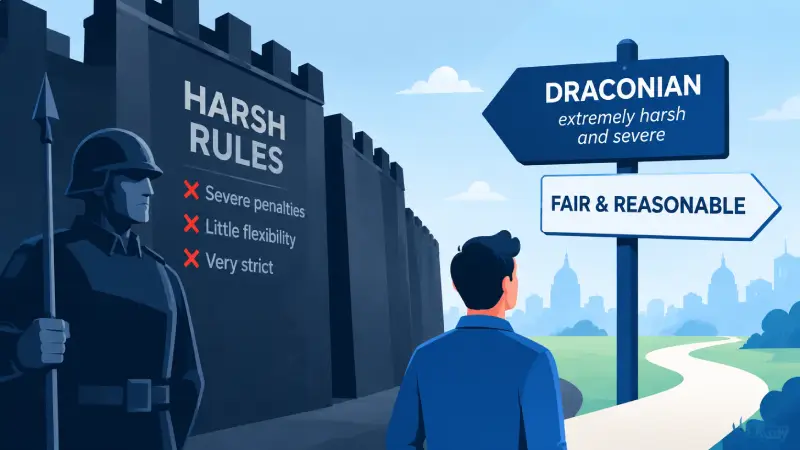
If you are searching for the draconian meaning, the word describes something extremely harsh, severe, strict, or cruel, especially a law, rule, punishment, policy, restriction, or official measure. When someone calls a rule draconian, they usually mean that it is far stricter or more severe than seems reasonable.
The word comes from Draco, an ancient Athenian lawmaker whose legal code became associated with unusually severe punishments. Today, draconian is used in modern English to describe rules, laws, policies, penalties, restrictions, and decisions that people consider excessively harsh.
Quick Answer: What Does Draconian Mean?
Draconian means extremely harsh, severe, strict, or excessive, especially when describing a law, rule, punishment, policy, or official measure.
For example:
The company introduced draconian rules after several security violations.
This means the company’s new rules were considered extremely strict or harsh.
A simple way to remember the word is:
Draconian = extremely harsh or severe, especially when something goes too far.
Draconian Meaning in Simple English
In simple English, draconian means much too strict or harsh.
A rule can be strict without being draconian. The word draconian usually adds the idea of extreme severity.
For example:
- A strict school may require students to arrive on time.
- A draconian school policy might impose an extremely severe punishment for being a few minutes late.
This is why draconian is a stronger word than strict.
It also usually carries a negative or critical tone. If someone says that a policy is draconian, they are generally suggesting that the policy is excessive, unreasonable, oppressive, or unnecessarily severe.
Draconian Definition
Draconian is an adjective meaning extremely severe, harsh, strict, or cruel, especially when describing laws, punishments, rules, policies, regulations, restrictions, or official measures.
It commonly describes:
- Draconian laws
- Draconian rules
- Draconian punishments
- Draconian policies
- Draconian measures
- Draconian restrictions
- Draconian penalties
- Draconian regulations
- Draconian budget cuts
- Draconian requirements
The exact meaning depends on context, but the central idea is always extreme severity.
What Is the Origin of Draconian?
The word draconian comes from Draco, an ancient Athenian lawmaker associated with a famously severe legal code.
Draco lived in ancient Athens around the 7th century BCE. His name became associated with unusually harsh legal punishments. Over time, English developed the adjective draconian to describe laws, rules, punishments, and measures that are similarly severe.
The modern word therefore has a strong connection to the historical reputation of Draco’s laws.
Why Is It Called Draconian?
It is called draconian because the word comes from the name Draco.
His name became a symbol of extreme legal severity. English speakers eventually began using draconian more broadly for modern rules, laws, policies, and punishments that seem excessively harsh.
You do not have to be discussing ancient Greece to use the word today. It is primarily a modern English adjective.
Draconian Meaning in Law
In legal contexts, draconian describes a law, regulation, penalty, or punishment that is considered extremely severe or disproportionate.
For example:
Critics called the proposed sentencing rules draconian.
This means the critics believed the proposed punishments were excessively harsh.
The word is particularly useful when discussing a situation where the punishment appears much more severe than the offense.
Examples of Draconian in Law
- The new law introduced draconian penalties for repeated violations.
- Critics argued that the sentencing rules were draconian.
- The organization opposed what it described as draconian regulations.
- The proposed restrictions were criticized as draconian.
- Lawyers questioned whether the new penalties were unnecessarily draconian.
Draconian Meaning in Government and Politics
In government and political discussions, draconian often describes policies, restrictions, laws, or official actions that are viewed as excessively strict.
For example:
The government faced criticism for introducing draconian restrictions.
Here, draconian communicates more than simply “strict.” It suggests that the restrictions are unusually severe and may be oppressive or excessive.
Because of this negative connotation, the word is often used by critics when discussing government actions.
Examples
- The government introduced draconian measures to address the crisis.
- Opposition leaders described the new restrictions as draconian.
- Critics argued that the policy gave authorities draconian powers.
- The proposed regulations were considered too draconian by several groups.
Draconian Meaning in Everyday English
Although draconian is strongly associated with law and government, it can also describe extremely strict rules in everyday situations.
For example:
The school has draconian attendance policies.
This means the attendance policies are exceptionally strict.
Another example:
My landlord has draconian rules about noise.
The speaker means the rules are unusually strict and difficult to follow.
However, draconian is a strong word. It should not normally be used for every inconvenience, minor restriction, or ordinary rule.
7 Powerful Examples of Draconian
Here are seven natural examples showing how draconian works in different contexts.
1. Draconian Laws
The new government introduced draconian laws that imposed severe penalties.
The sentence suggests that the laws are considered excessively harsh.
2. Draconian Punishment
The teacher was criticized for supporting a draconian punishment for a minor offense.
Here, draconian emphasizes that the punishment is far too severe.
3. Draconian Rules
Employees complained about the company’s draconian workplace rules.
This means the workplace rules are unusually strict.
4. Draconian Restrictions
Residents opposed the draconian restrictions placed on public activities.
The restrictions are presented as excessively limiting.
5. Draconian Policy
The company adopted a draconian policy against repeated lateness.
The policy is extremely strict and punitive.
6. Draconian Measures
Officials introduced draconian measures to control the situation.
The measures are described as severe and possibly excessive.
7. Draconian Cuts
The organization announced draconian budget cuts.
Here, draconian means the reductions are extremely severe.
Draconian vs. Strict
Draconian and strict are related, but they are not exactly the same.
Strict means requiring rules to be followed closely.
Draconian means extremely strict, severe, or harsh, often to an excessive degree.
Compare:
The school has strict attendance rules.
This simply tells us that attendance is closely regulated.
The school has draconian attendance rules.
This suggests that the attendance rules are excessively harsh or punitive.
So:
Strict = firm or closely controlled
Draconian = extremely strict or harsh
Not every strict rule is draconian.
Draconian vs. Harsh
Harsh is a broad word that can describe something severe, unpleasant, difficult, or unpleasantly intense.
Draconian is more specific. It is especially associated with extreme severity in rules, laws, punishments, policies, restrictions, and official measures.
For example:
- harsh criticism
- harsh weather
- harsh conditions
- harsh punishment
- draconian laws
- draconian regulations
- draconian restrictions
- draconian policies
You would not normally describe ordinary bad weather as draconian.
Instead, you would say:
The weather was severe.
The word draconian is most natural when the subject involves rules, authority, punishment, restrictions, or severe official action.
Draconian vs. Stringent
Stringent and draconian can both describe very strict requirements, but their tones are different.
Stringent often sounds more neutral. It means very strict or demanding.
Draconian usually carries a negative judgment and suggests excessive severity.
Compare:
The company has stringent security requirements.
This can simply mean the security standards are very demanding.
The company has draconian security requirements.
This suggests that the requirements are excessively strict or unreasonable.
Therefore, stringent can be appropriate in neutral professional writing, while draconian is more forceful and critical.
Draconian vs. Oppressive
Oppressive means excessively controlling, cruel, or burdensome.
Draconian emphasizes extreme severity, particularly in laws, rules, punishments, policies, and official measures.
For example:
The government imposed draconian restrictions.
This focuses on the extreme severity of the restrictions.
The government imposed oppressive restrictions.
This focuses more strongly on the feeling of control, burden, or domination.
The two words can overlap, but they emphasize slightly different aspects.
Draconian Synonyms
Common synonyms for draconian include:
- Extremely harsh
- Severe
- Strict
- Stringent
- Rigid
- Punitive
- Oppressive
- Ruthless
- Heavy-handed
- Uncompromising
- Excessively severe
- Harsh-handed
The best synonym depends on the context.
For example:
- Strict is more neutral.
- Stringent often sounds formal and neutral.
- Harsh is broad and common.
- Rigid emphasizes inflexibility.
- Punitive emphasizes punishment.
- Oppressive emphasizes excessive control.
- Heavy-handed emphasizes forceful or insensitive action.
- Draconian combines extreme severity with a generally negative judgment.
What Is the Opposite of Draconian?
The opposite of draconian depends on the context.
Useful opposites include:
- Lenient
- Flexible
- Moderate
- Reasonable
- Permissive
- Forgiving
- Relaxed
- Compassionate
For example:
The company replaced its draconian attendance policy with a more flexible system.
Here, flexible provides a clear contrast with draconian.
Another example:
The court adopted a more moderate approach instead of imposing a draconian penalty.
Is Draconian Always Negative?
Draconian is usually negative or strongly critical.
When someone describes a rule, policy, law, or punishment as draconian, they generally mean that it is too harsh, too restrictive, or excessively severe.
For example:
The company introduced draconian security measures.
This wording usually suggests that the security measures are considered excessive.
The word can technically be used to describe severity without the speaker explicitly stating their personal opinion, but in normal usage it carries a strong negative association.
Is Draconian a Formal Word?
Yes. Draconian is generally a formal or relatively formal adjective.
It commonly appears in:
- Government discussions
- Legal writing
- News reporting
- Politics
- Business writing
- Public policy
- Regulation
- Academic discussions
- Social issues
In casual conversation, people may choose simpler alternatives such as:
- Too strict
- Extremely harsh
- Way too severe
- Very restrictive
Compare:
Formal:
The new regulations are draconian.
Casual:
The new rules are way too strict.
Both communicate a similar idea, but draconian sounds more formal and forceful.
How Do You Pronounce Draconian?
In American English, draconian is commonly pronounced approximately as:
drə-KOH-nee-ən
The stress generally falls on the KOH syllable.
A phonetic representation commonly given for American English is:
/drəˈkoʊniən/
When learning the word, remember:
dra-CO-ni-an
Is Draconian an Adjective?
Yes. Draconian is an adjective.
An adjective describes a noun, so draconian is normally placed before a noun or used after a linking verb.
Examples:
- draconian law
- draconian punishment
- draconian policy
- draconian rule
- draconian restrictions
- draconian measures
Correct:
The government introduced a draconian policy.
Correct:
The policy was draconian.
Incorrect:
The government introduced a draconian.
The noun being described should be clear from the sentence.
Common Collocations With Draconian
Some combinations with draconian are especially common in American English and formal writing.
Draconian Laws
Laws considered extremely harsh or severe.
Draconian Measures
Very severe actions taken to address a problem.
Draconian Punishment
A punishment considered excessively severe.
Draconian Rules
Rules that are unusually strict.
Draconian Restrictions
Severe limitations on what people can do.
Draconian Penalties
Extremely severe consequences for violations.
Draconian Regulations
Very strict official requirements.
Draconian Cuts
Extremely severe reductions, often involving budgets, spending, jobs, or resources.
These collocations are especially useful in formal writing, journalism, government discussions, and business contexts.
Can Draconian Describe a Person?
Yes, but this is less common than using it to describe a person’s approach, behavior, policy, or decisions.
For example:
The manager’s draconian approach to discipline frustrated the staff.
This means the manager’s approach was extremely strict or harsh.
It is also possible to say:
The manager was draconian about workplace discipline.
However, it is often clearer to describe the person’s approach or methods rather than simply labeling the person.
Can Draconian Be Used for Business?
Yes. Draconian can describe extremely strict business policies, workplace rules, budget reductions, management decisions, or disciplinary measures.
Examples:
The company introduced draconian cost-cutting measures.
Employees criticized the new attendance policy as draconian.
The business adopted draconian rules after repeated security problems.
In business writing, the word usually signals that the policy or decision is considered unusually severe.
Can Draconian Be Used in School Contexts?
Yes. A school rule, disciplinary policy, attendance requirement, or punishment can be described as draconian when it is considered excessively strict.
Examples:
Parents described the school’s new disciplinary policy as draconian.
The school introduced draconian attendance rules.
Students complained about what they considered draconian penalties for minor violations.
The word is appropriate when the emphasis is on extreme strictness, not simply ordinary school discipline.
Can Draconian Be Used in Texting or Social Media?
Yes, but draconian is not primarily a slang word.
Someone might use it in a social media post, comment, or text message when discussing an unusually strict rule or policy.
For example:
That new policy is draconian.
These rules are getting pretty draconian.
Because draconian is relatively formal, casual users may instead say:
Those rules are way too strict.
So, if you see draconian in a text or social media post, it usually keeps its standard English meaning rather than developing a special slang meaning.
Common Mistakes With Draconian
Mistake 1: Treating Draconian as a Simple Synonym for Strict
Not every strict rule is draconian.
Strict can be neutral.
Draconian usually suggests extreme severity.
Mistake 2: Using Draconian for Anything Difficult
A difficult task is not automatically draconian.
For example:
The exam was draconian.
This could be understandable in some contexts, but it is not the most natural use unless the exam involved unusually harsh or unreasonable rules.
Mistake 3: Using Draconian for Weather
A sentence such as:
The weather was draconian.
is unnatural in standard English.
Better choices include:
The weather was severe.
The weather was harsh.
Mistake 4: Forgetting the Negative Connotation
Calling something draconian generally suggests criticism.
If you simply want to say that a requirement is demanding without criticizing it, stringent may be a better choice.
Mistake 5: Using Draconian When You Mean Strict but Fair
If a policy is firm but reasonable, strict is usually better.
Draconian implies that the severity may be excessive.
How to Use Draconian Correctly
A simple formula is:
draconian + law/rule/policy/punishment/restriction/measure/penalty
Examples:
draconian law
draconian rule
draconian punishment
draconian policy
draconian restrictions
draconian measures
draconian penalties
When using the word, ask yourself:
Is the thing extremely strict or harsh, and does it seem excessive?
If the answer is yes, draconian may be the right word.
Draconian Meaning at a Glance
| Feature | Meaning |
|---|---|
| Word | Draconian |
| Part of speech | Adjective |
| Simple meaning | Extremely harsh or strict |
| Main idea | Excessive severity |
| Common contexts | Laws, rules, policies, punishments, restrictions |
| Tone | Formal and usually negative |
| Origin | Draco, ancient Athenian lawmaker |
| Common synonym | Severe, harsh, stringent |
| Common opposite | Lenient, moderate, flexible |
| Pronunciation | drə-KOH-nee-ən |
Draconian Meaning: Quick Comparison
| Word | Meaning | Tone |
|---|---|---|
| Strict | Firmly enforcing rules | Neutral |
| Stringent | Very strict or demanding | Often neutral |
| Harsh | Severe or unpleasant | Negative |
| Rigid | Inflexible or unwilling to change | Often negative |
| Draconian | Extremely harsh or severe, often excessively so | Strongly negative |
| Lenient | Not strict, forgiving | Positive or neutral |
This comparison shows why draconian is stronger than simply saying strict.
When Should You Use Draconian?
Use draconian when you want to emphasize that a law, rule, punishment, policy, restriction, or official action is extremely severe and arguably excessive.
It is especially useful when ordinary words such as strict or harsh do not fully communicate the level of severity.
For example:
The company has strict security rules.
This is neutral.
The company has draconian security rules.
This suggests that the rules are extremely restrictive and possibly unreasonable.
10 Natural Draconian Examples in American English
- The company introduced draconian rules after the security breach.
- Critics called the proposed law draconian.
- The new policy imposes draconian penalties for minor violations.
- Employees considered the attendance requirements draconian.
- The city was criticized for taking draconian measures.
- The school replaced its draconian disciplinary policy with a more flexible system.
- The organization argued that the restrictions were unnecessarily draconian.
- The court rejected what critics described as a draconian punishment.
- The business faced complaints about its draconian workplace rules.
- The government was accused of adopting draconian regulations.
Frequently Asked Questions About Draconian Meaning
What does draconian mean in simple terms?
Draconian means extremely harsh, severe, or strict. It is usually used for laws, rules, punishments, policies, restrictions, or official measures that seem excessively severe.
What is an example of draconian?
An example is:
The government introduced draconian penalties for minor violations.
The sentence means the penalties are considered extremely harsh.
Is draconian a positive or negative word?
Draconian is usually a negative word. It generally suggests that a rule, punishment, policy, or measure is excessively harsh or restrictive.
What is a synonym for draconian?
Common synonyms include harsh, severe, stringent, rigid, punitive, oppressive, and heavy-handed.
What is the opposite of draconian?
Common opposites include lenient, moderate, flexible, reasonable, permissive, and forgiving.
Why is something called draconian?
The word comes from Draco, an ancient Athenian lawmaker whose legal code became associated with extremely severe punishments.
Is draconian the same as strict?
Not exactly. Strict means requiring rules to be followed closely, while draconian usually means extremely strict or harsh, often to an excessive degree.
Is draconian a formal word?
Yes. Draconian is generally a formal adjective commonly used in discussions about law, government, regulation, punishment, business policies, and public policy.
Can draconian describe a person?
Yes, but it is more natural to describe a person’s approach, methods, policies, or decisions as draconian. For example, “The manager took a draconian approach to discipline.”
Can draconian be used in everyday conversation?
Yes, but it is relatively formal. In casual conversation, people often use phrases such as way too strict, extremely harsh, or too severe instead.
Does draconian mean cruel?
It can imply cruelty in some contexts, but its central meaning is extreme harshness or severity. The exact meaning depends on what is being described.
Is draconian a noun or adjective?
Draconian is an adjective. It describes nouns such as laws, rules, policies, punishments, restrictions, and measures.
Final Takeaway
The draconian meaning is extremely harsh, severe, or strict, especially when describing a law, rule, punishment, policy, restriction, or official measure.
The word comes from Draco, an ancient Athenian lawmaker whose legal code became associated with severe punishment. In modern American English, draconian is usually a formal and strongly negative word used when someone believes a rule or action goes far beyond ordinary strictness.
The most important distinction to remember is:
Strict = firm or closely controlled
Draconian = extremely harsh or strict, often excessively so
If you remember one simple definition, remember:
Draconian = extremely harsh or severe, especially when a rule, punishment, or policy goes too far.


